Products (Grade 10 NSC Matric Mathematics): Revision Notes
📚Revision Notes
Products
Understanding algebraic expressions and their components
Before working with products in algebra, you need to understand the building blocks of algebraic expressions. Each part of an expression has a specific name and purpose.
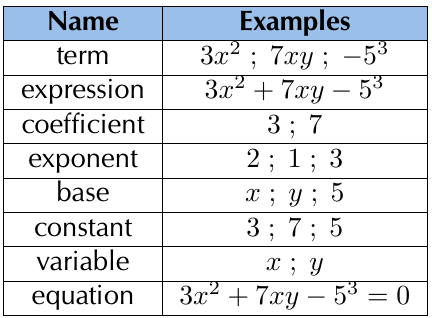
Let's break down these key terms using a clear example. Consider the expression :
- Term: Each separate part of the expression (like , , or )
- Expression: The entire mathematical statement containing one or more terms
- Coefficient: The numerical part that multiplies a variable (3 and 7 in our example)
- Exponent: The small number that shows how many times the base is multiplied by itself (2, 1, and 3)
- Base: The number or variable being raised to a power (x, y, and 5)
- Constant: A number without a variable (like )
- Variable: Letters that represent unknown values (x and y)
- Equation: When an expression equals something (like )
Note
Understanding these fundamental components is essential for success in algebraic multiplication. Each term plays a specific role in how we manipulate and combine expressions.
Types of algebraic expressions
Understanding the different types of expressions helps you choose the right multiplication method:
- Monomial: An expression with exactly one term
- Examples: , , ,
- Binomial: An expression with exactly two terms
- Examples: , ,
- Trinomial: An expression with exactly three terms
- Examples: ,
Multiplying a monomial and a binomial
When multiplying a single term by a two-term expression, use the distributive property. This means you multiply the monomial by each term in the binomial separately.
Method:
Example
Worked Example: Simplifying with Distribution
Question: Simplify
Solution:
Step 1: Apply the distributive property to each part
Step 2: Simplify each multiplication
Step 3: Combine like terms
Multiplying two binomials
When multiplying two binomial expressions, each term in the first binomial must be multiplied by each term in the second binomial.
General method:
Example
Worked Example: Multiplying Binomials
Question: Find the product
Solution:
Special products
Perfect squares
When you multiply a binomial by itself, you get a perfect square:
Formula:
Pattern: Square the first term, twice the product of both terms, square the second term
Difference of squares
When you multiply two binomials that differ only in the sign between terms:
Formula:
Pattern: This always gives the difference between the squares of the two terms
Important
These special product patterns are frequently tested on exams. Memorising them will save you significant time and reduce calculation errors.
Multiplying a binomial and a trinomial
To multiply a binomial by a trinomial, multiply each term in the binomial by every term in the trinomial.
Method:
Example
Worked Example: Binomial Times Trinomial
Question: Find the product
Solution:
Step 1: Expand the brackets
Step 2: Combine like terms
Exam tips for products
Note
Helpful Exam Strategies
- Always check your work by expanding brackets step by step
- Look for special patterns like perfect squares or difference of squares to save time
- Combine like terms carefully - this is where most errors occur
- Show all steps in exam questions to earn full marks
- Use brackets to keep negative signs with the correct terms
Common exam traps
Important
Watch Out For These Common Mistakes
- Forgetting to distribute negative signs correctly
- Missing terms when multiplying binomials
- Not combining like terms properly
- Confusing perfect square and difference of squares patterns
- Making arithmetic errors with coefficients
Summary
Key Points to Remember:
- Use the distributive property for all algebraic multiplication
- Perfect squares follow the pattern:
- Difference of squares gives:
- Always multiply every term in the first expression by every term in the second expression
- Check your final answer by combining like terms carefully