Compound Interest (Grade 10 NSC Matric Mathematics): Revision Notes
📚Revision Notes
Compound Interest
What is compound interest?
Compound interest is a powerful financial concept that allows your money to grow faster than simple interest. Unlike simple interest, where you only earn interest on your original investment, compound interest means you earn interest on both your principal amount AND on the interest that has already been added to your account.
Important
Definition: Compound interest is the interest earned on the principal amount and on its accumulated interest.
Think of it as "interest earning interest" - each year, your interest becomes part of your investment, so next year you earn interest on a larger amount. This creates a snowball effect that makes your money grow exponentially over time.
Note
Compound interest is particularly advantageous when investing money, but it works against you when borrowing money, as the amount you owe can grow quickly.
The compound interest formula
The standard formula for calculating compound interest is:
Where:
- A = accumulated amount (final value)
- P = principal amount (initial investment)
- i = interest rate written as a decimal (e.g., 5% = 0.05)
- n = number of years
How the formula develops
Let's understand how this formula works by following an investment step by step. Consider R1000 invested for 3 years at 5% per annum compound interest.
Example
Worked Example: Formula Development
Year 1:
- Starting amount: R1000
- Interest earned: R1000 × 0.05 = R50
- End of year 1: A₁ = 1000(1 + 0.05) = R1050
Year 2:
- Starting amount: R1050 (this becomes the new principal)
- End of year 2: A₂ = 1050(1 + 0.05) = 1000(1 + 0.05)²
Year 3:
- Starting amount: A₂
- End of year 3: A₃ = 1000(1 + 0.05)³
The pattern shows that the power of (1 + i) equals the number of years, giving us our general formula: A = P(1 + i)ⁿ
Step-by-step calculation method
Note
When solving compound interest problems, follow these steps:
- Write down the known variables (P, i, n, or A)
- Write down the formula A = P(1 + i)ⁿ
- Substitute the values into the formula
- Calculate and write the final answer with appropriate units
Worked examples
Example 1: Finding the accumulated amount
Question: Mpho wants to invest R30 000 into an account that offers a compound interest rate of 6% p.a. How much money will be in the account at the end of 4 years?
Example
Worked Example: Finding Accumulated Amount
Step 1: Write down known variables
- P = 30 000
- i = 0.06
- n = 4
Step 2: Write the formula
- A = P(1 + i)ⁿ
Step 3: Substitute values
- A = 30 000(1 + 0.06)⁴
- A = 30 000(1.06)⁴
- A = R37 874.31
Answer: Mpho will have R37 874.31 in the account after 4 years.
Example 2: Finding the required interest rate
Question: Charlie has been given R5000 for his sixteenth birthday. He wants to invest it so he can put down a deposit of R10 000 on a car for his eighteenth birthday. What compound interest rate does he need to achieve this growth?
Example
Worked Example: Finding Required Interest Rate
Step 1: Write down known variables
- A = 10 000
- P = 5000
- n = 2
Step 2: Write the formula
- A = P(1 + i)ⁿ
Step 3: Substitute and solve for i
- 10 000 = 5000(1 + i)²
- 10 000/5000 = (1 + i)²
- 2 = (1 + i)²
- √2 = 1 + i
- √2 - 1 = i
- i = 0.4142
Answer: Charlie needs to find an account offering 41.42% p.a. compound interest.
Important
This is unrealistic - typical savings accounts offer around 2% p.a., while aggressive investment portfolios might offer around 13% p.a.
The power of compound interest
Compound interest creates exponential growth, which means your money grows slowly at first, then rapidly accelerates over time. This is dramatically different from simple interest, which grows at a constant rate.
Example
Worked Example: Comparison of Simple vs Compound Interest
R10 000 invested for 10 years at 9% p.a.
Simple interest:
- A = P(1 + in) = 10 000(1 + 0.09 × 10) = R19 000
Compound interest:
- A = P(1 + i)ⁿ = 10 000(1 + 0.09)¹⁰ = R23 673.64
The compound interest investment earns R4673.64 more!
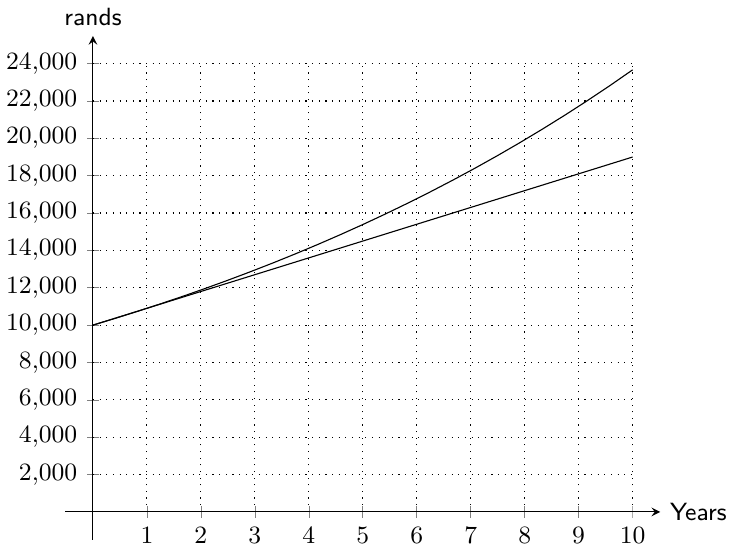
This graph shows how compound interest (steeper line) significantly outperforms simple interest (gentler line) over a 10-year period.
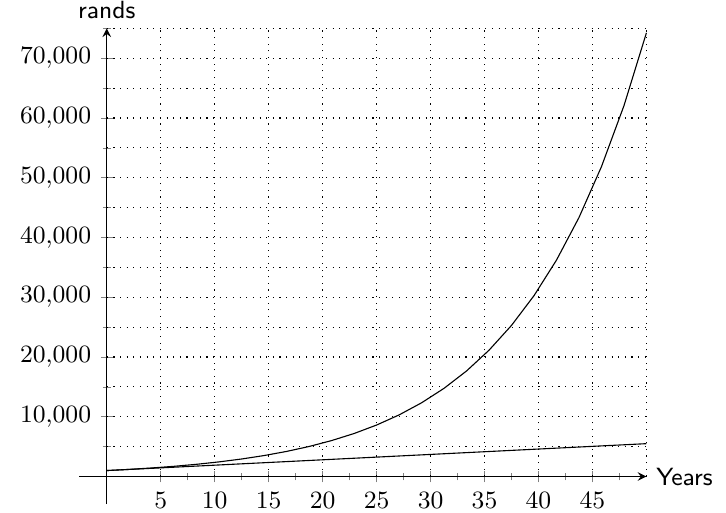
When we extend the time period to 50 years, the exponential nature of compound interest becomes even more dramatic. Notice how the growth remains relatively modest for the first 20-25 years, then accelerates rapidly.
Important
Important insight: This exponential growth is excellent news when you're earning interest on investments, but it's concerning when you're paying interest on debt - borrowed money can grow exponentially too.
Remember!
Summary
Key Points to Remember:
- Compound interest earns "interest on interest" - it grows exponentially rather than linearly
- The formula is A = P(1 + i)ⁿ where the power n represents the number of years
- Time is your friend - the longer you invest, the more dramatic the compound effect becomes
- Start early - even small amounts can grow substantially over long periods due to exponential growth
- It works both ways - compound interest helps investments grow, but makes debts grow faster too