Exponential Functions (Grade 10 NSC Matric Mathematics): Revision Notes
📚Revision Notes
Exponential Functions
What are exponential functions?
Exponential functions are mathematical functions where the variable appears as an exponent. These functions model rapid growth or decay in real-world situations like population growth, radioactive decay, and compound interest.
Note
Two Main Forms of Exponential Functions
The exponential function can be expressed in two primary forms:
- Basic form: where and
- General form: where , , and are constants
Basic exponential functions ()
The basic exponential function has the form , where is called the base. The behaviour of the function depends on the value of the base:
- When : The function shows exponential growth
- When : The function shows exponential decay
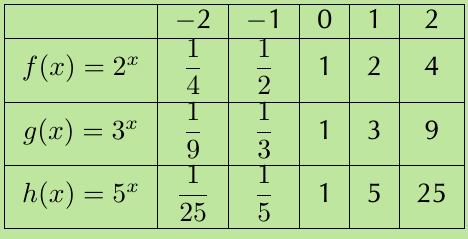
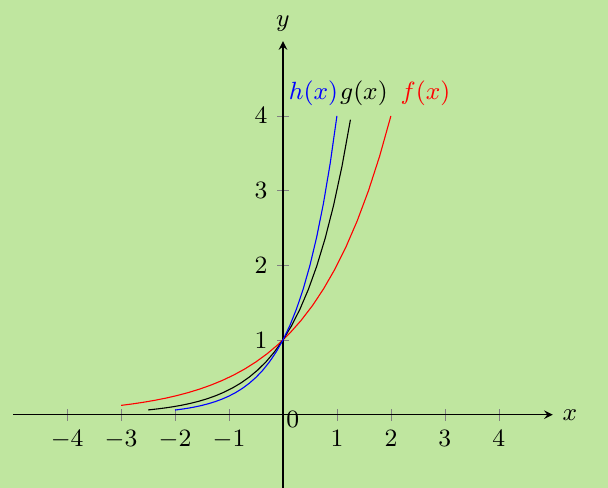
The graph above shows three exponential growth functions. Notice that all functions pass through the point because any number raised to the power of 0 equals 1.
Important
Key Properties of Basic Exponential Functions
- Domain: (all real numbers)
- Range: (all positive real numbers)
- Y-intercept:
- X-intercept: None (the graph never crosses the x-axis)
- Horizontal asymptote: (the x-axis)
Exponential decay functions
When the base is between 0 and 1, we get exponential decay. These functions can be written as where .
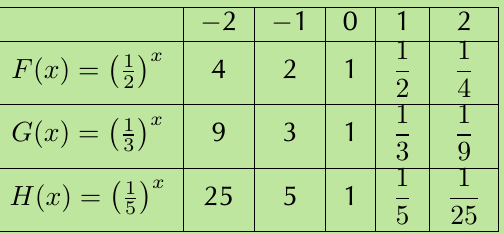
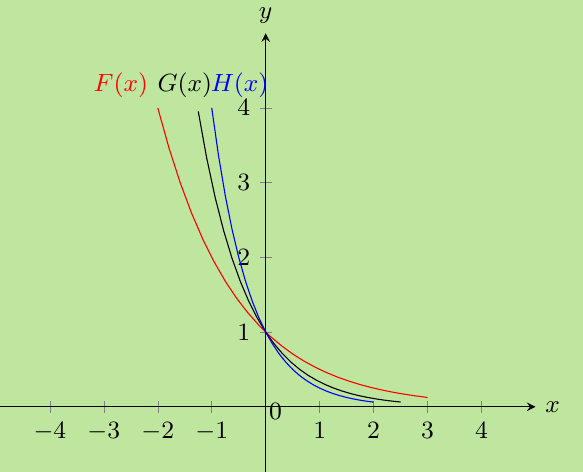
Notice how these decay functions are reflections of the growth functions about the y-axis.
General form:
The general form introduces three parameters that transform the basic exponential function:
- : Affects the steepness and orientation of the curve
- : Determines whether the function grows () or decays ()
- : Shifts the graph vertically
Effect of parameter (vertical shift)
The parameter causes a vertical shift of the entire graph:
- When : The graph shifts upwards by units
- When : The graph shifts downwards by units
- The horizontal asymptote becomes
Effect of parameter (orientation and steepness)
The parameter affects both the orientation and steepness of the curve:
For :
- When : The graph curves upwards (normal exponential growth)
- When : The graph curves downwards (reflected about the horizontal asymptote)
For :
- When : The graph curves downwards (normal exponential decay)
- When : The graph curves upwards (reflected about the horizontal asymptote)
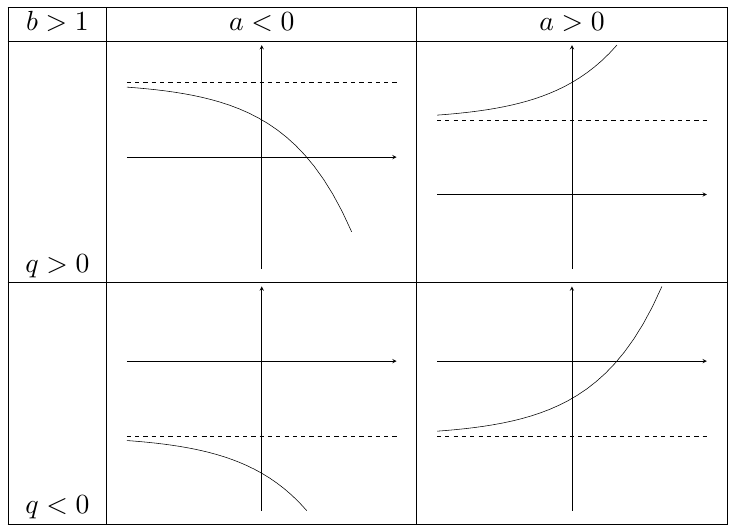
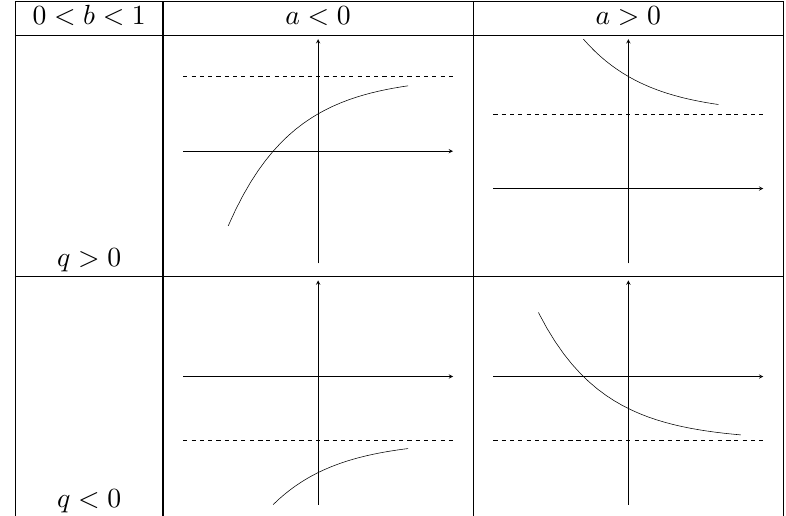
Domain and range
Domain
For all exponential functions , the domain is because you can substitute any real number for .
Range
The range depends on the sign of parameter :
Important
Range Rules Based on Parameter
When :
- Since for all real , we have
- Therefore:
- Range:
When :
- Since for all real , we have
- Therefore:
- Range:
Intercepts
Y-intercept
To find the y-intercept, substitute :
The y-intercept is the point .
X-intercept
To find the x-intercept, set :
Note
X-intercept Existence
An x-intercept exists only when (since is always positive).
Asymptotes
All exponential functions of the form have a single horizontal asymptote at .
Note
Why Horizontal Asymptotes Occur
This occurs because:
- As or , the term either approaches 0 or becomes very large
- The function approaches the horizontal line
Sketching exponential functions
To sketch an exponential function , determine these four characteristics:
- Sign of (determines curve orientation)
- Y-intercept at
- X-intercept (if it exists)
- Horizontal asymptote at
Example
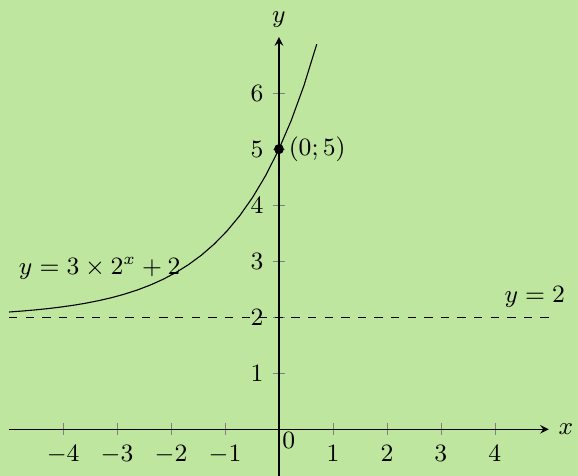
Worked Example 1: Sketching
Step 1: Examine the equation
- : Graph curves upwards
- : Graph is shifted up by 2 units
- : Exponential growth
Step 2: Find the y-intercept
- Let :
- Y-intercept:
Step 3: Find the x-intercept
- Set :
- Since always, there is no real solution, so no x-intercept exists.
Step 4: Identify the asymptote
- Horizontal asymptote:
Example
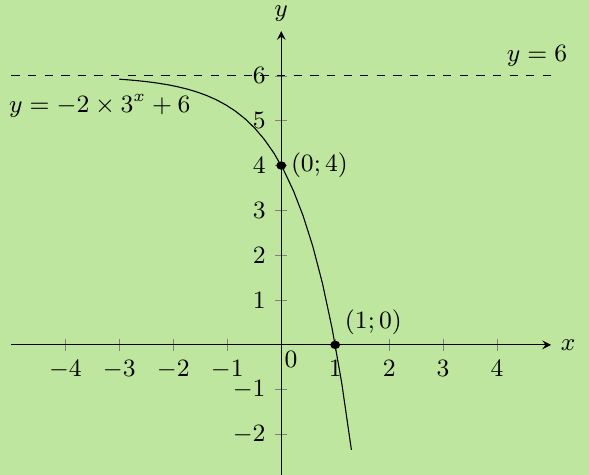
Worked Example 2: Sketching
Step 1: Examine the equation
- : Graph curves downwards
- : Graph is shifted up by 6 units
- : Exponential function with growth base, but reflected
Step 2: Find the y-intercept
- Let :
- Y-intercept:
Step 3: Find the x-intercept
- Set :
- X-intercept:
Step 4: Identify the asymptote
- Horizontal asymptote:
Example
Worked Example 3: Domain and Range of
Step 1: Find the domain The domain of any exponential function is all real numbers. Domain:
Step 2: Find the range Since for all real :
Range:
Important
Exam Tips
- Always check the sign of parameter to determine curve orientation
- Remember that exponential functions never touch the x-axis (horizontal asymptote)
- When , the function grows; when , the function decays
- The y-intercept is always
- Use key points and asymptotes to sketch accurate graphs
Summary
Key Points to Remember
- Exponential functions have the form where the variable appears in the exponent
- The domain is always all real numbers, but the range depends on the sign of
- The horizontal asymptote is the line
- Parameter affects orientation, determines growth/decay, and causes vertical shifts
- These functions model real-world phenomena like population growth, radioactive decay, and compound interest