Hyperbolic Functions (Grade 10 NSC Matric Mathematics): Revision Notes
📚Revision Notes
Hyperbolic Functions
What are hyperbolic functions?
Hyperbolic functions are mathematical functions that have the general form:
where and are constants, and .
These functions are called hyperbolic because their graphs form curves called hyperbolas. The simplest hyperbolic function is .
The basic hyperbolic function y = 1/x
Let's start by examining the basic hyperbolic function .

When we create a table of values for this function, we notice several important features:
Note
Key observations about :
- The function is undefined at (we cannot divide by zero)
- For positive x-values, we get positive y-values
- For negative x-values, we get negative y-values
- As x gets closer to zero, the y-values become very large (positive or negative)
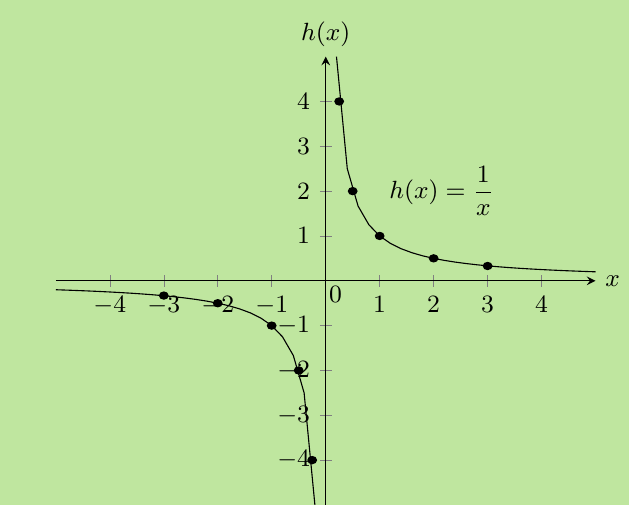
The graph shows that has two separate curves (called branches):
- One branch lies in the first quadrant (where both x and y are positive)
- The other branch lies in the third quadrant (where both x and y are negative)
Key characteristics of hyperbolic functions
Domain and range
For any hyperbolic function :
Important
Domain:
- The function is defined for all real numbers except zero
Range:
- The function can take any real value except the value q
Asymptotes
Hyperbolic functions have two types of asymptotes (lines that the curve approaches but never touches):
Note
Vertical asymptote: The line (the y-axis)
- As x approaches zero, the function values approach positive or negative infinity
Horizontal asymptote: The line
- As x approaches positive or negative infinity, the function values approach q
Intercepts
y-intercept: To find where the graph crosses the y-axis, we set : This is undefined, so hyperbolic functions have no y-intercept.
x-intercept: To find where the graph crosses the x-axis, we set :
The x-intercept exists only when , and is located at .
Axes of symmetry
Hyperbolic functions have two axes of symmetry:
- The line
- The line
Effects of parameters a and q
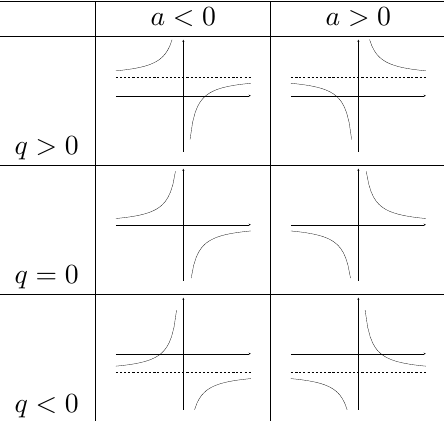
Understanding how the parameters and affect the shape and position of hyperbolic functions is crucial for sketching them accurately.
Effect of parameter q
Important
The parameter causes a vertical shift of the entire graph:
- When , the graph shifts upward by q units
- When , the graph shifts downward by |q| units
- When , there is no vertical shift (basic hyperbola)
The horizontal asymptote is always the line .
Effect of parameter a
The parameter determines the shape and position of the hyperbola:
Important
When :
- The hyperbola lies in the first and third quadrants
- If , the branches are further from the axes
- If , the branches are closer to the axes
When :
- The hyperbola lies in the second and fourth quadrants
- If , the branches are further from the axes
- If , the branches are closer to the axes
Sketching hyperbolic functions
To sketch a hyperbolic function , follow these steps:
Step-by-step method
Note
Systematic approach to sketching hyperbolic functions:
- Identify the parameters and from the equation
- Determine the quadrants where the graph lies (based on the sign of )
- Find the asymptotes:
- Vertical:
- Horizontal:
- Calculate the x-intercept (if it exists):
- Plot additional points if needed for accuracy
- Draw the hyperbola with two smooth curves approaching the asymptotes
Worked examples
Example
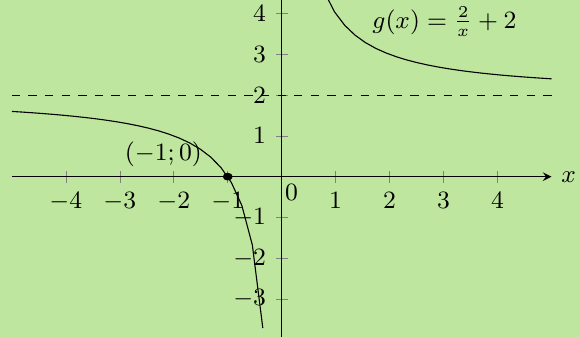
Worked Example 1: Sketching g(x) = 2/x + 2
Let's sketch the graph of .
Step 1: Identify parameters
- , so the graph lies in the first and third quadrants
Step 2: Find asymptotes
- Vertical asymptote:
- Horizontal asymptote:
Step 3: Find x-intercept
- Set :
- So the x-intercept is .
Example
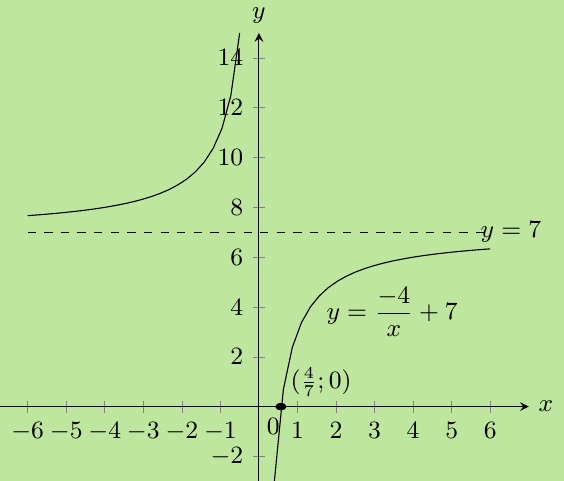
Worked Example 2: Sketching y = -4/x + 7
Let's sketch the graph of .
Step 1: Identify parameters
- , so the graph lies in the second and fourth quadrants
Step 2: Find asymptotes
- Vertical asymptote:
- Horizontal asymptote:
Step 3: Find x-intercept
- Set :
- So the x-intercept is .
Example
Worked Example 3: Domain and range of g(x) = 2/x + 2
For the function :
Domain: The function is undefined when , so the domain is .
Range: The function cannot equal 2 (the horizontal asymptote), so the range is .
Summary
Key Points to Remember:
-
Hyperbolic functions have the general form where
-
The domain is always all real numbers except zero:
-
The range excludes the horizontal asymptote value:
-
Asymptotes: Vertical at , horizontal at
-
Parameter effects: shifts vertically, determines shape and quadrants (positive → quadrants I & III, negative → quadrants II & IV)