Overview of Functions (Grade 10 NSC Matric Mathematics): Revision Notes
📚Revision Notes
Overview of Functions
What are functions?
Functions are powerful mathematical tools that help us understand relationships between different quantities. Think of a function as a special machine that takes an input, processes it according to specific rules, and produces exactly one output.
Note
This machine analogy is helpful for understanding functions: just like a vending machine takes your money (input) and gives you exactly one snack (output), mathematical functions take one input value and produce exactly one corresponding output value.
Functions serve as essential building blocks in many fields. Engineers use them to design machines, doctors apply them to predict the spread of diseases, economists rely on them to understand market behaviour, and pilots depend on them to keep aircraft flying safely.

One practical example involves cricket technology. When a player gets hit on their pads, sophisticated software uses functions to predict whether the ball would have struck the stumps. This helps umpires make accurate LBW decisions.
Real-world applications
Functions appear everywhere in daily life:
-
Money over time: You can only have one specific amount of money at any given moment. By tracking how your money changes over time, you can make better spending decisions and plan your budget effectively.
-
Temperature variations: Temperature depends on many factors like time of day, season, cloud cover, wind strength, and location. Despite these multiple inputs, there's only one temperature reading at any specific place and time.
-
Location tracking: You cannot be in two places simultaneously. When plotting where two people are as functions of time, the point where their paths cross shows exactly when and where they meet.
Note
Notice how in each example, despite having multiple factors that might influence the outcome, there's always exactly one result for any given input. This one-to-one relationship is what makes these situations function as mathematical functions.
Function definition
Important
Definition: A function creates a mathematical connection between two quantities, where each input value produces exactly one corresponding output value.
This "one input, one output" rule is what makes functions so reliable and useful for making predictions and solving problems.
Variables in functions
Functions involve two types of variables:
-
Independent variable (x-variable): This represents the input that you can choose freely. You have control over this value.
-
Dependent variable (y-variable): This represents the output that depends entirely on your chosen input value. You cannot control this value directly.
Note
Memory aid: Independent means you can choose freely, dependent depends on your choice.
For example, if you're studying how plant growth depends on the amount of water given, the water amount is your independent variable (you choose how much to give), and the plant height is your dependent variable (it depends on the water amount).
Mathematical notation systems
Set notation
Set notation provides a concise way to describe collections of numbers using mathematical symbols.
| Set-builder notation | Meaning |
|---|---|
| All real numbers greater than zero (positive numbers) | |
| Natural numbers greater than 3 and less than or equal to 5 | |
| All integers less than or equal to 100 |
Interval notation
Interval notation offers another method to represent ranges of real numbers using brackets.
| Interval notation | Meaning |
|---|---|
| All real numbers between 3 and 11, excluding 3 and 11 | |
| All real numbers less than −2, extending to negative infinity | |
| All real numbers from 1 to 9, including 1 but excluding 9 |
Important
Key rule: Round brackets ( ) exclude the number, square brackets [ ] include the number. Always use round brackets with infinity symbols.
Function notation
Function notation provides an efficient way to express and work with functions. Instead of writing , we can write .
Example
Worked Example 1: Determine the output value
If , find .
Solution:
- Replace with :
Therefore, when , the function output is .
Example
Worked Example 2: Determine the input value
If , find when .
Solution:
- Set up the equation:
- Solve for :
- Therefore:
When , the function output equals .
Six ways to represent functions
Functions can be expressed in multiple formats, each serving different purposes:
1. Words: "The relationship between two variables where one is always 5 less than the other."
2. Mapping diagram: Shows inputs flowing through a function box to produce outputs.
3. Table format:
| Input variable (x) | −3 | 0 | 5 |
|---|---|---|---|
| Output variable (y) | −8 | −5 | 0 |
4. Ordered pairs:
5. Algebraic formula:
6. Graph: Visual representation on coordinate axes
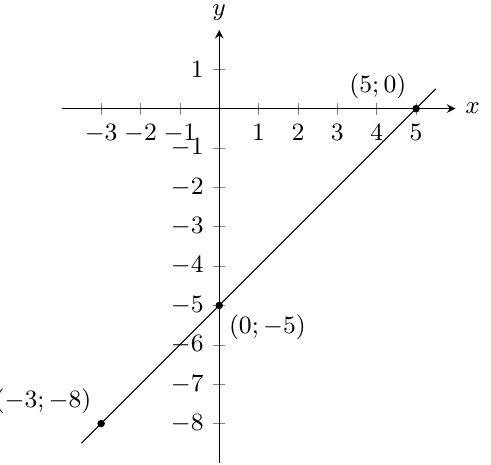
Note
All six representations describe the same function relationship, just in different formats. Choose the representation that best suits your specific needs. This flexibility is one of the most powerful aspects of working with functions.
Domain and range
Domain: The complete set of all possible input values (independent x-values) that produce valid outputs for a function.
Range: The complete set of all possible output values (dependent y-values) that can be obtained from the function.
Think of domain as "what you can put into the function" and range as "what you can get out of the function."
Important
Exam tip: Always check if there are any restrictions on the domain (like avoiding division by zero or negative square roots) when working with functions.
Summary
Key Points to Remember:
- Functions create a one-to-one relationship: each input produces exactly one output
- Independent variables are inputs you choose freely; dependent variables are outputs that depend on your input choice
- Set notation and interval notation both describe collections of numbers, with different bracket rules
- Functions can be represented in six different ways: words, mapping diagrams, tables, ordered pairs, formulas, and graphs
- Domain contains all possible inputs; range contains all possible outputs