Trigonometric Functions (Grade 10 NSC Matric Mathematics): Revision Notes
📚Revision Notes
Trigonometric Functions
Trigonometric functions are fundamental mathematical functions that describe periodic relationships. The three main trigonometric functions are sine, cosine, and tangent. These functions are essential for understanding wave patterns, circular motion, and many real-world phenomena.
Sine function
Basic sine function y = sin θ
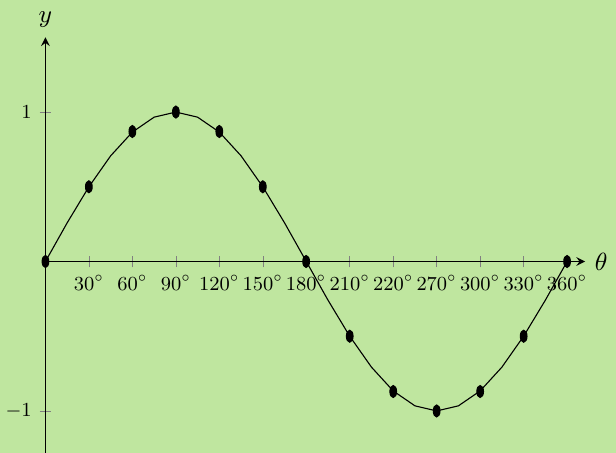
The sine function produces a smooth, wave-like curve that oscillates between -1 and 1. This function is periodic, meaning it repeats the same pattern every 360°.

To plot a sine graph, we substitute angle values and calculate the corresponding sine values:
| θ | 0° | 30° | 60° | 90° | 120° | 150° | 180° | 210° | 240° | 270° | 300° | 330° | 360° |
|---|---|---|---|---|---|---|---|---|---|---|---|---|---|
| sin θ | 0 | 0.5 | 0.87 | 1 | 0.87 | 0.5 | 0 | -0.5 | -0.87 | -1 | -0.87 | -0.5 | 0 |
Note
Key characteristics of :
- Domain:
- Range:
- Period: 360° (one complete wave)
- Amplitude: 1 (height from centre line to peak)
- y-intercept:
- x-intercepts: , ,
- Maximum turning point:
- Minimum turning point:
Functions of the form y = a sin θ + q
When we modify the basic sine function by adding constants a and q, we create transformed sine functions. These transformations change the appearance and position of the sine wave.
Effect of parameter q (vertical shift)
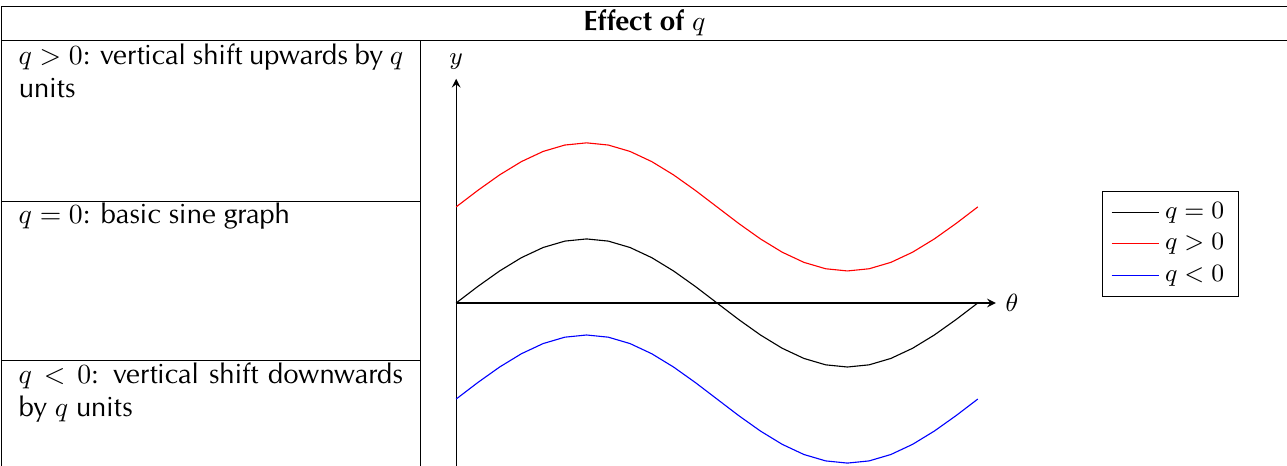
The parameter q causes a vertical shift of the entire sine graph:
- When : the graph shifts upwards by q units
- When : the graph shifts downwards by q units
Effect of parameter a (amplitude change)
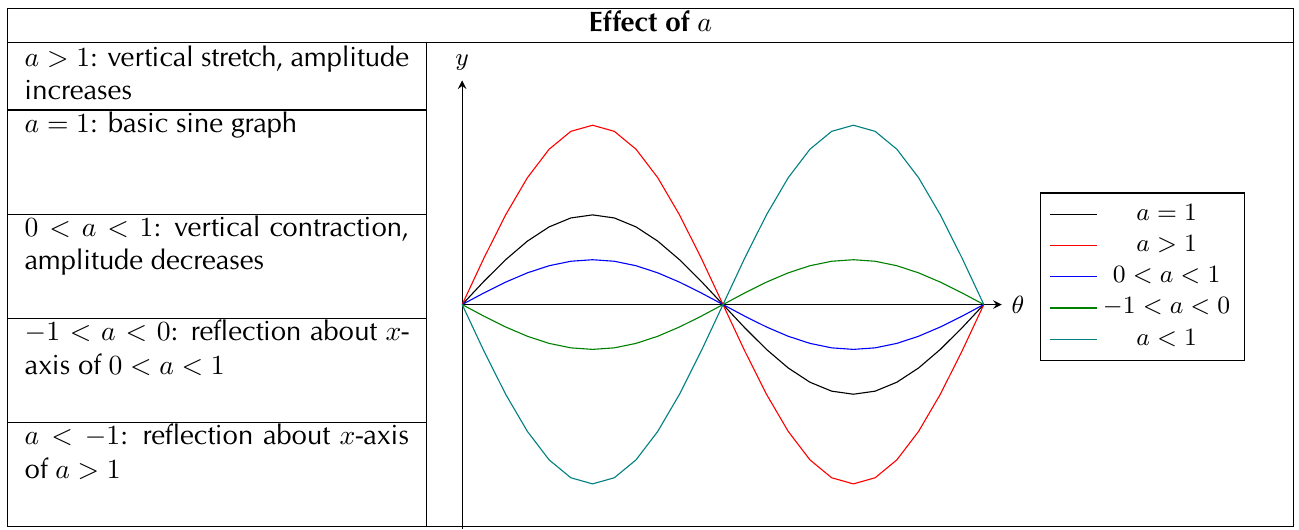
The parameter a affects the amplitude (height) of the sine wave:
- When : vertical stretch, amplitude increases
- When : amplitude decreases (compression)
- When : reflexion about the x-axis
- When : reflexion and amplitude decrease
- When : reflexion and amplitude increase
Important
Amplitude is always expressed as a positive value, regardless of whether a is positive or negative.
Domain and range for y = a sin θ + q
The domain remains for all transformed sine functions.
The range depends on the values of a and q:
- For : Range =
- For : Range =
Example
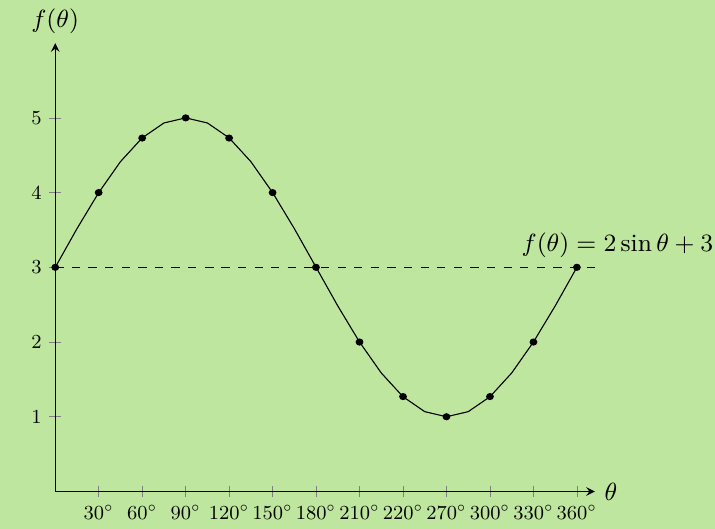
Worked Example: Sketching
Step 1: Examine the equation
- (vertical stretch, amplitude = 2)
- (vertical shift upwards by 3 units)
Step 2: Create a value table
| θ | 0° | 30° | 60° | 90° | 120° | 150° | 180° | 210° | 240° | 270° | 300° | 330° | 360° |
|---|---|---|---|---|---|---|---|---|---|---|---|---|---|
| f(θ) | 3 | 4 | 4.73 | 5 | 4.73 | 4 | 3 | 2 | 1.27 | 1 | 1.27 | 2 | 3 |
Step 3: Plot the graph
Characteristics:
- Domain:
- Range:
- y-intercept:
- Maximum turning point:
- Minimum turning point:
Cosine function
Basic cosine function y = cos θ
The cosine function is very similar to the sine function but starts at its maximum value when .
To understand cosine values, we can create a table:
| θ | 0° | 30° | 60° | 90° | 120° | 150° | 180° | 210° | 240° | 270° | 300° | 330° | 360° |
|---|---|---|---|---|---|---|---|---|---|---|---|---|---|
| cos θ | 1 | 0.87 | 0.5 | 0 | -0.5 | -0.87 | -1 | -0.87 | -0.5 | 0 | 0.5 | 0.87 | 1 |
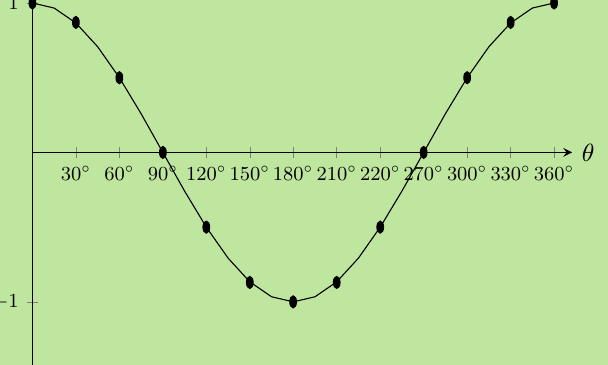
Note
Key characteristics of :
- Domain:
- Range:
- Period: 360°
- Amplitude: 1
- y-intercept:
- x-intercepts: ,
- Maximum turning points: ,
- Minimum turning point:
Functions of the form y = a cos θ + q
The transformations for cosine functions work exactly the same way as for sine functions.
Effect of parameters a and q on cosine
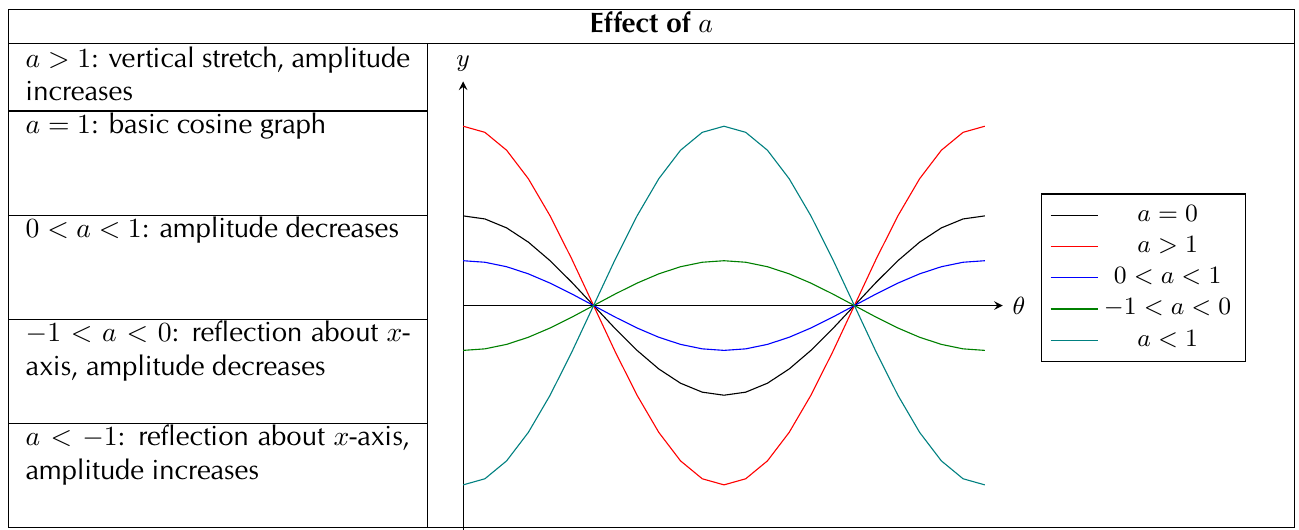
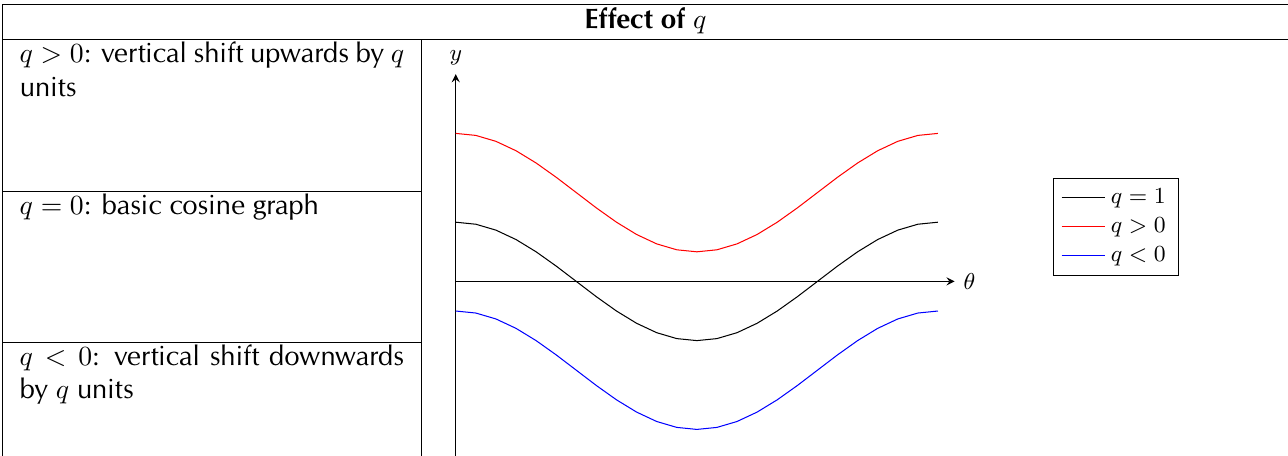
The effects are identical to those for sine functions:
- Parameter q: vertical shift up or down
- Parameter a: amplitude change and possible reflexion
Domain and range for y = a cos θ + q
- Domain:
- Range: Same calculation as for sine functions
- For : Range =
- For : Range =
Example
Worked Example: Sketching
Step 1: Examine the equation
- (amplitude = 2)
- (vertical shift upwards by 3 units)
Step 2: Create a value table
| θ | 0° | 30° | 60° | 90° | 120° | 150° | 180° | 210° | 240° | 270° | 300° | 330° | 360° |
|---|---|---|---|---|---|---|---|---|---|---|---|---|---|
| f(θ) | 5 | 4.73 | 4 | 3 | 2 | 1.27 | 1 | 1.27 | 2 | 3 | 4 | 4.73 | 5 |
Step 3: Plot the graph
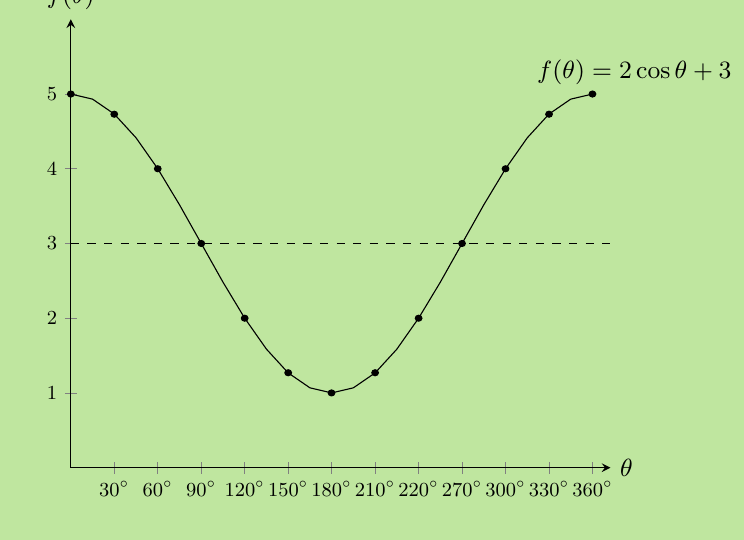
Characteristics:
- Domain:
- Range:
- y-intercept:
- Maximum turning points: ,
- Minimum turning point:
Relationship between sine and cosine
The sine and cosine functions are closely related. If you shift the cosine graph 90° to the right, it becomes identical to the sine graph:
Note
Key relationships:
Tangent function
Basic tangent function y = tan θ
The tangent function is different from sine and cosine because it has asymptotes (vertical lines where the function is undefined).
We can understand tangent using the relationship:
Important
This means tangent is undefined wherever (at and ).
| θ | 0° | 30° | 45° | 60° | 90° | 120° | 135° | 150° | 180° |
|---|---|---|---|---|---|---|---|---|---|
| tan θ | 0 | 0.58 | 1 | 1.73 | undef | -1.73 | -1 | -0.58 | 0 |
| θ | 210° | 235° | 240° | 270° | 300° | 315° | 330° | 360° |
|---|---|---|---|---|---|---|---|---|
| tan θ | 0.58 | 1 | 1.73 | undef | -1.73 | -1 | -0.58 | 0 |
Note
Key characteristics of :
- Domain:
- Range: All real numbers (ℝ)
- Period: 180° (half that of sine and cosine)
- Asymptotes: and
- y-intercept:
- x-intercepts: , ,
Functions of the form y = a tan θ + q
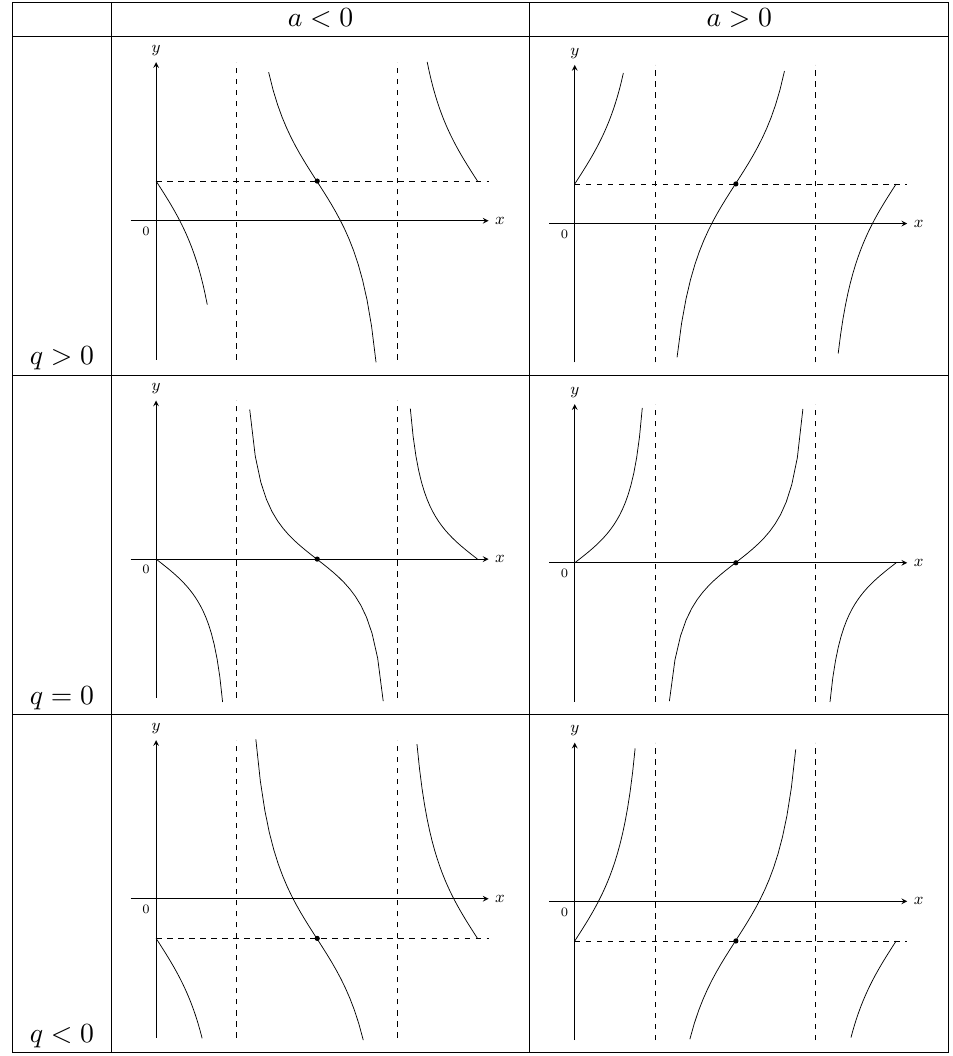
The transformations for tangent functions follow similar principles but affect the steepness rather than amplitude.
Effect of parameter q (vertical shift)
- When : graph shifts upwards by q units
- When : graph shifts downwards by q units
Effect of parameter a (steepness)
- When : branches become steeper (approach asymptotes faster)
- When : branches become less steep
- When : reflexion about x-axis plus steepness change
Domain and range for y = a tan θ + q
- Domain:
- Range: All real numbers (ℝ)
- Period: 180°
Example
Worked Example: Sketching
Step 1: Examine the equation
- (steeper branches)
- (vertical shift upwards by 1 unit)
Step 2: Create a value table
| θ | 0° | 30° | 60° | 90° | 120° | 150° | 180° | 210° | 240° | 270° | 300° | 330° | 360° |
|---|---|---|---|---|---|---|---|---|---|---|---|---|---|
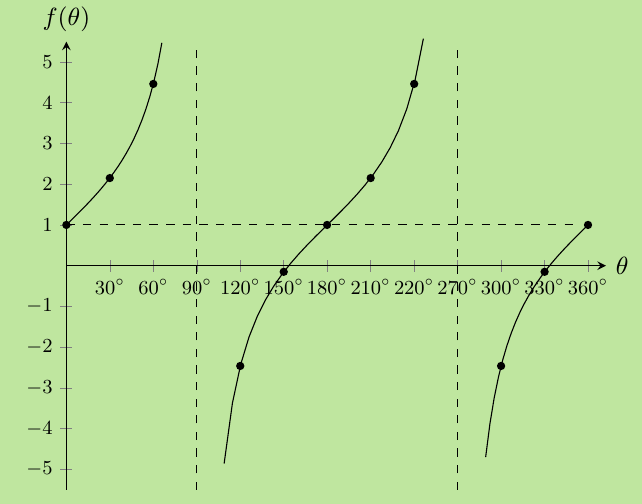
| y | 1 | 2.15 | 4.46 | — | -2.46 | -0.15 | 1 | 2.15 | 4.46 | — | -2.46 | -0.15 | 1 |
Step 3: Plot the graph with asymptotes at and
Characteristics:
- Domain:
- Range: All real numbers (ℝ)
- y-intercept:
- Asymptotes: ,
Exam tips and common traps
Important
Common mistakes to avoid:
- Always start with the basic graph before applying transformations
- Check your domain carefully - tangent functions exclude asymptote values
- Remember that amplitude is always positive - use for amplitude
- Period of tangent is 180°, not 360° like sine and cosine
- Vertical shift moves the entire graph - this affects y-intercepts and turning points
- When , the graph reflects about the x-axis - maximums become minimums
Summary
Key Points to Remember:
- Sine and cosine functions have the same shape but are shifted by 90°
- All trigonometric functions repeat their patterns (they are periodic)
- Parameter a affects amplitude for sine/cosine and steepness for tangent
- Parameter q causes vertical shifts for all trigonometric functions
- Tangent functions have asymptotes at 90° and 270° where