Gradient of a Line (Grade 10 NSC Matric Mathematics): Revision Notes
📚Revision Notes
Gradient of a Line
What is gradient?
Gradient is a measure that tells us how steep a line is. It describes the slope or steepness of the line joining two points. Think of gradient as how much a line rises or falls as you move from left to right.
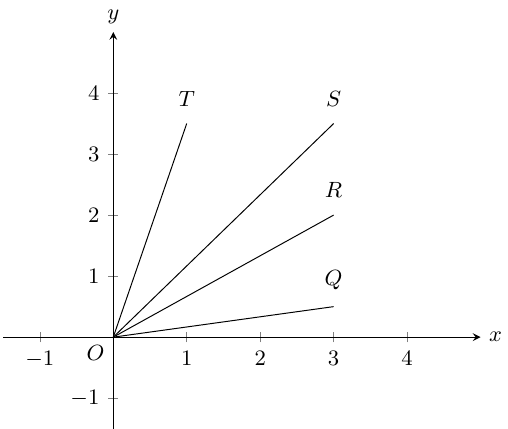
The gradient shows us the ratio of vertical change to horizontal change. When we look at different lines, some are steeper than others - this is what gradient measures.
Note
The concept of gradient is fundamental to understanding how lines behave in coordinate geometry. A positive gradient means the line slopes upward from left to right, while a negative gradient means it slopes downward.
Understanding the gradient formula
To find the exact gradient of a line, we use a right-angled triangle formed by any two points on the line. The gradient equals the length of the vertical side divided by the length of the horizontal side.
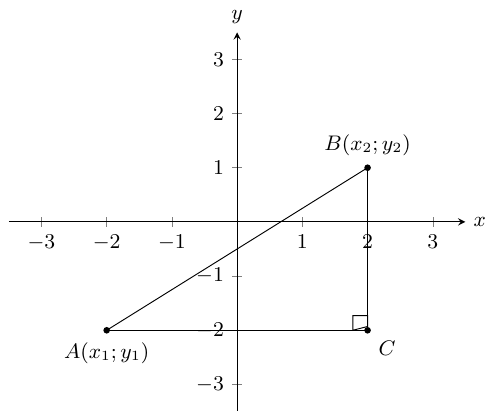
For any two points A(x₁; y₁) and B(x₂; y₂), the vertical change is the difference in y-values, and the horizontal change is the difference in x-values.
Important
Key formula:
Important: Always be consistent with your order. If you use (y₂ - y₁) on top, use (x₂ - x₁) on the bottom.
Calculating gradient between two points
Let's work through finding the gradient step by step using the rise over run method.
Example
Worked Example: Basic gradient calculation
Question: Find the gradient of the line between points E(2; 5) and F(-3; 9).
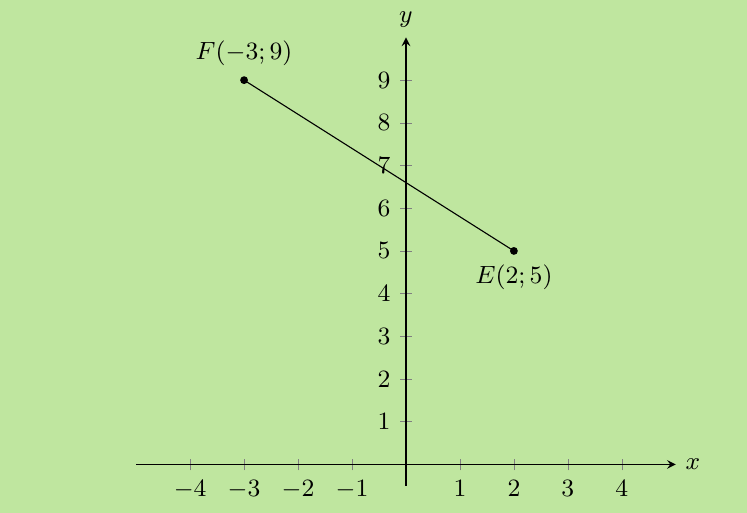
Solution: Step 1: Assign coordinates
Let E be (x₁; y₁) = (2; 5) and F be (x₂; y₂) = (-3; 9)
Step 2: Apply the gradient formula
Step 3: Substitute the values
Answer: The gradient of EF is
Finding missing coordinates using gradient
When we know the gradient and one complete coordinate, we can find missing coordinate values by applying the gradient formula and solving algebraically.
Example
Worked Example: Finding a missing coordinate
Question: Given G(7; -9) and H(x; 0), with gradient = 3, find x.
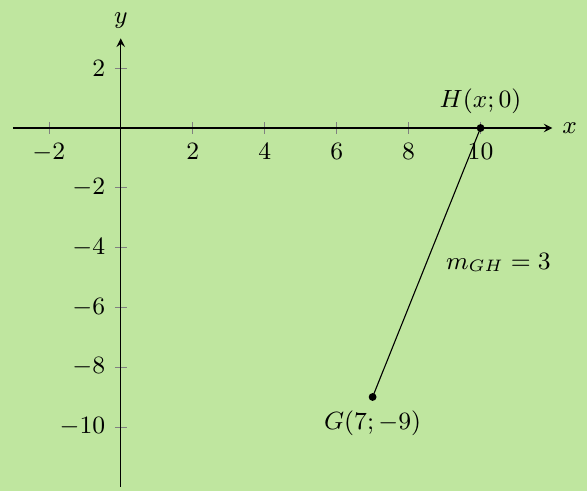
Solution: Step 1: Assign known values
G(x₁; y₁) = (7; -9), H(x₂; y₂) = (x; 0), and m = 3
Step 2: Apply the gradient formula
Step 3: Solve for x
Answer: The coordinates of H are (10; 0)
Straight lines and their equations
Definition: A straight line is a set of points with a constant gradient between any two of the points.
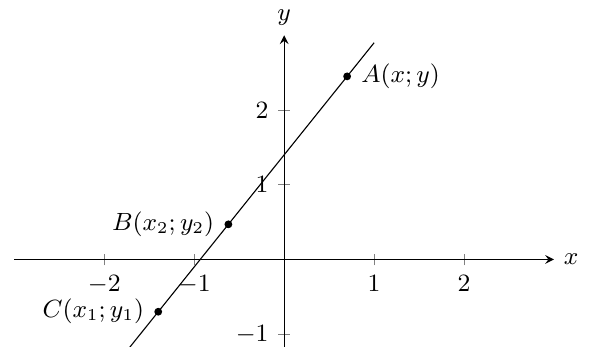
When points lie on a straight line, the gradient between any pair of points is always the same. This leads us to the general equation of a straight line.
Note
General formula for a straight line:
This can be simplified to:
Standard form: where m is the gradient and c is the y-intercept.
Example
Worked Example: Finding the equation of a straight line
Question: Find the equation of the straight line through P(-1; -5) and Q(5; 4).
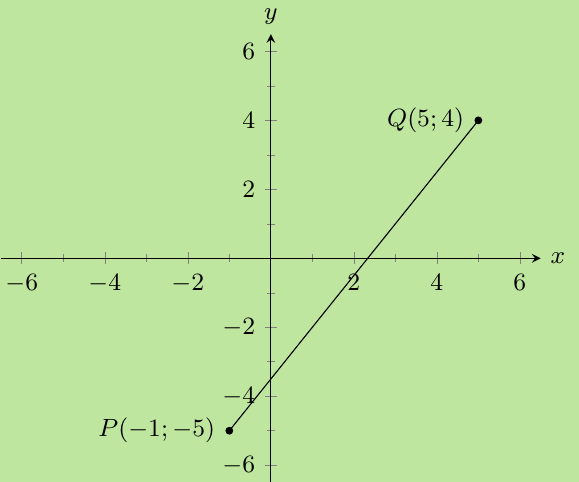
Solution:
Step 1: Assign coordinates
P(x₁; y₁) = (-1; -5), Q(x₂; y₂) = (5; 4)
Step 2: Use the general line formula
Step 3: Substitute and simplify
Step 4: Rearrange to standard form
Answer: The equation is
Parallel lines
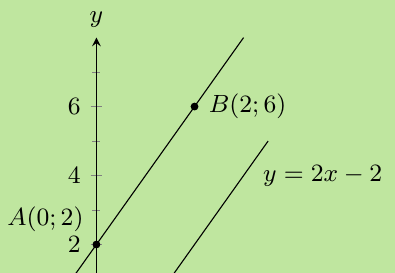
Key concept: Two lines that run parallel to each other always maintain the same distance apart and have equal gradients.
For parallel lines:
Note
Remember: If two lines have the same gradient, they will never intersect (unless they are the same line). This is the defining property of parallel lines in coordinate geometry.
Example
Worked Example: Proving lines are parallel
Question: Prove that line AB with A(0; 2) and B(2; 6) is parallel to line CD with equation 2x - y = 2.
Solution:
Step 1: Find gradient of line AB
Step 2: Find gradient of line CD
Rewrite 2x - y = 2 in standard form: y = 2x - 2
Therefore,
Step 3: Compare gradients
Since , the lines are parallel.
Perpendicular lines
Key concept: If two lines intersect perpendicularly, the product of their gradients equals -1.
For perpendicular lines:
This means perpendicular lines have gradients that are negative inverses of each other.
Important
Common mistake to avoid: Don't confuse perpendicular lines with parallel lines. Perpendicular lines intersect at 90°, while parallel lines never intersect.
If one line has gradient , a perpendicular line will have gradient .
Example
Worked Example: Finding coordinates using perpendicular condition
Question: Line AB is perpendicular to line CD. Find y given A(2; -3), B(-2; 6), C(4; 3) and D(7; y).
Solution:
Step 1: Use the perpendicular relationship
Step 2: Calculate gradient of AB
Step 3: Use the perpendicular condition
Step 4: Solve for y
Answer: The coordinates of D are
Special cases: horizontal and vertical lines
Horizontal lines
A line parallel to the x-axis is horizontal and has gradient = 0. This happens because there's no vertical change.
Vertical lines
A line parallel to the y-axis is vertical and has undefined gradient. This happens because there's no horizontal change, leading to division by zero.
Note
Memory aid: Think of horizontal lines as "flat" (no rise, so gradient = 0) and vertical lines as "standing up" (no run, so gradient is undefined).
Points on a line (collinearity)
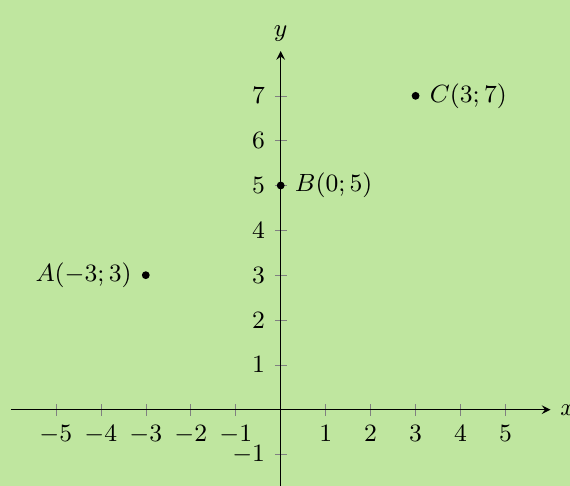
Collinear points are points that lie on the same straight line. We can prove points are collinear by showing they have the same gradient between any pair of points.
Example
Worked Example: Proving collinearity using gradient method
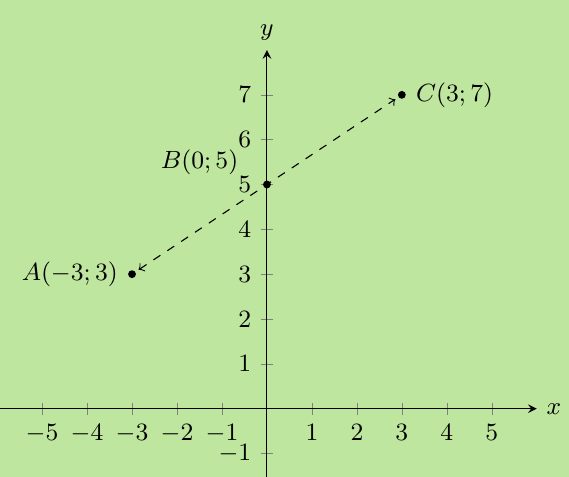
Question: Prove that A(-3; 3), B(0; 5) and C(3; 7) are on a straight line.
Solution:
Step 1: Calculate gradients between different pairs
Step 2: Compare gradients
Since , the points A, B and C lie on a straight line.
Summary
Key Points to Remember:
-
Gradient formula: - always be consistent with order
-
Parallel lines: Have equal gradients ()
-
Perpendicular lines: Have gradients whose product is -1 ()
-
Horizontal lines: Have gradient = 0 (no vertical change)
-
Vertical lines: Have undefined gradient (no horizontal change)
-
Collinear points: Have the same gradient between any pair of points
-
Memory aids: "Rise over run" for gradient, "Same gradient = parallel", "Product = -1 = perpendicular"