Mid-Point of a Line (Grade 10 NSC Matric Mathematics): Revision Notes
📚Revision Notes
Mid-Point of a Line
What is a mid-point?
The mid-point of a line segment is the point that lies exactly halfway between two given endpoints. Think of it as the "middle" point that divides a line segment into two equal parts. On a coordinate plane, we can find this middle point by calculating the average of the x-coordinates and the average of the y-coordinates of the two endpoints.
Note
When you have two points on a coordinate plane, the mid-point will always lie on the straight line connecting these points, positioned at equal distances from both endpoints. This geometric property makes the mid-point formula a powerful tool for coordinate geometry problems.
The mid-point formula
To find the coordinates of the mid-point M(x; y) between any two points A(x₁; y₁) and B(x₂; y₂), we use the following formula:
Important
The Mid-Point Formula:
This can be written as two separate equations:
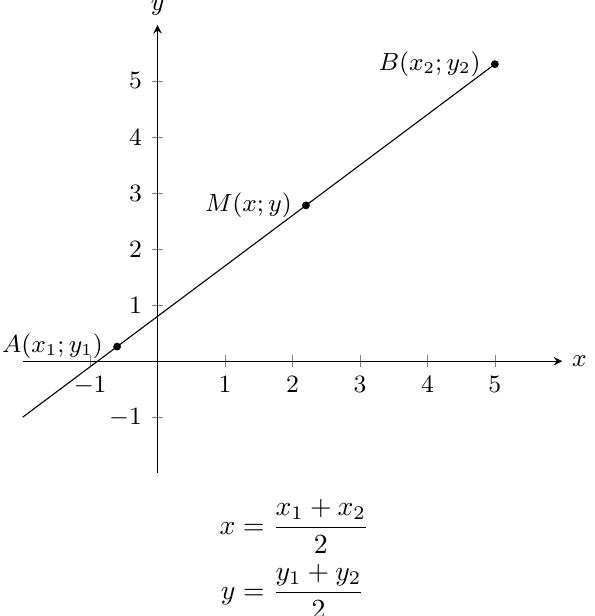
The formula works by taking the arithmetic mean (average) of the corresponding coordinates. This averaging process ensures that the resulting point is positioned exactly halfway between the two original points.
Step-by-step method for calculating mid-points
Note
Following a systematic approach will help you solve mid-point problems accurately and avoid common errors. Always work through these steps in order to ensure you don't miss any important details.
Follow these clear steps when solving mid-point problems:
- Draw a sketch - Always plot the given points on a coordinate plane to visualise the problem
- Identify the coordinates - Label the points clearly as (x₁; y₁) and (x₂; y₂)
- Write down the formula - State the mid-point formula clearly
- Substitute the values - Replace the variables with the actual coordinate values
- Calculate and simplify - Work through the arithmetic carefully
- Write the final answer - Express your answer as coordinate pair (x; y)
- Check your answer - Verify that your result makes sense by looking at your sketch
Worked examples
Example
Worked Example 1: Finding a mid-point between two points
Question: Calculate the coordinates of the mid-point F(x; y) of the line between point E(2; 1) and point G(-2; -2).
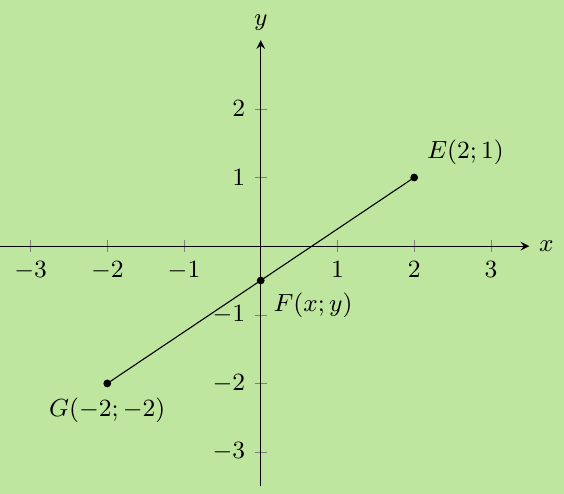
Solution:
Step 1: Draw a sketch (shown above)
Step 2: Assign values to (x₁; y₁) and (x₂; y₂)
- x₁ = -2, y₁ = -2, x₂ = 2, y₂ = 1
Step 3: Write down the mid-point formula
Step 4: Substitute values into the formula
Step 5: Write the answer
- The mid-point is at F(0; -½).
Example
Worked Example 2: Finding a mid-point with different coordinates
Question: Find the mid-point of line AB, given A(6; 2) and B(-5; -1).
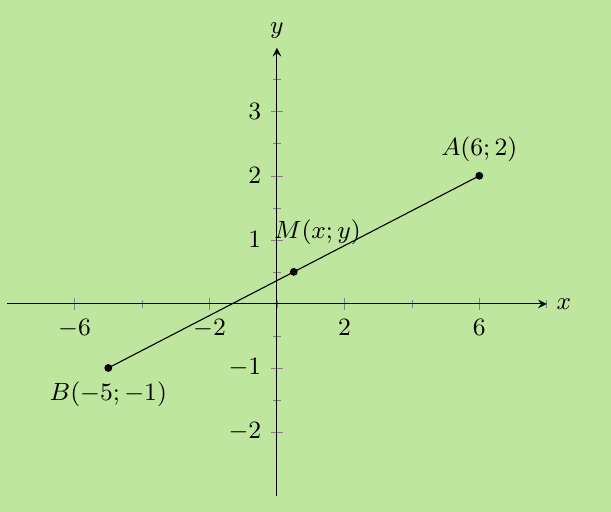
Solution:
Step 1: Draw a sketch (shown above)
Step 2: Assign values to (x₁; y₁) and (x₂; y₂)
- Let the mid-point be M(x; y)
- x₁ = 6, y₁ = 2, x₂ = -5, y₂ = -1
Step 3: Write down the mid-point formula
Step 4: Substitute values and simplify
Step 5: Write the final answer
- M(½; ½) is the mid-point of line AB.
Example
Worked Example 3: Finding an unknown endpoint
Question: The line joining C(-2; 4) and D(x; y) has the mid-point M(1; -3). Find point D.
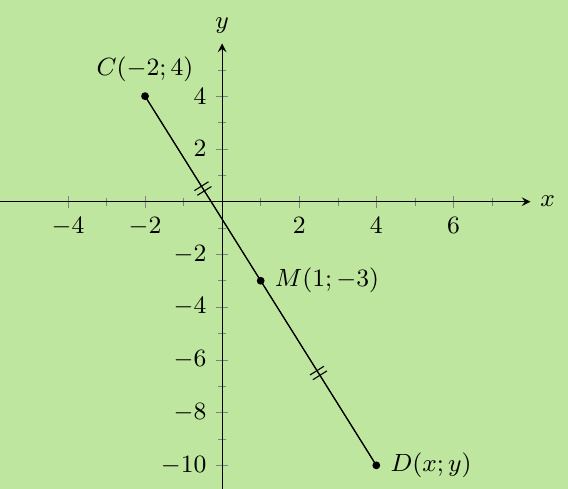
Solution:
Step 1: Draw a sketch (shown above)
Step 2: Assign values to (x₁; y₁) and (x₂; y₂)
Let the coordinates of C be (x₁; y₁) and the coordinates of D be (x₂; y₂).
- x₁ = -2, y₁ = 4, x₂ = x, y₂ = y
Step 3: Write down the mid-point formula
Step 4: Substitute values and solve for x₂ and y₂
For the x-coordinate:
For the y-coordinate:
Step 5: Write the final answer The coordinates of point D are (4; -10).
Applications of the mid-point formula
The mid-point formula is particularly useful in:
- Finding the centre of line segments in geometric constructions
- Solving parallelogram problems where diagonals bisect each other
- Coordinate geometry proofs involving symmetry and balance
- Real-world applications such as finding the halfway point between two locations
Note
When working with parallelograms, remember that the diagonals bisect each other, meaning they share the same mid-point. This property can help you find unknown coordinates of vertices and is a powerful tool for solving complex coordinate geometry problems.
Key exam tips
Important
Essential Exam Strategies:
- Always draw a sketch first - this helps you visualise the problem and check if your answer is reasonable
- Be careful with negative signs - pay close attention when adding negative coordinates
- Show all your working - write down each step clearly for full marks
- Check your final answer - ensure your calculated mid-point lies between the two given points
- Use brackets correctly - when substituting negative values, use brackets to avoid sign errors
- Simplify fractions - always express your final coordinates in simplest form
Summary
Key Points to Remember:
-
The mid-point formula averages the x-coordinates and y-coordinates:
-
The mid-point always lies exactly halfway between the two given points on the line segment
-
Drawing a sketch is essential for visualising the problem and checking your answer makes sense
-
When finding unknown endpoints, substitute the known mid-point coordinates into the formula and solve the resulting equations
-
In parallelograms, the diagonals bisect each other, so they share the same mid-point - use this property to solve problems involving quadrilaterals