Summary (Grade 10 NSC Matric Mathematics): Revision Notes
📚Revision Notes
Summary
What is analytical geometry?
Analytical geometry combines algebra and geometry to solve problems using coordinates and equations. It allows us to work with geometric shapes and relationships using algebraic methods on a coordinate plane.
This powerful mathematical tool bridges the gap between abstract algebraic concepts and visual geometric representations, making it easier to solve complex problems involving shapes, distances, and relationships in two-dimensional space.
Points and coordinates
A point is an ordered pair of numbers written as , where:
- is the horizontal coordinate (x-coordinate)
- is the vertical coordinate (y-coordinate)
- The point represents a specific location on the coordinate plane
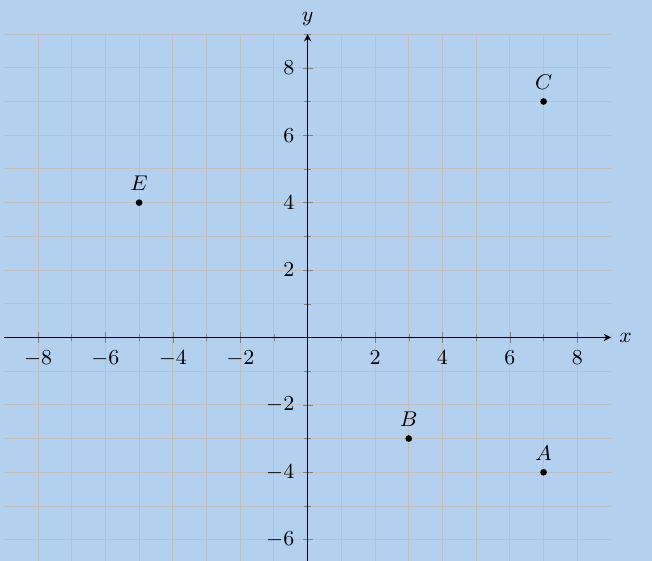
The coordinate plane consists of two perpendicular axes that intersect at the origin .
Note
The coordinate system provides a systematic way to describe any location in a plane using just two numbers. This makes it possible to perform calculations on geometric shapes using algebraic techniques.
Distance between two points
Distance is a measure of the length between two points on the coordinate plane. Understanding how to calculate distance is fundamental to solving many analytical geometry problems.
Distance formula
For any two points and , the distance between them is:
Note
This formula is derived from the Pythagorean theorem. The distance between two points forms the hypotenuse of a right triangle, where the legs are the differences in x-coordinates and y-coordinates.
Worked example: calculating distance
Example
Worked Example: Calculating Distance Between Points
Find the distance between points and .
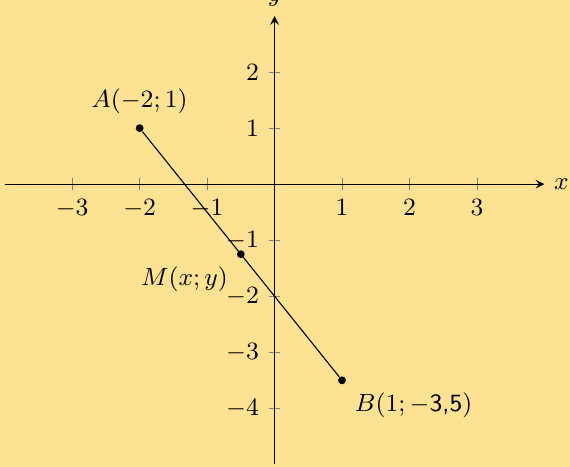
Solution: Using the distance formula:
-
,
-
,
-
-
-
-
Gradient of a line
The gradient (or slope) of a line is determined by the ratio of vertical change to horizontal change between any two points on the line. This concept is crucial for understanding how steep a line is and in which direction it's sloping.
Gradient formula
For any two points on a line, the gradient is:
where and are two different points on the line.
Types of gradients
- Positive gradient: Line slopes upward from left to right
- Negative gradient: Line slopes downward from left to right
- Zero gradient: Horizontal line
- Undefined gradient: Vertical line
Special cases
Important
Critical Cases to Remember:
- Horizontal lines: The gradient equals 0 because there's no vertical change
- Vertical lines: The gradient is undefined due to division by zero (no horizontal change)
These special cases often appear in exam questions, so make sure you can identify them quickly!
Straight line equations
A straight line is a set of points with a constant gradient between any two points. Being able to write and manipulate line equations is essential for solving coordinate geometry problems.
Standard form
The standard form of a straight line equation is:
where:
- is the gradient
- is the y-intercept (where the line crosses the y-axis)
Note
This form is particularly useful because you can immediately identify the gradient and y-intercept just by looking at the equation. This makes graphing and analysis much more straightforward.
Alternative form
The equation of a straight line can also be written as:
This form is useful when you know two points on the line and need to find the equation.
Parallel and perpendicular lines
Understanding the relationships between parallel and perpendicular lines is crucial for solving many coordinate geometry problems.
Parallel lines
Parallel lines never meet and have equal gradients.
If two lines are parallel:
Perpendicular lines
Perpendicular lines meet at right angles (90°).
If two lines are perpendicular:
This means the gradients are negative reciprocals of each other.
Important
Key Relationship to Remember:
For perpendicular lines, if one line has gradient , the other has gradient . This relationship is frequently tested in exams!
Midpoint of a line segment
The midpoint is the point exactly halfway between two given points. This concept is useful for finding centres of line segments and solving problems involving symmetry.
Midpoint formula
For two points and , the midpoint is:
Worked example: finding a midpoint
Example
Worked Example: Finding the Midpoint
Find the midpoint between and .
Solution: Using the midpoint formula:
Exam tips
Important
Essential Exam Strategies:
- Always draw a diagram when working with coordinate geometry problems
- Check your calculations by substituting coordinates back into equations
- Remember that parallel lines have equal gradients, while perpendicular lines have gradients that multiply to give -1
- When finding distance, always use the distance formula rather than counting squares on a grid
- Label points clearly and show all working steps
Remember!
Summary
Key Points to Remember:
- A point is written as an ordered pair representing a location on the coordinate plane
- Distance between two points uses the formula
- Gradient is the ratio of vertical change to horizontal change:
- Parallel lines have equal gradients, perpendicular lines have gradients that multiply to give -1
- The midpoint formula averages the x and y coordinates: