Proofs and Conjectures (Grade 10 NSC Matric Mathematics): Revision Notes
📚Revision Notes
Proofs and Conjectures
Introduction to Euclidean geometry proofs
Euclidean geometry deals with spatial relationships using logical deductions. Unlike analytical geometry which uses algebra and coordinates, Euclidean geometry relies on a system of logical reasoning to prove geometric properties.
Note
When working with proofs and conjectures, you need to understand that:
- A conjecture is an educated guess about a geometric relationship
- A proof is a logical argument that demonstrates why a conjecture is always true
- Proofs use previously established theorems, definitions, and properties
Properties of parallelograms
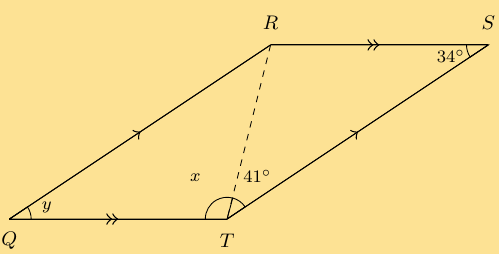
A parallelogram is a quadrilateral where both pairs of opposite sides are parallel. This simple definition leads to several important properties that are essential for proofs.
Key properties of parallelograms:
- Opposite sides are equal in length
- Opposite angles are equal
- Diagonals bisect each other
- Co-interior angles are supplementary (sum to 180°)
These properties work both ways - you can use them to prove a quadrilateral is a parallelogram, or you can use the fact that a quadrilateral is a parallelogram to prove these properties exist.
Methods for proving quadrilaterals are parallelograms
There are several ways to prove that a quadrilateral is a parallelogram. The most common methods involve showing:
- Both pairs of opposite sides are parallel
- Both pairs of opposite sides are equal
- Both pairs of opposite angles are equal
- Diagonals bisect each other
- One pair of opposite sides is both parallel and equal
Using co-interior angles
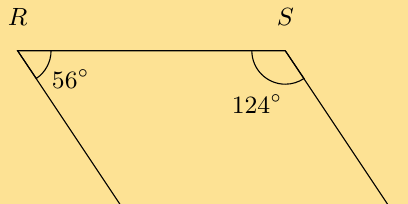
When you have parallel lines cut by a transversal, co-interior angles (also called same-side interior angles) are supplementary - they add up to 180°.
Important
If you can show that co-interior angles sum to 180°, then the lines are parallel. This is a powerful tool for proving parallelograms and is one of the most frequently used techniques in geometric proofs.
Step-by-step proof methodology
Example
Systematic Approach to Geometric Proofs
When constructing a geometric proof, follow this systematic approach:
- Identify what you need to prove (the conclusion)
- List what information is given
- Draw and label a clear diagram
- Plan your approach - which properties or theorems will you use?
- Write the proof in logical steps, stating reasons for each step
- Check your conclusion matches what you needed to prove
Formal proof structure
Use a two-column format with "Steps" and "Reasons":
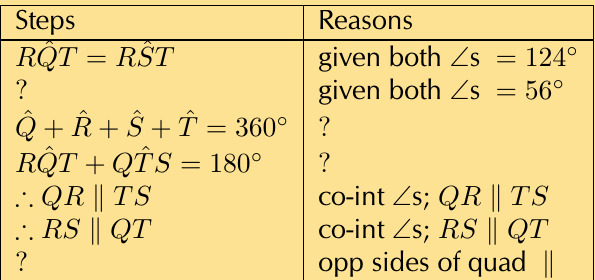
Each step must be justified by:
- Given information
- Previously proven statements
- Established theorems or properties
- Logical deductions
Worked example: proving a quadrilateral is a parallelogram
Example
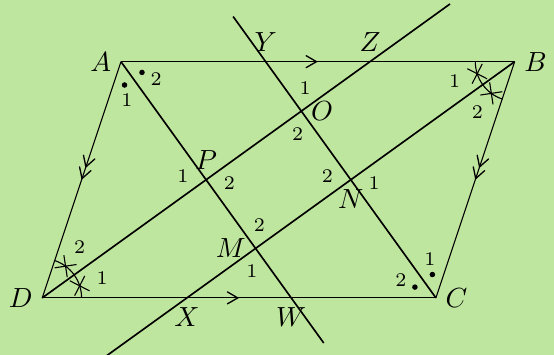
Worked Example: Proving MNOP is a Parallelogram Using Angle Bisectors
Given: In parallelogram ABCD, angle bisectors have been constructed. You need to prove that MNOP is also a parallelogram.
Solution:
Step 1: Use properties of the given parallelogram ABCD to identify equal sides and angles.
Step 2: Prove triangles are congruent using AAS (Angle-Angle-Side).
- In triangles △CDZ and △ABX:
- DCZ = BAX (given equal angles)
- D₁ = B₁ (given equal angles)
- DC = AB (opposite sides of parallelogram)
- Therefore △CDZ ≅ △ABX (AAS)
Step 3: Use congruent triangles to show equal corresponding parts. From the congruent triangles: CZ = AXE and CZD = AXB
Step 4: Repeat the process for other triangle pairs to establish more equal relationships.
Step 5: Show that opposite angles of quadrilateral MNOP are equal, which proves it's a parallelogram.
This methodical approach demonstrates how complex proofs build upon simpler established facts.
Types of quadrilaterals and their properties
Understanding the hierarchy and properties of different quadrilaterals is crucial for geometric proofs.
Parallelograms
- Both pairs of opposite sides parallel
- Opposite sides and angles equal
- Diagonals bisect each other
Rectangles
A rectangle is a parallelogram with all angles equal to 90°:
- All parallelogram properties apply
- All angles are 90°
- Diagonals are equal in length
- Diagonals bisect each other
Rhombi
A rhombus is a parallelogram with all sides equal:
- All parallelogram properties apply
- All sides equal in length
- Diagonals bisect each other at 90°
- Diagonals bisect the interior angles
Squares
A square is both a rectangle and a rhombus:
- All sides equal
- All angles 90°
- Diagonals equal, bisect each other at 90°
- All interior angles equal 90°
Trapeziums
A trapezium has one pair of parallel sides:
- Only one pair of opposite sides parallel
- Other properties vary depending on specific type
Kites
A kite has two pairs of adjacent sides equal:
- Two pairs of adjacent sides equal
- One pair of opposite angles equal
- Diagonals intersect at 90°
- One diagonal bisects the other
Exam tips for geometric proofs
Note
Essential Exam Strategies
- Always start with a clear, labelled diagram - this helps you visualise the problem
- State what is given and what you need to prove clearly at the beginning
- Use proper mathematical notation and be precise with your language
- Show all working steps - don't skip logical connections
- Give reasons for every statement you make
- Check your final answer matches the original question
Common proof techniques
- Congruent triangles (SSS, SAS, AAS, RHS)
- Parallel line properties (corresponding, alternate, co-interior angles)
- Properties of special quadrilaterals
- Angle relationships (vertically opposite, supplementary, complementary)
Remember!
Summary
Key Points to Remember:
-
Parallelograms have both pairs of opposite sides parallel, which leads to all their other properties including equal opposite sides and angles
-
Co-interior angles on parallel lines always sum to 180° - this is one of the most useful facts for proving lines are parallel
-
Congruent triangles are the foundation of many geometric proofs - master the four congruence criteria (SSS, SAS, AAS, RHS)
-
Always justify every step in your proof with a valid reason - given information, definitions, theorems, or logical deductions
-
Draw clear, labelled diagrams and plan your approach before starting to write - good preparation leads to clearer, more logical proofs