Quadrilaterals (Grade 10 NSC Matric Mathematics): Revision Notes
📚Revision Notes
Quadrilaterals
Introduction to quadrilaterals
A quadrilateral is a closed shape made up of four straight line segments connected end to end. This means you can draw a quadrilateral by connecting four points with straight lines to form a complete loop.
Important
Fundamental Property: The interior angles of any quadrilateral always add up to .
Parallelogram
Definition
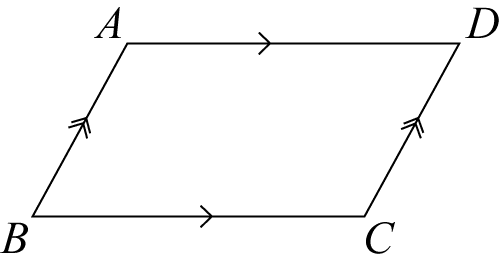
A parallelogram is a quadrilateral where both pairs of opposite sides are parallel to each other. This means that if you extend the opposite sides, they will never meet.
Note
Properties of a parallelogram
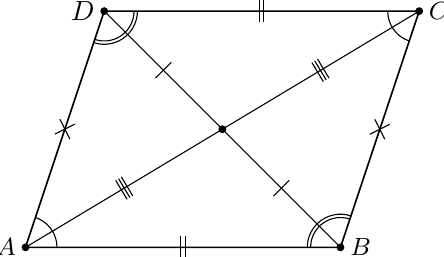
When you have a parallelogram, it automatically has these special properties:
- Both pairs of opposite sides are parallel
- Both pairs of opposite sides are equal in length
- Both pairs of opposite angles are equal
- The diagonals bisect each other (they cut each other exactly in half)
Example
Worked Example: Proving properties of a parallelogram
Question: ABCD is a parallelogram with AB || DC and AD || BC. Show that AB = DC, AD = BC, and the opposite angles are equal.
Solution:
Step 1: Draw diagonal AC to create triangles △ABC and △CDA
Step 2: Mark all equal angles created by the parallel lines
- When parallel lines are cut by a transversal, alternate interior angles are equal
- Co-interior angles are supplementary (add to )
Step 3: Prove △ABC ≅ △CDA using the marked equal angles
- Since AB || DC, we get alternate angles equal
- Since BC || AD, we get alternate angles equal
- AC is a common side
- Therefore △ABC ≅ △CDA (AAS)
This proves that AB = CD and BC = DA, and also that opposite angles are equal.
Important
How to prove a quadrilateral is a parallelogram
You can prove a quadrilateral is a parallelogram by showing any one of these conditions:
- Both pairs of opposite sides are parallel
- Both pairs of opposite sides are equal in length
- Both pairs of opposite angles are equal
- The diagonals bisect each other
- One pair of opposite sides are both equal and parallel
Rectangle
Definition
A rectangle is a parallelogram that has all four interior angles equal to . This means every corner is a right angle.
Note
Properties of a rectangle
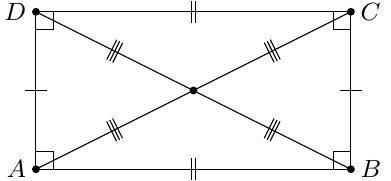
A rectangle has all the properties of a parallelogram, plus these special properties:
- All interior angles are equal to
- The diagonals are equal in length
- The diagonals bisect each other
Example
Worked Example: Proving diagonal properties of rectangles
Question: PQRS is a rectangle. Prove that the diagonals are equal in length.
Solution:
Step 1: Draw diagonals PR and QS to form triangles △PSR and △QRS
Step 2: Use the properties of rectangles to mark equal angles and sides
- PS = QR (opposite sides of rectangle)
- SR is common to both triangles
- ∠PSR = ∠QRS = (angles of rectangle)
Step 3: Prove △PSR ≅ △QRS using RHS Therefore PR = QS, which means the diagonals are equal in length.
Rhombus
Definition
A rhombus is a parallelogram where all four sides are equal in length. Think of it as a "squashed square" where all sides are the same but the angles aren't necessarily .
Note
Properties of a rhombus
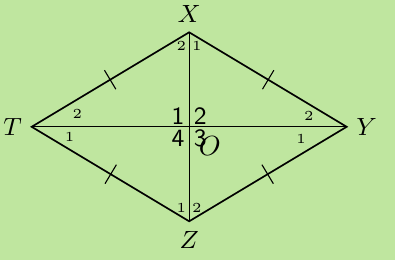
A rhombus has all the properties of a parallelogram, plus these special properties:
- All sides are equal in length
- The diagonals bisect each other at (they are perpendicular)
- The diagonals bisect the interior angles
Example
Worked Example: Properties of rhombus diagonals
Question: XYZT is a rhombus. Prove that the diagonals bisect each other perpendicularly and bisect the interior angles.
Solution:
Step 1: Mark equal sides since it's a rhombus (all sides equal)
Step 2: Use the SSS congruence to prove triangles formed by diagonals are congruent
- This proves the diagonals bisect each other at right angles
Step 3: Use properties of congruent triangles to show the diagonals bisect the interior angles
The result is that rhombus diagonals are perpendicular bisectors of each other and create four congruent right triangles.
Important
How to prove a parallelogram is a rhombus
Show any one of these conditions:
- All sides are equal in length
- Diagonals intersect at right angles
- Diagonals bisect interior angles
Square
Definition
A square can be defined in two ways:
- A rhombus with all four interior angles equal to , OR
- A rectangle with all four sides equal in length
Note
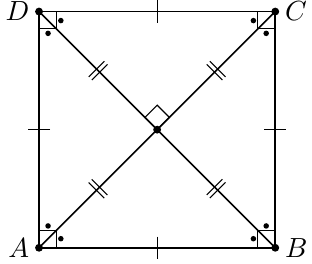
Properties of a square
A square combines ALL the properties of both rectangles and rhombuses:
- All sides are equal in length
- All interior angles are equal to
- Opposite sides are parallel
- Diagonals are equal in length
- Diagonals bisect each other at
- Diagonals bisect the interior angles (each creating angles)
Important
How to prove a parallelogram is a square
Show either:
- It's a rhombus (all sides equal) with interior angles equal to , OR
- It's a rectangle (all angles ) with all sides equal
Trapezium
Definition
A trapezium (also called a trapezoid) is a quadrilateral with exactly one pair of opposite sides parallel. This makes it different from a parallelogram, which has both pairs of opposite sides parallel.
Note
Properties of a trapezium
- Only one pair of opposite sides are parallel
- The parallel sides are called the bases
- The non-parallel sides are called the legs
- No other special properties are guaranteed (unless it's an isosceles trapezium)
Kite
Definition
A kite is a quadrilateral with two pairs of adjacent sides that are equal in length. Adjacent means the sides are next to each other, not opposite.
Note
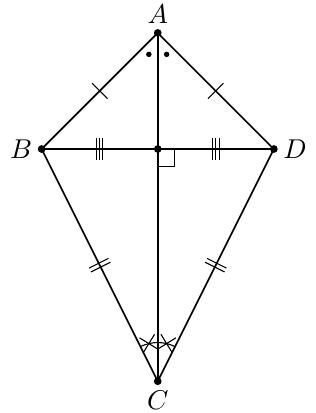
Properties of a kite
- Two pairs of adjacent sides are equal
- One diagonal bisects the other diagonal at right angles
- One pair of opposite angles are equal (the angles between unequal sides)
- The diagonal between the equal sides bisects the interior angles and acts as an axis of symmetry
Example
Worked Example: Properties of a kite
Question: ABCD is a kite with AD = AB and CD = CB. Prove that diagonal AC bisects angles A and C.
Solution:
Step 1: Use the definition to mark equal sides: AD = AB and CD = CB
Step 2: Prove △ADC ≅ △ABC using SSS congruence
- AD = AB (given)
- CD = CB (given)
- AC is common
Step 3: Use congruent triangles to show AC bisects the angles Since the triangles are congruent, corresponding angles are equal, proving that diagonal AC bisects both angles A and C.
Relationships between quadrilaterals
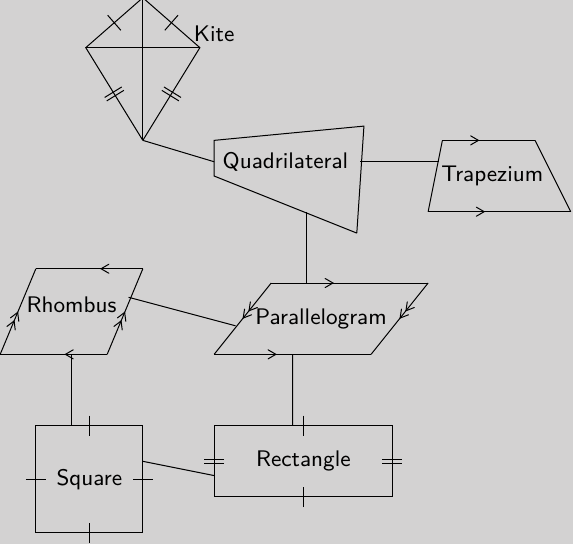
Understanding how different quadrilaterals relate to each other is crucial for problem-solving:
Important
The hierarchy works like this:
- All squares are rectangles AND rhombuses
- All rectangles and rhombuses are parallelograms
- All parallelograms are quadrilaterals
- Trapeziums and kites are quadrilaterals but not parallelograms
Key exam tip: When proving what type of quadrilateral you have, work up the hierarchy. For example, to prove something is a square, first prove it's a parallelogram, then prove it's both a rectangle and a rhombus.
Summary
Key Points to Remember:
- Quadrilateral angles always sum to - this is your starting point for many problems
- Parallelograms have opposite sides parallel and equal, opposite angles equal, and diagonals that bisect each other
- Rectangles are parallelograms with angles and equal diagonals
- Rhombuses are parallelograms with equal sides and perpendicular diagonals
- Squares combine all properties of rectangles and rhombuses
- The hierarchy matters: Square → Rectangle/Rhombus → Parallelogram → Quadrilateral