Measurements (Grade 10 NSC Matric Mathematics): Revision Notes
📚Revision Notes
Area of a Polygon
What is area?
Area is the amount of two-dimensional space contained within the boundary of a flat shape. We always measure area using square units such as cm², m², or km².
Note
Think of area as how much space you could cover if you painted inside the lines of a shape, or how much paper you would need to completely fill the shape.
Area formulas for common polygons
Different shapes require different formulas to calculate their areas. Here are the most important ones you need to know:
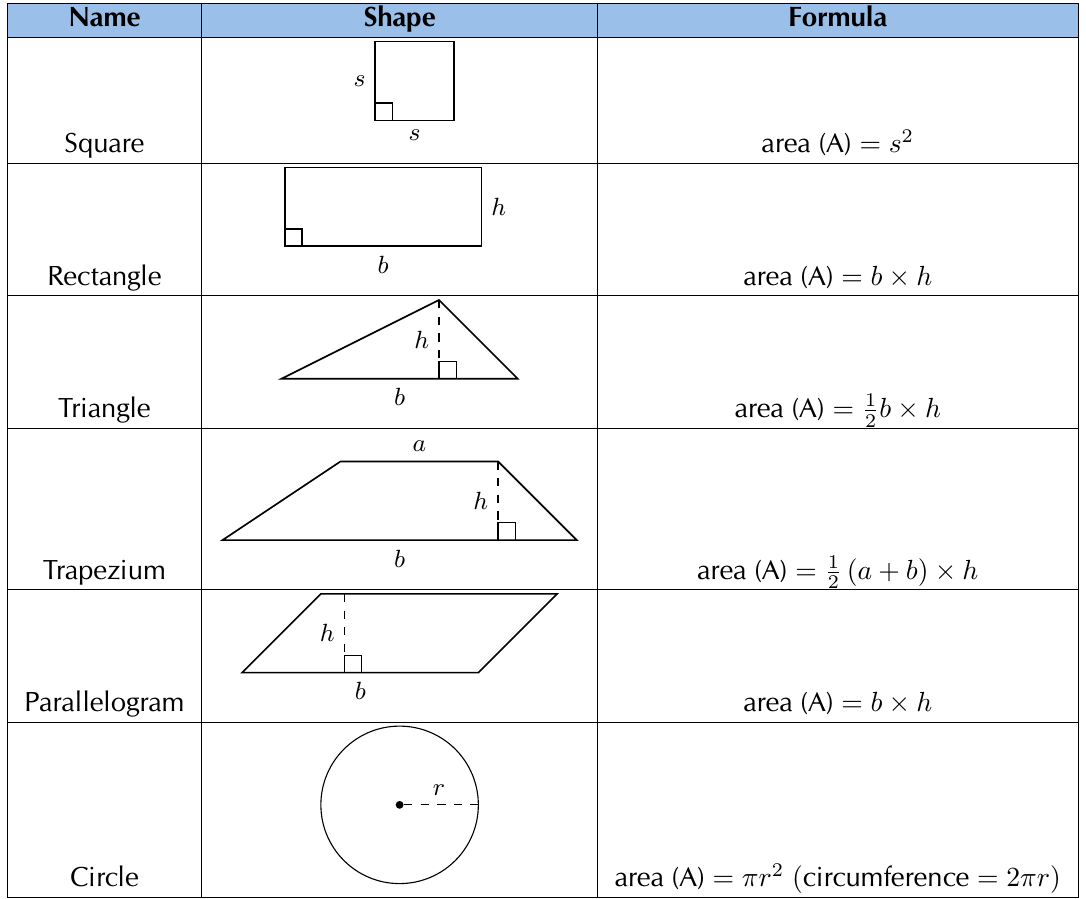
| Shape | Formula | Key points |
|---|---|---|
| Square | Area = s² | s = length of one side |
| Rectangle | Area = b × h | b = base, h = height |
| Triangle | Area = ½b × h | b = base, h = perpendicular height |
| Trapezium | Area = ½(a + b) × h | a and b = parallel sides, h = height |
| Parallelogram | Area = b × h | b = base, h = perpendicular height |
| Circle | Area = πr² | r = radius |
Important
Important notes about area formulas
- For triangles and trapeziums, always remember the "½" in the formula
- The height must always be perpendicular (at 90°) to the base
- Parallelograms and rectangles use the same formula: base × height
- Don't confuse the slanted side of a parallelogram with its height
Worked example: Finding the area of a parallelogram
When the height of a parallelogram is not directly given, you may need to calculate it first using the Pythagoras theorem.
Example
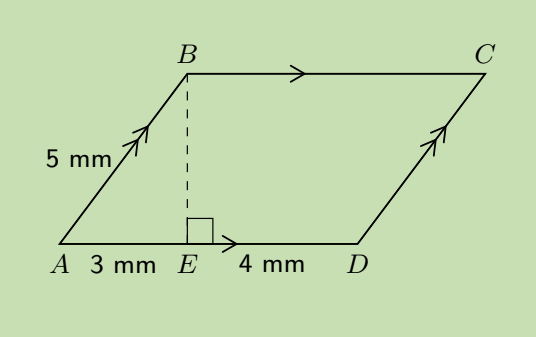
Worked Example: Finding the area of parallelogram ABCD
Question: Find the area of parallelogram ABCD.
Solution:
Step 1: Find the perpendicular height BE
We can see from the diagram that:
- AB = 5 mm (slanted side)
- AE = 3 mm
- ED = 4 mm
- BE is the perpendicular height we need to find
Using Pythagoras theorem in triangle ABE:
Rearranging to find BE:
- mm
Step 2: Calculate the area using the parallelogram formula
- Area = base × height
- Area = AD × BE
First, find the base AD:
- mm
Now calculate the area:
- mm²
Answer: The area of the parallelogram is 28 mm².
Area measurements for land
In real-world applications, especially for measuring large areas of land, we use:
- 1 hectare ≈ 0.01 square kilometres
- 1 acre ≈ 0.004 square kilometres
These units are commonly used in agriculture, property development, and environmental studies.
Summary
Exam Tips
- Always identify the shape first, then choose the correct formula
- Look carefully for the perpendicular height - it's not always obvious
- When heights aren't given directly, you may need to use Pythagoras theorem
- Check your units - area is always in square units
- For composite shapes, break them down into simpler shapes and add their areas
Summary
Key Points to Remember
- Area measures the space inside a shape and is always expressed in square units
- Each polygon type has its own specific formula - memorise the key ones
- Height must always be perpendicular to the base when using area formulas
- Use Pythagoras theorem to find missing heights in right-angled triangles
- Break down complex shapes into simpler polygons to calculate total area