Right Pyramids, Right Cones and Spheres (Grade 10 NSC Matric Mathematics): Revision Notes
📚Revision Notes
Right Pyramids, Right Cones and Spheres
What are these 3D shapes?
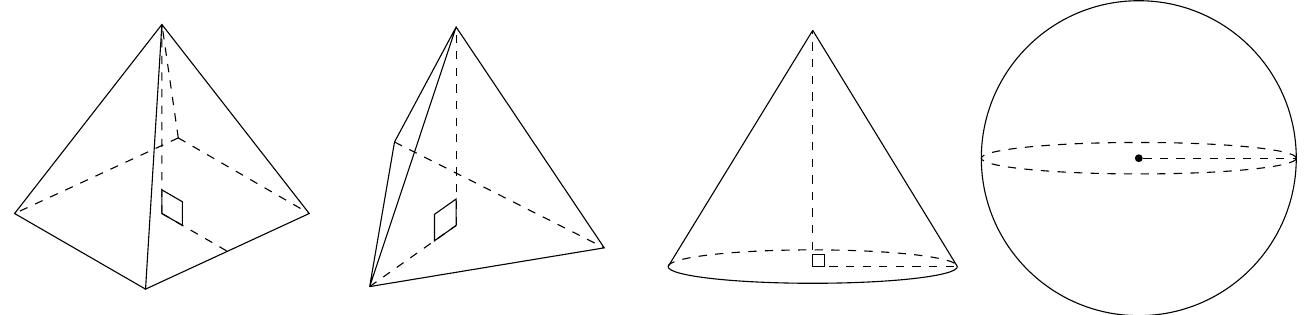
Pyramids are three-dimensional shapes that have a polygon (flat shape) as their base and triangular faces that meet at a single point called the apex. The key feature is that the faces are not perpendicular to the base - they slope inward to meet at the top.
Note
A right pyramid is a special type of pyramid where the line from the apex to the centre of the base is perpendicular to the base. This perpendicular alignment creates symmetrical triangular faces and makes calculations more straightforward.
We name pyramids based on their base shape:
- Square pyramid: has a square base
- Triangular pyramid: has a triangular base
Right cones are similar to pyramids, but instead of a polygon base, they have a circular base. The apex sits directly above the centre of the circular base.
Spheres are perfectly round three-dimensional shapes that look the same from any direction. Every point on the surface is exactly the same distance from the centre.
Understanding key measurements
Before calculating surface areas and volumes, you need to identify these important measurements:
- Base area: The area of the bottom face
- Height (H): The perpendicular distance from apex to base
- Slant height: The diagonal distance from apex to the edge of the base
- Radius (r): Distance from centre to edge (for circles and spheres)
Important
Don't confuse height and slant height! The height is always perpendicular to the base, while the slant height is the diagonal measurement along the sloped face.
Surface area calculations
Surface area means the total area of all the faces or surfaces of a 3D shape. For pyramids and cones, this equals the base area plus the area of all the slanted sides.
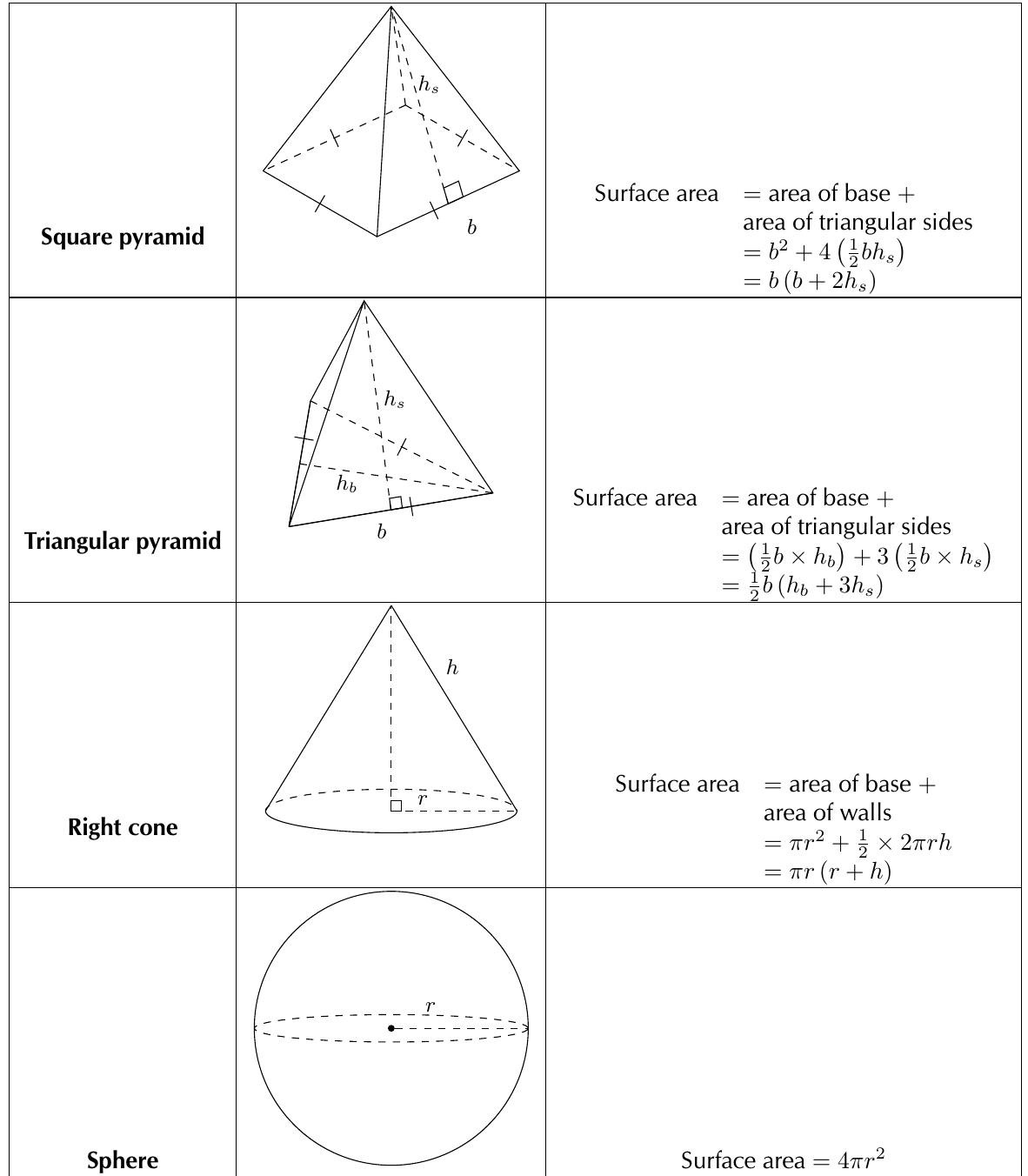
Square pyramids
For a square pyramid with base side length and slant height :
The formula works because:
- is the area of the square base
- is the area of the four triangular faces
Triangular pyramids
For a triangular pyramid with base width , base height , and slant height :
This includes:
- for the triangular base area
- for the three triangular faces
Right cones
For a cone with radius and slant height :
This combines:
- for the circular base
- for the curved surface area
Spheres
For a sphere with radius :
This is a special formula that gives the total surface area of the curved surface.
Example
Worked Example: Finding Surface Area of a Triangular Pyramid
Question: Find the surface area of a triangular pyramid with base width 6 cm and slant height 10 cm.
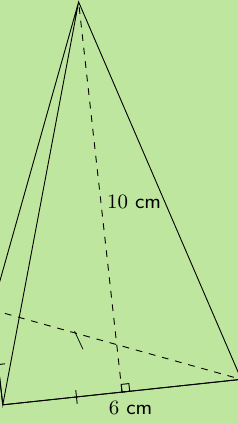
Solution:
Step 1: Find the base area First, find the height of the base triangle using Pythagoras:
Base area =
Step 2: Find the area of the three slanted faces
Area of sides =
Step 3: Add the areas together
Total surface area =
Volume calculations
Volume measures how much space is inside a 3D shape. For pyramids and cones, the volume is always one-third of the base area multiplied by the height.
Key volume formulas
Square pyramid:
Triangular pyramid:
Right cone:
Sphere:
Example
Worked Example: Finding Volume of a Cone
Question: Find the volume of a cone with radius 3 cm and height 11 cm.
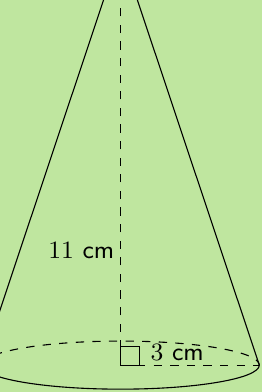
Solution:
Step 1: Identify the given values
- Radius cm
- Height cm
Step 2: Apply the volume formula
Example
Worked Example: Finding Volume of a Sphere
Question: Find the volume of a sphere with radius 4 cm.
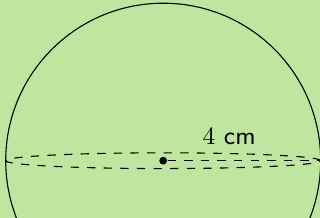
Solution:
Step 1: Apply the sphere volume formula
Problem-solving strategy
Note
Step-by-Step Problem-Solving Approach
When tackling surface area and volume problems, follow this systematic approach:
- Sketch and label the shape with all given measurements
- Identify what you need to find - surface area or volume
- Find any missing measurements using Pythagoras theorem if needed
- Select the correct formula based on the shape type
- Substitute values carefully and calculate step by step
- Check your units - area uses cm², volume uses cm³
Finding slant heights
Often you'll need to calculate the slant height using Pythagoras theorem:
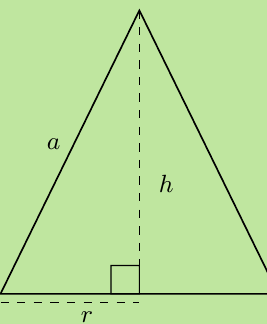
For cones and pyramids: slant height² = height² + radius² (or half base width)
Exam tips and common mistakes
Important
Critical Points to Avoid Common Mistakes
- Always sketch the shape first - this helps you visualise the problem
- Don't confuse height and slant height - height is always perpendicular to the base
- For surface area, remember to include ALL faces (base + sides)
- Volume formulas for pyramids and cones always include the factor ⅓
- When finding missing measurements, set up your Pythagoras equation carefully
- Check whether the given measurement is radius or diameter for circles
- Round your final answer according to the question requirements
Summary
Key Points to Remember:
- Surface area = area of base + area of all slanted sides
- Volume of pyramids and cones =
- Sphere formulas both contain 4 and π: and
- Always use Pythagoras when you need to find slant heights from given height and radius
- Sketch and label every problem before starting calculations