The Effect of Multiplying a Dimension by a Factor of k (Grade 10 NSC Matric Mathematics): Revision Notes
📚Revision Notes
The Effect of Multiplying a Dimension by a Factor of k
What is dimensional scaling?
Dimensional scaling occurs when one or more dimensions of a 3D shape are multiplied by a constant factor, called k. This scaling affects both the volume and surface area of the shape in predictable ways.
When dimensions are scaled, the volume and surface area change according to specific mathematical relationships. Understanding these patterns helps you calculate new measurements without having to work through complex formulas every time.
Note
The beauty of dimensional scaling is that it follows consistent mathematical patterns. Once you understand these relationships, you can quickly determine how scaling affects any 3D shape without lengthy calculations.
Key scaling relationships
The effect of multiplying dimensions by a factor k depends on how many dimensions are changed:
Important
Fundamental Scaling Rules:
- One dimension scaled by k: Volume scales by k
- Two dimensions scaled by k: Volume scales by k²
- All three dimensions scaled by k: Volume scales by k³, Surface area scales by k²
These relationships are the foundation for all dimensional scaling calculations.
Scaling effects on rectangular prisms
Let's examine how scaling affects a rectangular prism with dimensions length (l), breadth (b), and height (h).
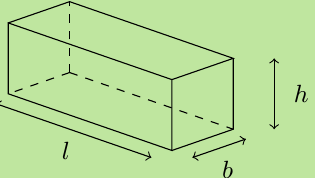
Original formulas
- Volume:
- Surface area:
When one dimension is multiplied by k
Consider when the height is multiplied by 5. The volume increases by exactly the scaling factor, but the surface area calculation becomes more complex:
- New volume:
- New surface area:
Note
When only one dimension is scaled, the volume relationship is straightforward: multiply the original volume by the scaling factor. However, surface area doesn't follow a simple scaling rule in this case.
When two dimensions are multiplied by k
When both length and height are multiplied by 5, we see the k² relationship emerge:
- New volume:
- New surface area:
The volume scales by times the original.
When all three dimensions are multiplied by k
When all dimensions are multiplied by k, we get the most important scaling relationships:
- New volume:
- New surface area:
Important
Universal Scaling Laws: When ALL dimensions are scaled by factor k:
- Volume scales by k³
- Surface area scales by k²
These are the most commonly tested relationships in examinations.
Scaling effects on cylinders
For cylinders with radius r and height h, the same principles apply but with circular geometry.
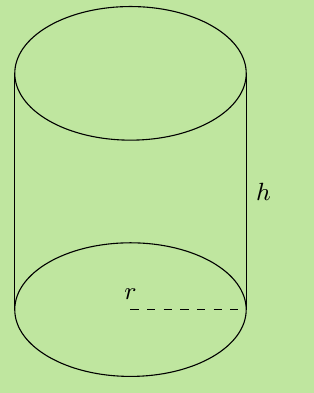
Original formulas
- Volume:
- Surface area:
When radius is multiplied by k
Since the radius appears squared in the volume formula, scaling the radius has a squared effect on volume:
- New volume:
- New surface area:
Note
Notice how scaling the radius of a cylinder affects the volume in the same way as scaling two dimensions of a rectangular prism - both result in k² scaling for volume.
Worked example 1: Scaling base dimensions
Example
Worked Example: Scaling Base Dimensions
Question: Consider a rectangular prism with height 4 cm and base lengths of 3 cm. Calculate the new surface area and volume if the base lengths are multiplied by 3.
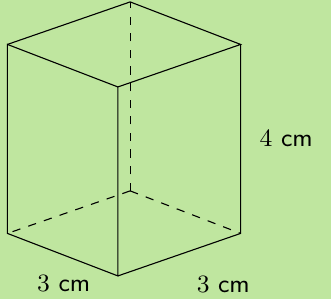
Solution:
Step 1: Calculate original volume and surface area
Step 2: Calculate new dimensions Two dimensions are multiplied by 3, so:
Step 3: Express as factors
Worked example 2: Proving scaling relationships
Example
Worked Example: Proving Scaling Relationships
Question: Prove that if the height of a rectangular prism is multiplied by k, the volume increases by factor k.
Solution:
Step 1: Original volume =
Step 2: New volume with height multiplied by k
Step 3: Therefore, multiplying height by k increases volume by factor k.
Worked example 3: Cylinder scaling
Example
Worked Example: Cylinder Scaling
Question: For a cylinder with radius r and height h, find the new volume and surface area when radius is multiplied by k.
Solution:
Step 1: Original measurements
Step 2: New measurements with radius kr
Common exam patterns
Note
Exam Tip 1: Identify which dimensions are scaled Always clearly identify which dimensions are being multiplied by the scaling factor before applying the rules. This prevents confusion and ensures you apply the correct scaling relationship.
Note
Exam Tip 2: Use the scaling rules
- Volume scaling:
- Surface area scaling: only when ALL dimensions are scaled by k
Memorise these patterns to save time during examinations.
Note
Exam Tip 3: Show your working Examiners award marks for showing the step-by-step application of scaling factors, not just the final answer. Always demonstrate your understanding of the scaling process.
Important
Common Mistake to Avoid Don't assume surface area always scales by - this only applies when ALL dimensions are scaled by the same factor k. When only some dimensions are scaled, surface area calculations become more complex and don't follow simple scaling rules.
Summary
Key Points to Remember:
- One dimension scaled by k: Volume scales by k
- Two dimensions scaled by k: Volume scales by k²
- All dimensions scaled by k: Volume scales by k³ and surface area scales by k²
- Scaling patterns are predictable: Use the rules rather than recalculating from scratch
- Always identify which dimensions are being scaled before applying the scaling relationships