Mutually Exclusive and Complementary Events (Grade 10 NSC Matric Mathematics): Revision Notes
📚Revision Notes
Mutually Exclusive and Complementary Events
What are mutually exclusive events?
Mutually exclusive events are events that cannot happen at the same time. When one event occurs, the other cannot possibly occur in the same experiment. This is one of the most fundamental concepts in probability theory and understanding it correctly is essential for solving many probability problems.
Key characteristics of mutually exclusive events
The defining features of mutually exclusive events help us identify when we can use special probability rules:
- If event A happens, event B cannot happen (and vice versa)
- The events have no outcomes in common
- The intersection of the two events is empty:
- In a Venn diagram, mutually exclusive events appear as separate circles that do not overlap
Note
Understanding Venn diagrams is crucial for visualising mutually exclusive events. When events are mutually exclusive, their circles in a Venn diagram will never touch or overlap, making it immediately clear that they cannot occur simultaneously.
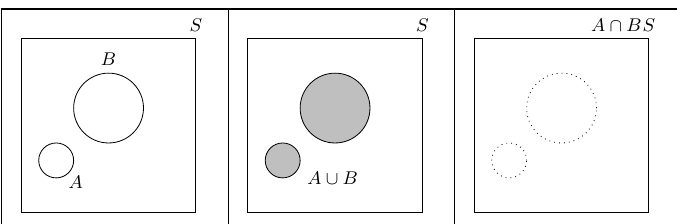
The Venn diagrams above show different set relationships. The leftmost diagram shows two separate events A and B that don't overlap - this represents mutually exclusive events.
Important formula for mutually exclusive events
When dealing with mutually exclusive events, we can use a simplified version of the addition rule. For mutually exclusive events only, the probability of either event A or event B occurring is:
Important
This formula only works when the events are mutually exclusive. If events can occur together, you need to subtract the intersection using the general formula: . Using the wrong formula is a common exam mistake!
Example
Worked Example: Proving Events Are Mutually Exclusive
Problem: We roll two dice and consider these events:
- Event A: The sum of the dice equals 8
- Event B: At least one die shows a 1
Show that these events are mutually exclusive.
Solution:
Step 1: Draw the sample space and identify both events.
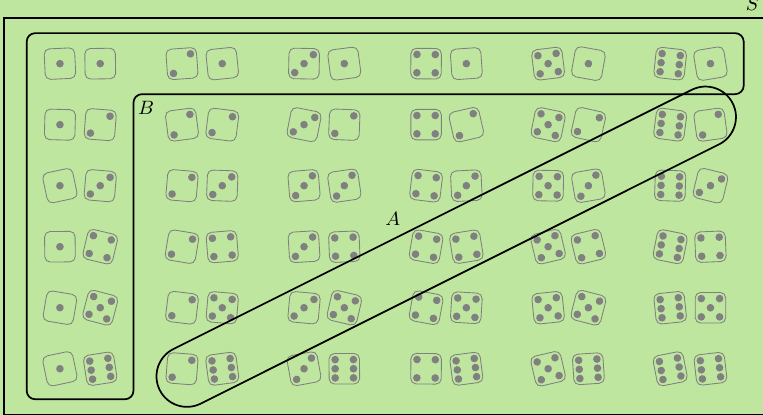
Step 2: Check for intersection.
Looking at the diagram, we can see that there are no outcomes that belong to both events A and B. When at least one die shows 1, the maximum possible sum is 7 (1,6 or 6,1). Therefore, it's impossible to have a sum of 8 when one die shows 1.
Since there are no common elements, the events are mutually exclusive.
What are complementary events?
Complementary events are a special type of mutually exclusive events with an additional property. The complement of an event A contains all outcomes that are not in event A. Think of complementary events as representing "everything else" that could happen in the sample space.
Key properties of complementary events
Complementary events have unique characteristics that make them particularly useful in probability calculations:
- We write the complement of A as A' or not(A)
- Complementary events are always mutually exclusive:
- Together, complementary events cover the entire sample space:
- The probabilities of complementary events always sum to 1:
Note
The key difference between general mutually exclusive events and complementary events is that complementary events must cover the entire sample space together, while general mutually exclusive events might leave some outcomes uncovered.
Important formulas for complementary events
These four fundamental relationships define complementary events:
Important
Essential Complementary Event Formulas:
- (no overlap between an event and its complement)
- (together they cover the whole sample space)
- (probabilities sum to 1)
- (useful for finding complement probabilities)
These formulas are frequently tested and formula 4 is particularly useful when it's easier to calculate the complement probability.
Example
Worked Example: Using Venn Diagrams with Complementary Events
Problem: In a survey, 70 people were asked about product usage:
- 25 people use product A
- 35 people use product B
- 15 people use neither product
Use a Venn diagram to find how many people:
- Use product A only
- Use product B only
- Use both products
Solution:
Step 1: Summarise the given information.
- Sample space size:
- People using A:
- People using B:
- People using neither: 15, so people using at least one:
Step 2: Find the intersection using the union formula. We know:
Converting to numbers:
Step 3: Draw and complete the Venn diagram.
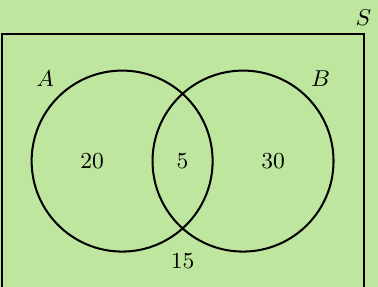
Step 4: Calculate the final answers.
- Product A only: people
- Product B only: people
- Both products: people
Exam tips for mutually exclusive and complementary events
Understanding these concepts thoroughly will help you approach exam questions with confidence:
- Check for overlap: Mutually exclusive events have no common outcomes - always verify this before using simplified formulas
- Use the addition rule carefully: only works for mutually exclusive events
- Complement probabilities: Always remember that - this can often provide a shortcut to solutions
- Venn diagrams: Draw them to visualise relationships between events - they prevent calculation errors
- Real-world examples: Mutually exclusive events cannot happen together (like winning and losing the same game)
Note
When working with probability problems, always ask yourself: "Can these events happen at the same time?" If the answer is no, you're dealing with mutually exclusive events and can use the simplified addition rule.
Summary
Key Points to Remember:
- Mutually exclusive events cannot occur at the same time and have no intersection
- For mutually exclusive events:
- Complementary events are mutually exclusive events where one is "everything not in the other"
- Complementary events always satisfy:
- Use Venn diagrams to visualise and solve probability problems involving these events
- Always check whether events can occur together before choosing which formula to use