Summary (Grade 10 NSC Matric Mathematics): Revision Notes
📚Revision Notes
Summary
Basic probability concepts
Probability is a mathematical way of measuring how likely something is to happen. It uses numbers between 0 and 1 to describe the chance of different outcomes occurring.
An experiment refers to any process where the outcome is uncertain. This could be rolling a dice, flipping a coin, or drawing a card from a deck.
Note
Think of an experiment as any situation where you can't predict the exact result beforehand, even though you know what results are possible.
An outcome is a single result that can occur from an experiment. For example, when rolling a dice, getting a "3" is one possible outcome.
The sample space is the complete set of all possible outcomes for an experiment. We use the symbol S to represent the sample space. The size of the sample space, written as n(S), tells us the total number of possible outcomes.
An event is a specific collection of outcomes that we are interested in. We use the letter E to represent an event, and n(E) represents the number of outcomes in that event.
Probability calculations
Theoretical probability
When all outcomes in an experiment have an equal chance of occurring, we can calculate the exact theoretical probability using the formula:
Important
Theoretical Probability Formula:
This means: Probability of event E = Number of favourable outcomes ÷ Total number of possible outcomes
Relative frequency
The relative frequency of an event is found through experimentation. It represents how often an event actually occurs when we repeat the experiment many times:
Note
Relative frequency becomes more accurate as the number of trials increases. This is why larger sample sizes give better estimates of true probability.
Key probability properties
- A probability of 0 means the event will never occur
- A probability of 1 means the event will always occur
- A probability of 0.5 means the event occurs half the time
- Probabilities can be written as decimals, fractions, or percentages
- The probability of the entire sample space is always 1: P(S) = 1
Set theory in probability
Union of sets
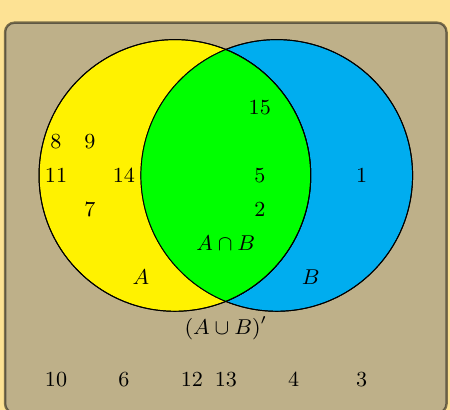
The union of two sets A and B, written as A ∪ B, contains all elements that are in at least one of the two sets. In probability terms, this represents outcomes that belong to event A or event B (or both).
Important
Union Formula:
Remember to subtract the intersection to avoid double-counting outcomes that belong to both events.
Intersection of sets
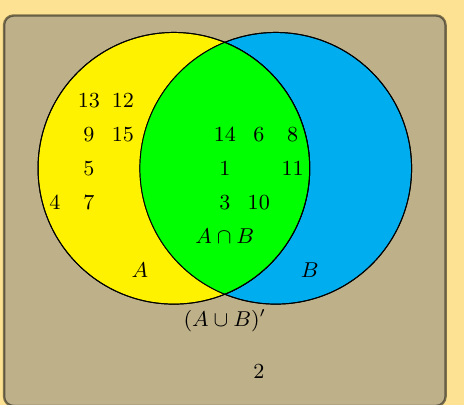
The intersection of two sets A and B, written as A ∩ B, contains all elements that are in both sets simultaneously. This represents outcomes that belong to both event A and event B.
Complement of a set
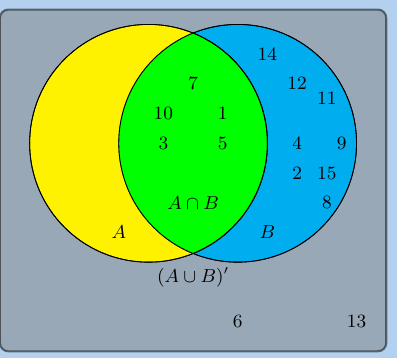
The complement of set A, written as A' or "not A", contains all elements that are not in set A. In probability, this represents all outcomes where event A does not occur.
Note
The complement is useful when it's easier to calculate what doesn't happen rather than what does happen.
Special types of events
Mutually exclusive events
Mutually exclusive events are events that cannot occur at the same time. When one event happens, the other cannot happen.
Important
For mutually exclusive events A and B:
- A ∩ B = ∅ (their intersection is empty)
- P(A ∩ B) = 0
- P(A ∪ B) = P(A) + P(B) (simple addition rule applies)
Complementary events
Complementary events are special pairs of mutually exclusive events that together cover the entire sample space. Event A and its complement A' are complementary because:
Important
Properties of Complementary Events:
- A ∩ A' = ∅ (they are mutually exclusive)
- A ∪ A' = S (they cover the entire sample space)
- P(A) + P(A') = 1 (their probabilities sum to 1)
Exam tips
Note
Essential Exam Strategies:
- Always check that your calculated probabilities are between 0 and 1
- When working with Venn diagrams, carefully count elements in each region
- Remember that "or" typically means union (∪) and "and" typically means intersection (∩)
- For mutually exclusive events, you can simply add their probabilities: P(A ∪ B) = P(A) + P(B)
- Use the complement rule when it's easier to calculate what doesn't happen: P(A) = 1 - P(A')
Summary
Key Points to Remember:
- Probability measures likelihood using numbers between 0 and 1
- Sample space contains all possible outcomes; events are subsets of outcomes we're interested in
- Union (∪) means "at least one", intersection (∩) means "both", complement (') means "not"
- Mutually exclusive events cannot happen together; complementary events are opposites that cover everything
- The sum of all probabilities in a complete set of outcomes always equals 1