Theoretical Probability (Grade 10 NSC Matric Mathematics): Revision Notes
📚Revision Notes
Theoretical Probability
Understanding uncertainty and experiments
Probability helps us describe uncertain events that happen around us every day. When you toss a coin, you cannot know beforehand whether it will land heads or tails. When your favourite sports team plays a match, you cannot predict the final score with certainty. These uncertain situations can all be analysed using probability theory.
Note
The concept of uncertainty is fundamental to probability. Even with perfect knowledge of the initial conditions, we cannot predict the exact outcome of many real-world processes due to their inherent randomness.
Key terminology in probability
Understanding probability begins with mastering four essential terms that form the foundation of all probability calculations.
Experiment
An experiment is any uncertain process where we cannot predict the exact outcome beforehand. Examples include tossing a coin, rolling dice, or observing the final score of a football match.
Outcome
An outcome is a single possible result from an experiment. For instance, when tossing a coin, "heads" is one outcome and "tails" is another outcome.

Sample space
The sample space is the complete set of all possible outcomes for an experiment. We use the symbol S to represent the sample space, and n(S) to show how many outcomes are in the sample space.
Let's examine three different experiments and their sample spaces:
Experiment 1: Coin toss A coin can land in only two ways - heads (H) or tails (T). Therefore:
- Sample space: S = {H, T}
- Size of sample space: n(S) = 2
Experiment 2: Rolling two dice and adding the dots Each die can show 1, 2, 3, 4, 5, or 6 dots. When rolling two dice, there are 6 × 6 = 36 different combinations possible.
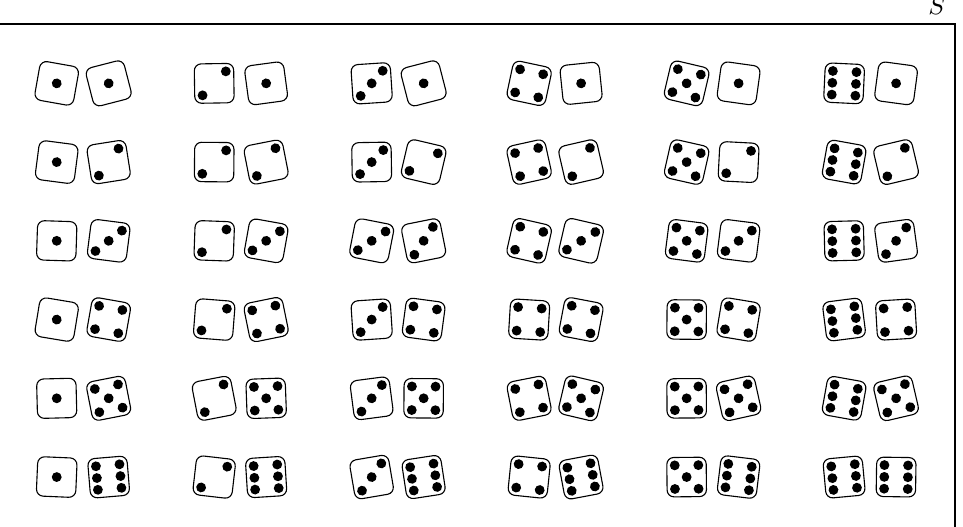
The sample space contains all 36 equally likely combinations, so n(S) = 36.
Experiment 3: Football match final score Two teams can each score 0, 1, 2, 3, or more goals. The sample space includes all possible score combinations like (0-0), (1-0), (2-1), etc.

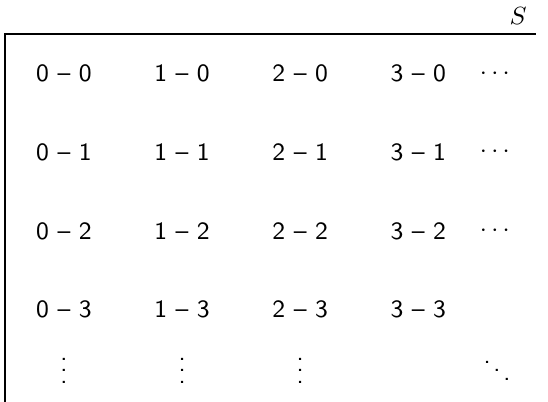
Note
Since there is no upper limit to how many goals teams can score, this sample space is infinitely large. This demonstrates that not all experiments have finite sample spaces.
Event
An event is a specific set of outcomes from the sample space that we are particularly interested in. We use the letter E to represent an event, and n(E) to show how many outcomes are in that event.
Examples of events:
- Experiment 1: "The coin lands heads up" → E = {H}, so n(E) = 1
- Experiment 2: "The sum of the dice equals 8" → E contains 5 outcomes, so n(E) = 5
- Experiment 3: "The first team wins" → E contains infinitely many outcomes where the first score is greater than the second
What is theoretical probability?
Theoretical probability is a number between 0 and 1 that tells us how likely an event is to occur. We can express probability in three different ways:
- As a decimal: For example, 0.75
- As a percentage: For example, 75%
- As a fraction: For example, ¾
Important probability facts
Important
Essential Probability Values:
- P(E) = 0 means the event will never happen
- P(E) = 1 means the event will always happen
- P(E) = 0.5 means the event happens half the time, or 1 time out of every 2
The theoretical probability formula
When all possible outcomes in a sample space are equally likely to occur, we can calculate the exact theoretical probability using this formula:
Where:
- P(E) = probability of event E
- n(E) = number of outcomes in the event
- n(S) = total number of outcomes in the sample space
Important
Critical Condition: This formula only works when all outcomes are equally likely. For example, a fair coin has equally likely outcomes (heads and tails each have a 50% chance), but football match scores are not equally likely (a 1-1 draw is much more common than an 11-15 result).
Worked example: Calculating theoretical probabilities
Example
Worked Example: Calculating Probability for Coin and Dice Experiments
Question: What is the theoretical probability of each event in our first two experiments?
Solution:
Step 1: Identify n(S) for each experiment
- Experiment 1 (coin): n(S) = 2
- Experiment 2 (dice): n(S) = 36
Step 2: Identify n(E) for each event
- Experiment 1 - "coin lands heads": n(E) = 1
- Experiment 2 - "sum equals 8": n(E) = 5
Step 3: Apply the formula
For the coin experiment:
For the dice experiment:
Note that we cannot calculate theoretical probability for the football match example because the outcomes (different scores) are not equally likely to occur.
When to use theoretical probability
Important
Conditions for Using Theoretical Probability:
Theoretical probability can only be used when:
- All possible outcomes are known
- All outcomes are equally likely to happen
- The sample space is finite (has a countable number of outcomes)
If these conditions are not met, we need to use other methods to determine probability.
Remember!
Summary
Key Points to Remember:
- Probability measures how likely an event is, always between 0 and 1
- The sample space contains all possible outcomes of an experiment
- An event is a specific set of outcomes we are interested in
- Theoretical probability formula:
- This formula only works when all outcomes are equally likely
- Practice identifying sample spaces and events to master probability calculations