Union and Intersection (Grade 10 NSC Matric Mathematics): Revision Notes
📚Revision Notes
Union and Intersection
Understanding union and intersection
When working with sets in probability, we often need to combine sets or find what they have in common. Two fundamental operations help us do this: union and intersection.
Union of sets
Union creates a new set that contains all elements from both original sets. Think of it as combining everything together.
Note
Definition: The union of two sets is a new set that contains all elements that are in at least one of the two sets.
Notation: The union is written as or "A or B"
Key points about union:
- Includes all elements from set A
- Includes all elements from set B
- If an element appears in both sets, it's only counted once
- Uses "OR" logic - an element belongs to the union if it's in A OR B (or both)
Intersection of sets
Intersection creates a new set that contains only the elements that appear in both original sets.
Note
Definition: The intersection of two sets is a new set that contains all elements that are in both sets.
Notation: The intersection is written as or "A and B"
Key points about intersection:
- Only includes elements that exist in both set A and set B
- If sets have no common elements, the intersection is empty
- Uses "AND" logic - an element belongs to the intersection if it's in A AND B
Visualising union and intersection with Venn diagrams
Venn diagrams help us see union and intersection operations clearly. Different arrangements of sets produce different results.
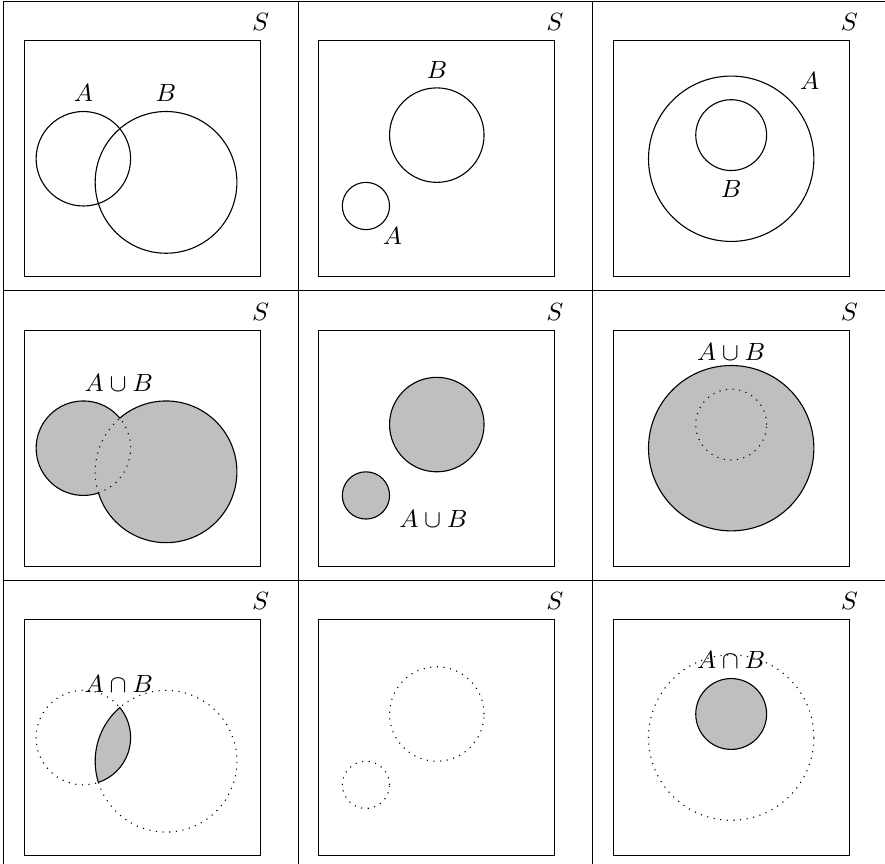
The diagram above shows three common configurations:
Overlapping sets
Note
When sets A and B overlap:
- Union (): All shaded areas (everything in either circle)
- Intersection (): Only the overlapping region (where circles meet)
Separate sets (disjoint)
Note
When sets A and B don't overlap:
- Union (): Both complete circles
- Intersection (): Empty (no common elements)
Nested sets
Note
When one set is completely inside another:
- Union (): The larger circle (since it contains everything)
- Intersection (): The smaller circle (completely contained within the larger)
Worked examples
Example 1: Finding intersection
Example
Worked Example: Finding Intersection
A group of learners are given a Venn diagram with numbered elements.
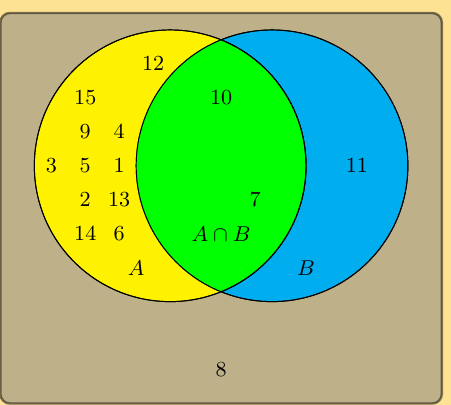
Question: Which set best describes the event set of ?
Solution: To find , we need elements that are in BOTH set A and set B.
Looking at the diagram:
- Elements only in A (yellow region): 15, 9, 4, 3, 5, 1, 2, 13, 14, 6
- Elements only in B (blue region): 11
- Elements in both A and B (green intersection): 12, 10, 7
- Elements outside both sets: 8
Therefore,
Exam tip: Always look for the overlapping region when finding intersection.
Example 2: Finding union
Example
Worked Example: Finding Union
Using a similar Venn diagram setup:
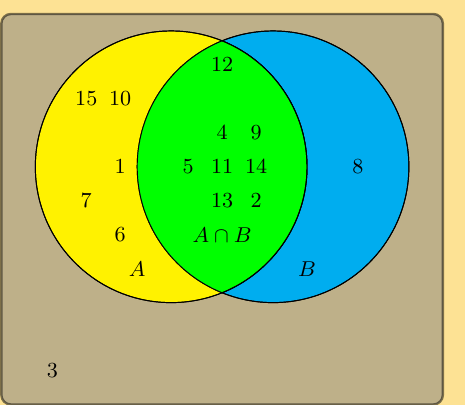
Question: Which set best describes the event set of ?
Solution: To find , we need ALL elements that are in A OR B (or both).
Looking at the diagram:
- All elements in A: 15, 10, 1, 7, 6, plus intersection elements 4, 5, 2, 9, 11, 12, 13, 14
- All elements in B: 8, plus intersection elements 4, 5, 2, 9, 11, 12, 13, 14
- Elements outside both sets: 3
Combining everything in either set A or B:
Exam tip: For union, include everything except elements completely outside both circles.
Common exam traps
Important
Avoid These Common Mistakes:
- Don't double-count elements: In union, elements appearing in both sets are only listed once
- Empty intersection: When sets don't overlap, (empty set)
- Check the sample space: Make sure you identify what's inside and outside the universal set S
- Read carefully: Union uses "OR" logic, intersection uses "AND" logic
Problem-solving method
Note
Systematic Approach to Union and Intersection Problems:
- Identify the operation: Look for (union) or (intersection)
- Examine the Venn diagram: Locate sets A and B clearly
- For intersection: Find only the overlapping region
- For union: Find all elements in either circle
- List elements systematically: Work through each region methodically
- Check your answer: Ensure no elements are missed or double-counted
Summary
Key Points to Remember:
- Union (): Contains all elements from both sets - think "everything combined"
- Intersection (): Contains only common elements - think "what's shared"
- Union uses OR logic: Element is included if it's in A or B (or both)
- Intersection uses AND logic: Element is included only if it's in A and B
- Venn diagrams make it visual: Overlapping regions show intersection, all shaded areas show union