Collecting Data (Grade 10 NSC Matric Mathematics): Revision Notes
📚Revision Notes
Collecting Data
Introduction to data and statistics
When conducting experiments or surveys, researchers often collect vast amounts of information. Statistics helps us summarise and make sense of this information by highlighting the most important aspects while ensuring we don't accidentally overlook crucial details.
Data forms the foundation of all statistical analysis. Understanding different types of data is essential for choosing the correct statistical methods and drawing accurate conclusions.
Note
Proper data classification is the first step in any statistical analysis. Without understanding what type of data you're working with, you cannot select appropriate analytical methods or draw valid conclusions.
What is data?
Data refers to pieces of information that have been observed and recorded from experiments or surveys.
Important
The word "data" is plural (the singular form is "datum"), so we say "the data are" rather than "the data is".
Types of data
There are two main categories of data: quantitative data and qualitative data. Understanding the distinction between these categories is crucial for selecting appropriate statistical methods.
Quantitative data
Quantitative data are data that can be expressed as numbers. This type of data allows us to perform mathematical calculations and statistical analysis.
Quantitative data can be further divided into two subcategories:
Discrete quantitative data
- Represented by integers (whole numbers)
- Usually occurs when counting things
- Examples: number of learners in a class, number of SMS messages sent, number of goals scored

Note
Discrete data always involves counting distinct, separate items that cannot be broken down into smaller units. You cannot have 2.5 students in a class or send 3.7 text messages.
Continuous quantitative data
- Represented by real numbers (can include decimals)
- Can take any value within a range
- Usually occurs when measuring things
- Examples: height of a person, mass of an object, distance travelled by a car, duration of a phone call
Qualitative data
Qualitative data are data that cannot be written as numbers. Instead, they describe qualities, characteristics, or categories.
There are two common types of qualitative data:
Categorical data
- Comes from a limited number of possible categories
- Examples: favourite drink, colour of a mobile phone, language spoken at home

Anecdotal data
- Takes the form of interviews, stories, or personal experiences
- Examples: personal experience with a product, opinions about someone's behaviour
Converting between data types
Important
Sometimes categorical qualitative data can be converted into quantitative data by counting how many times each category appears. This is a powerful technique that allows us to apply quantitative analysis methods to originally qualitative information.
For example, if we survey 30 learners about their mobile phone colours and get responses like those shown in the colour grid above, we can count the frequency of each colour:
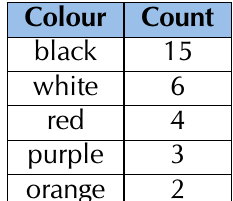
This converts the original qualitative responses into discrete quantitative data (counts).
Worked examples
Example
Worked Example 1: Identifying data types
Question: Thembisile asked 20 classmates how many SMS messages they sent the previous day. The results were:
| 20 | 3 | 0 | 14 | 30 | 9 | 11 | 13 | 13 | 15 |
|---|---|---|---|---|---|---|---|---|---|
| 9 | 13 | 16 | 12 | 13 | 7 | 17 | 14 | 9 | 13 |
Is this data set qualitative or quantitative? Explain your answer.
Solution: This is quantitative and discrete data because the number of SMS messages is a count represented by integers (whole numbers).
Example
Worked Example 2: Cellular provider survey
Question: Thembisile surveyed 20 learners about their cellular providers. The results were:

Is this data set qualitative or quantitative? Explain your answer.
Solution: This is categorical qualitative data because each response represents a category (cellular provider name) rather than a numerical value.
Example
Worked Example 3: Converting qualitative to quantitative data
When we have categorical data like mobile network providers, we can convert it to quantitative data by counting frequencies:
- Vodacom: 8 responses
- MTN: 6 responses
- Cell C: 3 responses
- Virgin Mobile: 2 responses
- 8-ta: 1 response
This frequency count becomes discrete quantitative data.
Important
Exam Tips:
- Always identify the data type first before attempting statistical calculations
- Look for key words: "count", "number of" usually indicates discrete data
- Measurements like height, weight, time are usually continuous data
- Categories or names indicate qualitative data
- Remember: You can count qualitative categories to create quantitative data
Summary
Key Points to Remember:
- Data are pieces of information collected from experiments or surveys (note: "data" is plural)
- Quantitative data can be written as numbers and allow mathematical calculations
- Discrete quantitative data use whole numbers (integers) and come from counting
- Continuous quantitative data can be any real number and come from measuring
- Qualitative data cannot be written as numbers and describe categories or qualities
- Categorical qualitative data can sometimes be converted to quantitative data by counting frequencies