Defining Ratios in the Cartesian Plane (Grade 10 NSC Matric Mathematics): Revision Notes
📚Revision Notes
Defining Ratios in the Cartesian Plane
Introduction to extended trigonometric definitions
Trigonometric ratios can be extended beyond right-angled triangles to work with any angle in the Cartesian plane. This extension allows us to define trigonometric functions for angles of any size, not just those between 0° and 90°.
Note
The key insight is that trigonometric ratios depend only on the size of the angle, not on the lengths of the triangle's sides. When we plot any point on the Cartesian plane and draw a line from the origin to that point, we can create a right-angled triangle and calculate trigonometric ratios using the coordinates.
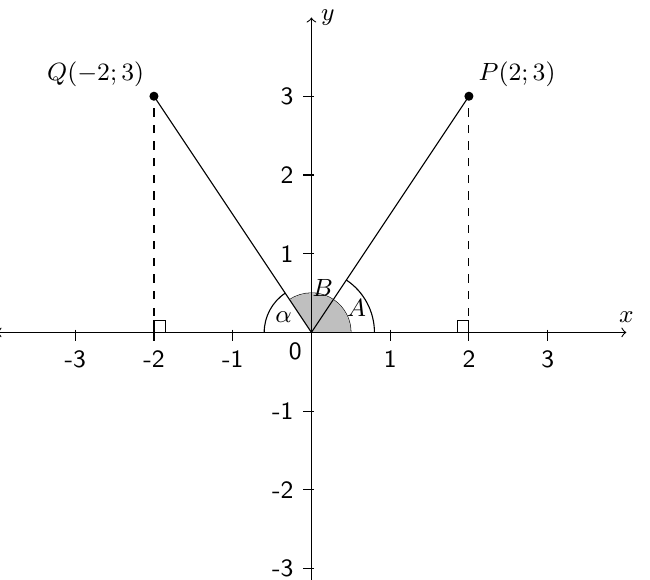
Finding angles using coordinate points
To find an angle when given specific coordinate points, follow these steps:
- Plot the point on the Cartesian plane
- Draw a line from the origin (0,0) to the point
- Create a right-angled triangle by drawing a perpendicular line to the x-axis
- Use trigonometric ratios to calculate the angle
For a point with coordinates , we can calculate the angle using:
Example
Worked Example: Finding an angle from coordinates
For point P(2,3):
- Opposite side = 3, Adjacent side = 2
- Therefore
General definitions of trigonometric ratios
When working with any point P(x,y) on the Cartesian plane, we can define all trigonometric ratios in terms of the coordinates and the radius r.
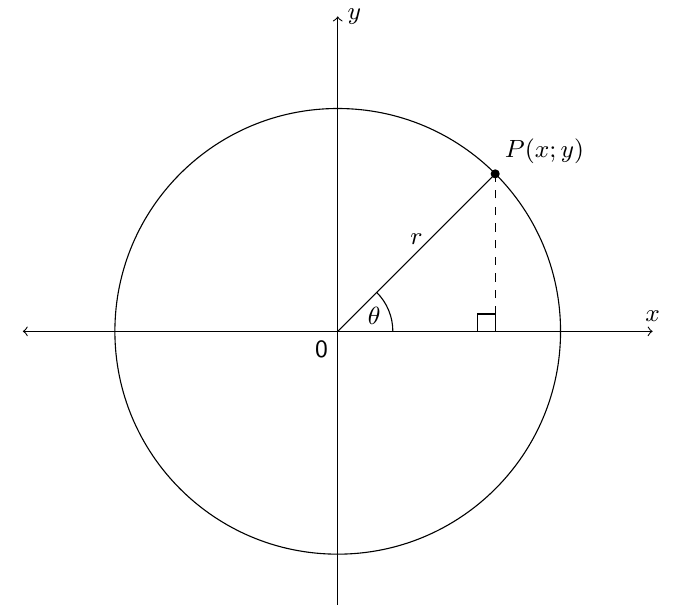
Note
The radius r is the distance from the origin to point P, calculated using Pythagoras' theorem:
The six trigonometric ratios
Primary ratios:
- (opposite/hypotenuse)
- (adjacent/hypotenuse)
- (opposite/adjacent)
Reciprocal ratios:
- (1/sin θ)
- (1/cos θ)
- (1/tan θ)
Important
The radius r is always positive since it represents a distance.
The CAST diagram
The CAST diagram shows which trigonometric ratios are positive in each quadrant of the Cartesian plane.
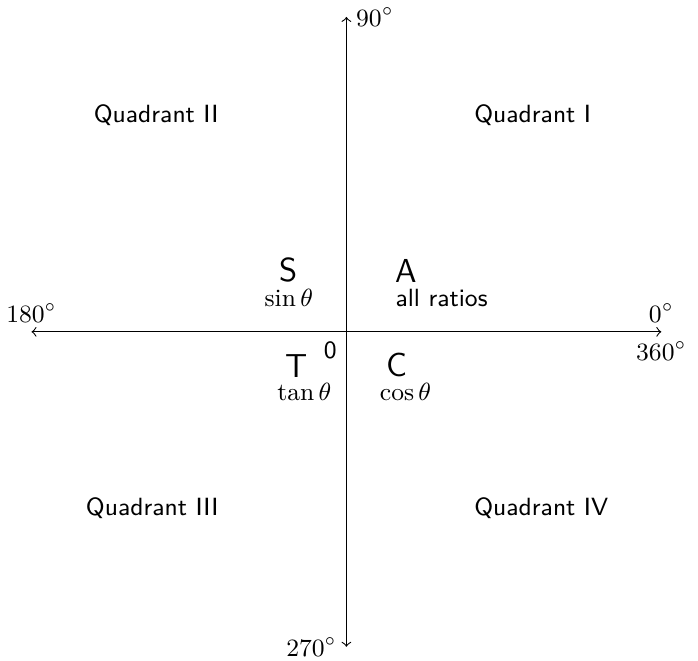
Quadrant signs explained
Note
Quadrant I (0° to 90°):
- All ratios are positive
- Both x and y coordinates are positive
Quadrant II (90° to 180°):
- Sin and cosec are positive
- y is positive, x is negative
Quadrant III (180° to 270°):
- Tan and cot are positive
- Both x and y coordinates are negative
Quadrant IV (270° to 360°):
- Cos and sec are positive
- x is positive, y is negative
Memory aid: "All Students Take Chemistry"
Special angles in the Cartesian plane
Two important special angles have exact values that are essential to memorise.
Important
Angle of 0° When θ = 0°, the point lies on the positive x-axis:
Angle of 90° When θ = 90°, the point lies on the positive y-axis:
Worked example 1: Ratios in the Cartesian plane
Example
Worked Example: Calculating trigonometric ratios
Given: Point P(-3,4) with angle θ between OP and the positive x-axis.
Find: cos θ, 3 tan θ, and ½ cosec θ
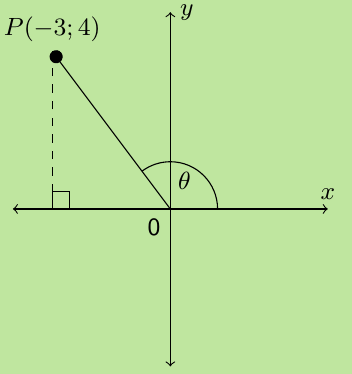
Step 1: Calculate the radius using Pythagoras' theorem
Step 2: Substitute values into the required ratios
- x = -3, y = 4, r = 5
Step 3: Calculate each ratio
Worked example 2: Finding unknown coordinates
Example
Worked Example: Finding coordinates and proving identities
Given: Angle XOK = θ in the third quadrant, where X is on the positive x-axis and K(-5,y). OK = 13 units.
Find: The value of y and prove that
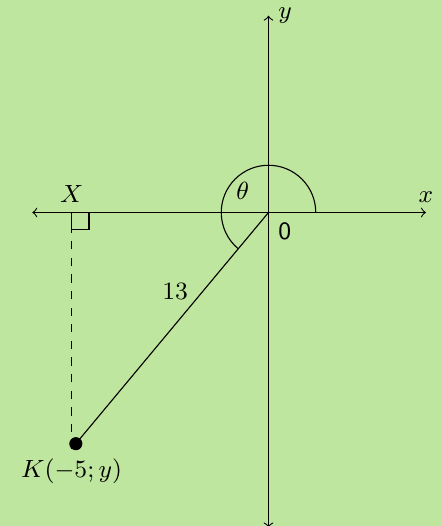
Step 1: Use Pythagoras' theorem to find y
Step 2: Determine the correct sign Since θ is in the third quadrant, y must be negative. Therefore:
Step 3: Prove the identity With x = -5, y = -12, r = 13:
LHS:
RHS:
Since LHS = RHS, the identity is proven.
Exam tips
Note
- Always sketch the point on the coordinate plane when solving problems
- Remember that r is always positive as it represents distance
- Use the CAST diagram to determine the sign of trigonometric ratios
- Check which quadrant the angle lies in before determining signs
- When solving without a calculator, exact values and fractions are expected
Summary
Key Points to Remember:
- Trigonometric ratios can be extended to any angle using coordinates in the Cartesian plane
- The general definitions are: , , , with
- The CAST diagram shows which ratios are positive: All (I), Sin (II), Tan (III), Cos (IV)
- Special angles have exact values: , , , ,
- Always sketch the problem to visualise the quadrant and determine the correct signs