Defining the Trigonometric Ratios (Grade 10 NSC Matric Mathematics): Revision Notes
📚Revision Notes
Defining the Trigonometric Ratios
Introduction to trigonometric ratios
Trigonometric ratios are fundamental mathematical relationships that connect the angles and sides of right-angled triangles. These ratios are based on the principle that similar triangles have proportional sides, which means the ratios between corresponding sides remain constant regardless of the triangle's size.
The three basic trigonometric ratios - sine, cosine, and tangent - form the foundation of all trigonometry. Understanding these ratios is essential for solving problems involving right-angled triangles and is a key requirement for your NSC Mathematics exam.
Note
Trigonometric ratios are universal - once you understand them for one right-angled triangle, you can apply the same principles to any right-angled triangle, regardless of its size. This makes them incredibly powerful tools in mathematics.
Understanding right-angled triangles
Before learning the trigonometric ratios, you must understand how to identify the different sides of a right-angled triangle in relation to a specific angle.
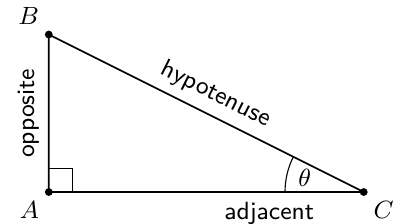
In any right-angled triangle, there are three sides that have special names depending on which angle you are considering:
-
Hypotenuse: This is always the longest side of the triangle and is directly opposite the right angle (90°). The hypotenuse never changes position - it is always opposite the right angle.
-
Opposite side: This is the side that is directly across from (opposite to) the angle you are working with. The opposite side changes depending on which angle you are considering.
-
Adjacent side: This is the side that is next to (adjacent to) the angle you are working with and helps form that angle. Like the opposite side, the adjacent side changes depending on which angle you are considering.
Important
Always identify the right angle first, then locate the hypotenuse, and finally determine the opposite and adjacent sides based on the specific angle mentioned in the question. This systematic approach will prevent confusion during exams.
The three trigonometric ratios
The trigonometric ratios are defined using the relationships between the sides of a right-angled triangle. For any angle θ (theta) in a right-angled triangle, there are three fundamental ratios.
Sine ratio (sin θ)
The sine of an angle is the ratio of the length of the opposite side to the length of the hypotenuse.
Cosine ratio (cos θ)
The cosine of an angle is the ratio of the length of the adjacent side to the length of the hypotenuse.
Tangent ratio (tan θ)
The tangent of an angle is the ratio of the length of the opposite side to the length of the adjacent side.
Note
Notice that both sine and cosine ratios involve the hypotenuse, while tangent does not. This is why tangent problems often involve different solution approaches compared to sine and cosine problems.
The SOH CAH TOA memory technique
To help remember the three trigonometric ratios, mathematicians use the mnemonic SOH CAH TOA:
Note
The SOH CAH TOA Memory Aid
- SOH: Sine = Opposite/Hypotenuse
- CAH: Cosine = Adjacent/Hypotenuse
- TOA: Tangent = Opposite/Adjacent
This memory aid is extremely useful during exams when you need to quickly recall which sides to use for each trigonometric ratio.
Important considerations for exams
Important
Critical Warning: The definitions of opposite, adjacent, and hypotenuse are only applicable when working with right-angled triangles. Always verify that your triangle contains a right angle (90°) before applying these ratios, otherwise your answer will be incorrect.
Exam Strategy: When approaching trigonometry problems, follow this systematic approach:
- Confirm the triangle has a right angle
- Identify the hypotenuse (always opposite the right angle)
- Determine which angle the question is asking about
- Identify the opposite and adjacent sides relative to that angle
- Apply the appropriate trigonometric ratio using SOH CAH TOA
Worked example: Identifying sides and setting up ratios
Example
Worked Example: Triangle Side Identification
Let's work through a complete example to demonstrate how to identify triangle sides and set up trigonometric ratios.
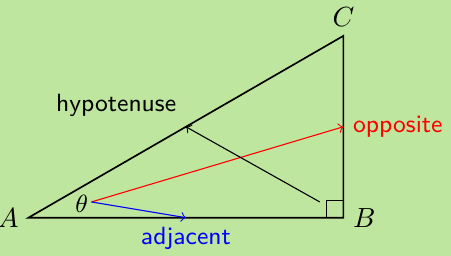
Question: For the right-angled triangle shown, identify the hypotenuse, opposite, and adjacent sides with respect to angle θ, then set up the trigonometric ratios.
Step 1: Identify the triangle components
First, locate the right angle - this is always marked with a small square symbol. The hypotenuse is always the side directly opposite this right angle and is the longest side of the triangle.
Next, focus on angle θ. The opposite side is the side directly across from angle θ (not touching the angle). The adjacent side is the side that is next to angle θ and helps form this angle (but is not the hypotenuse).
For angle θ:
- Hypotenuse: AC (longest side, opposite the right angle)
- Opposite: BC (the side across from angle θ)
- Adjacent: AB (the side next to angle θ)
Step 2: Set up the trigonometric ratios
Now we can write the three trigonometric ratios for angle θ:
Step 3: Consider the other angle
If we were asked about angle α (the other non-right angle), the opposite and adjacent sides would switch positions, but the hypotenuse remains the same:
For angle α:
- Hypotenuse: AC (still the same)
- Opposite: AB (now opposite to angle α)
- Adjacent: BC (now adjacent to angle α)
The trigonometric ratios for angle α would be:
Worked example: Complete ratio calculations
Example
Worked Example: Calculating Trigonometric Ratios
Question: In triangle ABC with right angle at B, side AB = 3 units, side BC = 4 units, and side AC = 5 units. Calculate sin A, cos A, and tan A.
Step 1: Identify the sides relative to angle A
- Hypotenuse: AC = 5 units (opposite the right angle)
- Opposite (to angle A): BC = 4 units
- Adjacent (to angle A): AB = 3 units
Step 2: Apply the trigonometric ratios
Worked example: Using ratios to find unknown sides
Example
Worked Example: Finding Unknown Sides
Question: In a right-angled triangle, angle θ = 30°, the hypotenuse = 10 cm, and you need to find the opposite side.
Step 1: Identify what you know and what you need
- Known: θ = 30°, hypotenuse = 10 cm
- Unknown: opposite side
- Required ratio: sin θ (involves opposite and hypotenuse)
Step 2: Set up the equation
Step 3: Solve for the unknown
Summary
Key Points to Remember:
- Trigonometric ratios only work with right-angled triangles - always check for the right angle first
- Use SOH CAH TOA to remember which sides go with which ratios: Sine = Opposite/Hypotenuse, Cosine = Adjacent/Hypotenuse, Tangent = Opposite/Adjacent
- The hypotenuse never changes - it's always the longest side opposite the right angle
- Opposite and adjacent sides change depending on which angle you're considering
- Practice identifying sides systematically - find the right angle, then the hypotenuse, then determine opposite and adjacent based on your angle of interest