Similarity of Triangles (Grade 10 NSC Matric Mathematics): Revision Notes
📚Revision Notes
Similarity of Triangles
What are similar triangles?
Similar triangles are triangles that have the same shape, but not necessarily the same size. This means they have identical angles but their sides are proportional to each other. Understanding similarity forms the foundation of trigonometry and helps us work with relationships between angles and sides.
When we say triangles are similar, we use the symbol . For example, if triangle ABC is similar to triangle DEF, we write: △ABC △DEF.
Note
The similarity symbol is read as "is similar to" and indicates that two triangles have the same shape but may differ in size.
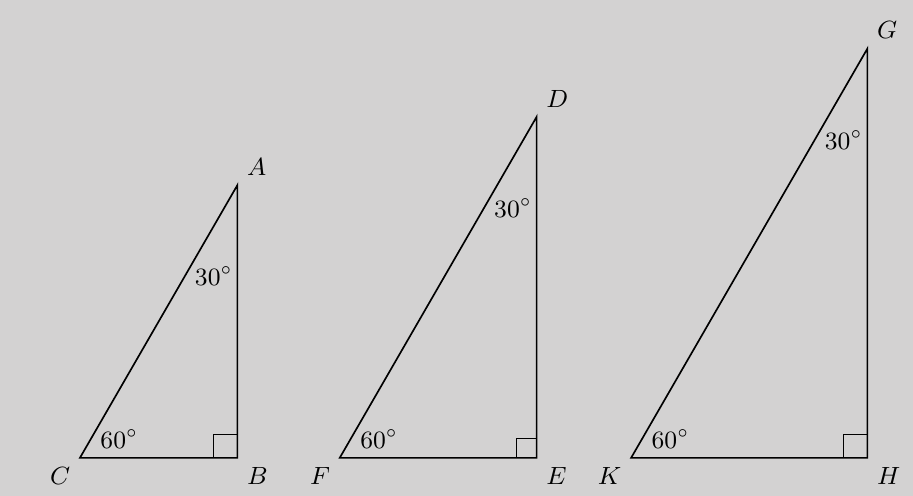
Properties of similar triangles
Similar triangles have two important properties that always hold true:
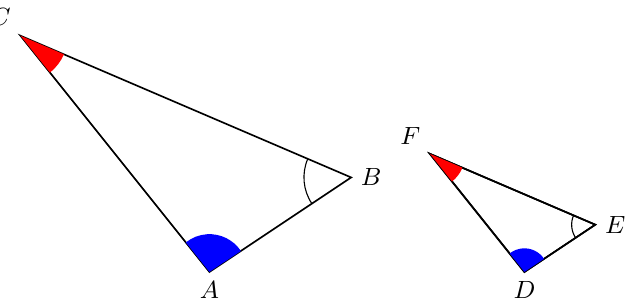
Equal corresponding angles
In similar triangles, corresponding angles are equal. This means:
- The angle at vertex A equals the angle at vertex D
- The angle at vertex B equals the angle at vertex E
- The angle at vertex C equals the angle at vertex F
We write this as: , ,
Proportional corresponding sides
In similar triangles, corresponding sides are proportional. This means the ratios between corresponding sides are always the same, regardless of the actual lengths of the sides.
Important
For triangles specifically, either property on its own is enough to establish similarity - if corresponding angles are equal, the sides will automatically be proportional, and vice versa. This gives us the standard similarity criteria: AAA (equal angles), SSS (proportional sides), and SAS (two sides proportional with the included angle equal). Note that this is a special feature of triangles - for other polygons, both properties must be checked separately.
Ratios in similar triangles
When triangles are similar, we can express the relationship between their sides in several ways. Consider triangles ABC and DEF where △ABC △DEF:
Example
Method 1: Ratios between corresponding sides
Method 2: Ratios of corresponding sides
These ratios remain constant because when angles stay the same, the relationship between the sides stays the same. This is a fundamental principle that makes trigonometry possible.
Writing similarity statements correctly
The order of letters when writing similarity statements is crucial. You must list the vertices in corresponding order.
Important
Correct: △ABC △DEF (A corresponds to D, B corresponds to E, C corresponds to F)
Incorrect: △ABC △DFE (This would mean A corresponds to D, B corresponds to F, C corresponds to E, which changes the relationships)
Always ensure that corresponding vertices are in the same position in both triangle names.
Connection to trigonometry
The concept of similar triangles is the foundation of trigonometry. When we work with right-angled triangles that have the same angles, their sides maintain consistent ratios. This consistency allows us to define trigonometric ratios like sine, cosine, and tangent.
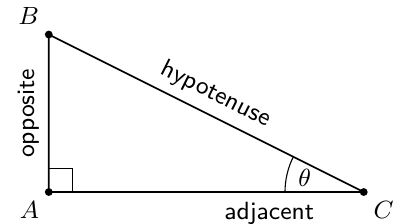
In right-angled triangles, we can identify sides relative to any angle as:
- Hypotenuse: The longest side (opposite the right angle)
- Opposite: The side opposite to the angle we're considering
- Adjacent: The side next to the angle we're considering
Note
The similarity principle ensures that these ratios remain constant for triangles with the same angles, which is what makes trigonometric calculations reliable and useful.
Remember!
Summary
Key Points to Remember:
-
Similar triangles have the same shape but not necessarily the same size - their corresponding angles are equal and corresponding sides are proportional
-
The ratio between corresponding sides is always the same in similar triangles, no matter what the actual lengths are
-
Vertex order matters when writing similarity statements - always list corresponding vertices in the same position
-
Similarity forms the foundation of trigonometry by ensuring consistent ratios in right-angled triangles
-
Always check that you have the correct corresponding sides when calculating ratios between similar triangles