Solving Trigonometric Equations (Grade 10 NSC Matric Mathematics): Revision Notes
📚Revision Notes
Solving Trigonometric Equations
Introduction
Solving trigonometric equations involves finding unknown lengths and angles in right-angled triangles, as well as solving more general trigonometric equations. This process uses the fundamental trigonometric ratios and their inverse functions to determine missing values.
Note
The approach varies depending on what you need to find:
- Finding lengths: Use trigonometric ratios to create equations
- Finding angles: Use inverse trigonometric functions
- Solving equations: Rearrange and apply inverse functions
Finding unknown lengths in right-angled triangles
When you need to find an unknown side length in a right-angled triangle, you can use the trigonometric ratios if you know one angle and one side length.
The trigonometric ratios
The three main trigonometric ratios are:
- Sine:
- Cosine:
- Tangent:
Remember that the hypotenuse is always the longest side opposite the right angle. The opposite side is across from your angle of interest, and the adjacent side is next to your angle of interest.
Important
Remember SOH CAH TOA:
- Sin = Opposite/Hypotenuse
- Cos = Adjacent/Hypotenuse
- Tan = Opposite/Adjacent
This mnemonic helps you remember which sides to use for each ratio.
Step-by-step method for finding lengths
Step 1: Identify the sides
- Label the hypotenuse, opposite, and adjacent sides relative to the given angle
- Determine which trigonometric ratio to use based on what you know and what you need to find
Step 2: Set up the equation
- Write the appropriate trigonometric ratio
- Substitute the known values
Step 3: Rearrange to solve for the unknown
- Use algebra to isolate the unknown variable
- Multiply or divide both sides as needed
Step 4: Calculate the answer
- Use your calculator to find the numerical value
- Round to the required number of decimal places
Example
Worked Example: Finding a length using sine
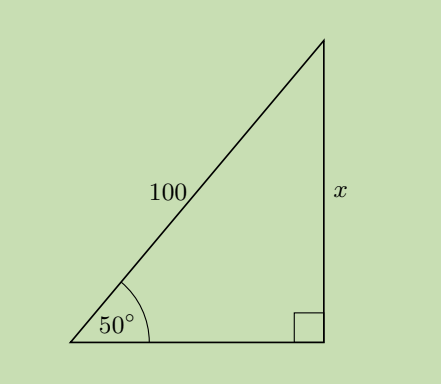
To find the length in this triangle:
Step 1: Identify the ratio needed
- We have the hypotenuse (100) and need the opposite side ()
- Use:
Step 2: Rearrange the equation
Step 3: Calculate
Example
Worked Example: Finding a length using cosine
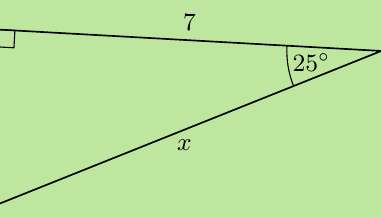
For this triangle where we need to find :
Step 1: Identify the ratio needed
- We have the hypotenuse (7) and need the adjacent side ()
- Use:
Step 2: Rearrange the equation
Step 3: Calculate
Finding multiple unknown lengths

When you need to find two unknowns, use two different trigonometric ratios:
For the 25° angle:
- , so
- , so
Calculating:
Finding unknown angles in right-angled triangles
When you know two side lengths and need to find an angle, you use the inverse trigonometric functions on your calculator.
Using inverse functions
The inverse trigonometric functions work backwards from the ratios to find angles:
Important
Calculator Technique for Inverse Functions:
To use inverse functions on your calculator:
- Press SHIFT (or 2nd) to access inverse functions
- Press the trigonometric function button (sin, cos, or tan)
- Enter the ratio value
- Press = to get the angle
Always remember: SHIFT key is essential for finding angles!
Example
Worked Example: Finding an angle
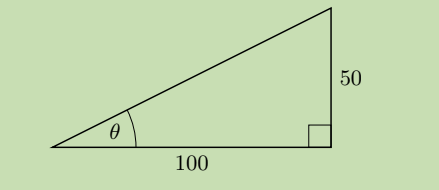
To find angle in this triangle:
Step 1: Identify the ratio
- We have opposite (50) and adjacent (100)
- Use:
Step 2: Use inverse function
- Press: SHIFT → tan → 0.5 → =
- Result:
Solving general trigonometric equations
Beyond right-angled triangles, you may need to solve trigonometric equations where the triangle isn't shown.
Method for solving trigonometric equations
Step 1: Rearrange the equation
- Isolate the trigonometric function on one side
- Ensure the value is between -1 and 1 for sine and cosine
Step 2: Use the inverse function
- Apply the appropriate inverse trigonometric function
- Use your calculator to find the angle
Step 3: Check for valid solutions
- Remember that sine and cosine have maximum values of 1
- If the required value is greater than 1, there is no solution
Example
Worked Example: Basic equation
Find if
Step 1: The equation is already arranged
Step 2: Use inverse cosine
- Press: SHIFT → cos → 0.2 → =
- Result:
Example
Worked Example: Equation with coefficient
Find if
Step 1: Rearrange
Step 2: Use inverse sine
- Press: SHIFT → sin → 0.8 → =
- Result:
Cases with no solution
Sometimes trigonometric equations have no solution. This occurs when:
- The required value for sine or cosine is greater than 1
- The required value for sine or cosine is less than -1
Important
Recognizing No Solution Cases:
Example: Solve
Since :
Since 2.14 > 1 and the maximum value of cosine is 1, there is no solution.
Always check if your calculated ratio exceeds the valid range for trigonometric functions!
Important calculator notes
- Always use the SHIFT key to access inverse functions
- Round answers appropriately (usually to 1 decimal place for angles)
- Check that your calculator is in degree mode
- Write "no solution" clearly when equations cannot be solved
Summary
Key Points to Remember:
- The trigonometric ratios are: sin = opposite/hypotenuse, cos = adjacent/hypotenuse, tan = opposite/adjacent
- Use inverse functions (with SHIFT key) only when finding angles from known ratios
- Maximum values for sine and cosine functions are 1 - values greater than 1 indicate no solution exists
- Always identify triangle parts relative to the angle you're working with - the hypotenuse never changes, but opposite and adjacent depend on your reference angle
- Calculator technique is crucial - practice using SHIFT for inverse functions and ensure degree mode is selected
Note
Common Exam Tips:
- Identify the triangle parts carefully - label opposite, adjacent, and hypotenuse relative to the given angle
- Choose the correct ratio based on which sides you know and which you need to find
- Use inverse functions when finding angles, not when finding lengths
- Check your calculator mode - ensure it's set to degrees
- Round appropriately - typically 2 decimal places for lengths, 1 for angles
- Recognize no-solution cases - when sine or cosine values exceed 1