Final and Intermediate Goods (Grade 11 NSC Matric Economics): Revision Notes
📚Revision Notes
Final and Intermediate Goods
Understanding economic goods
When we talk about economics, we focus on economic goods rather than free goods. Economic goods are items that people need or want, but they don't exist in unlimited quantities. This scarcity means we must work and use resources to produce them. Think about your smartphone, food, or clothing - these all require effort, materials, and time to create.
Note
Economic goods are consumable items that are useful to people but scarce in relation to their demand, so that human effort is required to obtain them. This distinguishes them from free goods like air or sunlight.
Free goods, on the other hand, are naturally abundant and require no effort to obtain. The best example is air - you can breathe as much as you want without paying for it or working to get it.
Types of economic goods
All economic goods can be placed into one of two important categories:
Intermediate goods and services
These are items used to create other products. They're like ingredients in a recipe - you don't buy them for yourself, but businesses use them to make the things you actually want to purchase.
Examples of intermediate goods:
- Steel used to build cars
- Flour used by bakeries to make bread
- Computer chips used in smartphones
- Advertising services used by companies
Final goods and services
These are products that reach the end consumer and won't be processed or sold again. When you buy something for your own use, you're purchasing a final good.
Examples of final goods:
- The bread you buy from a bakery
- A car you purchase for personal transport
- A haircut at the salon
- A smartphone you buy for personal use
The same item can be both
Here's where it gets interesting - the same product can be either intermediate or final depending on how it's used. Sugar provides a perfect example:
Example
Worked Example: Sugar Classification
As a final good: When you buy sugar at the shop to sweeten your tea at home
- Purpose: Personal consumption
- Buyer: Household
- Classification: Final good
As an intermediate good: When a biscuit factory buys sugar to use in manufacturing biscuits
- Purpose: Production input
- Buyer: Business
- Classification: Intermediate good
The classification depends entirely on the purpose and who's buying it.
Important
The same product can be either intermediate or final depending on how it's used and who purchases it. The key question is: "Will this be used to produce something else, or is this the final product?"
Who buys final goods and services?
In the South African economy, final goods and services are purchased by four main groups:
1. Households
- What they buy: Food, clothing, entertainment, transport
- Economic term: This spending is called consumption (C)
- Example: Your family buying groceries at Pick n Pay
2. Businesses
- What they buy: Equipment, machinery, buildings, technology
- Economic term: This spending is called investment spending (I)
- Example: A factory buying new production equipment
3. Government
- What they buy: Infrastructure, public services, government operations
- Economic term: This spending is called government expenditure (G)
- Example: Building new schools or hospitals
4. Foreign sector
- What they buy: South African products sold overseas
- Economic term: This spending is called exports (X)
- Example: Selling South African wine to Germany
Note
When we import goods from other countries, we call these imports (Z). Remember the acronym CIGX-Z: Consumption, Investment, Government expenditure, eXports, and imports (Z).
Flows in the economy
The economy works like a continuous cycle where goods, services, and money move between different participants. This movement creates what economists call the circular flow of the economy.
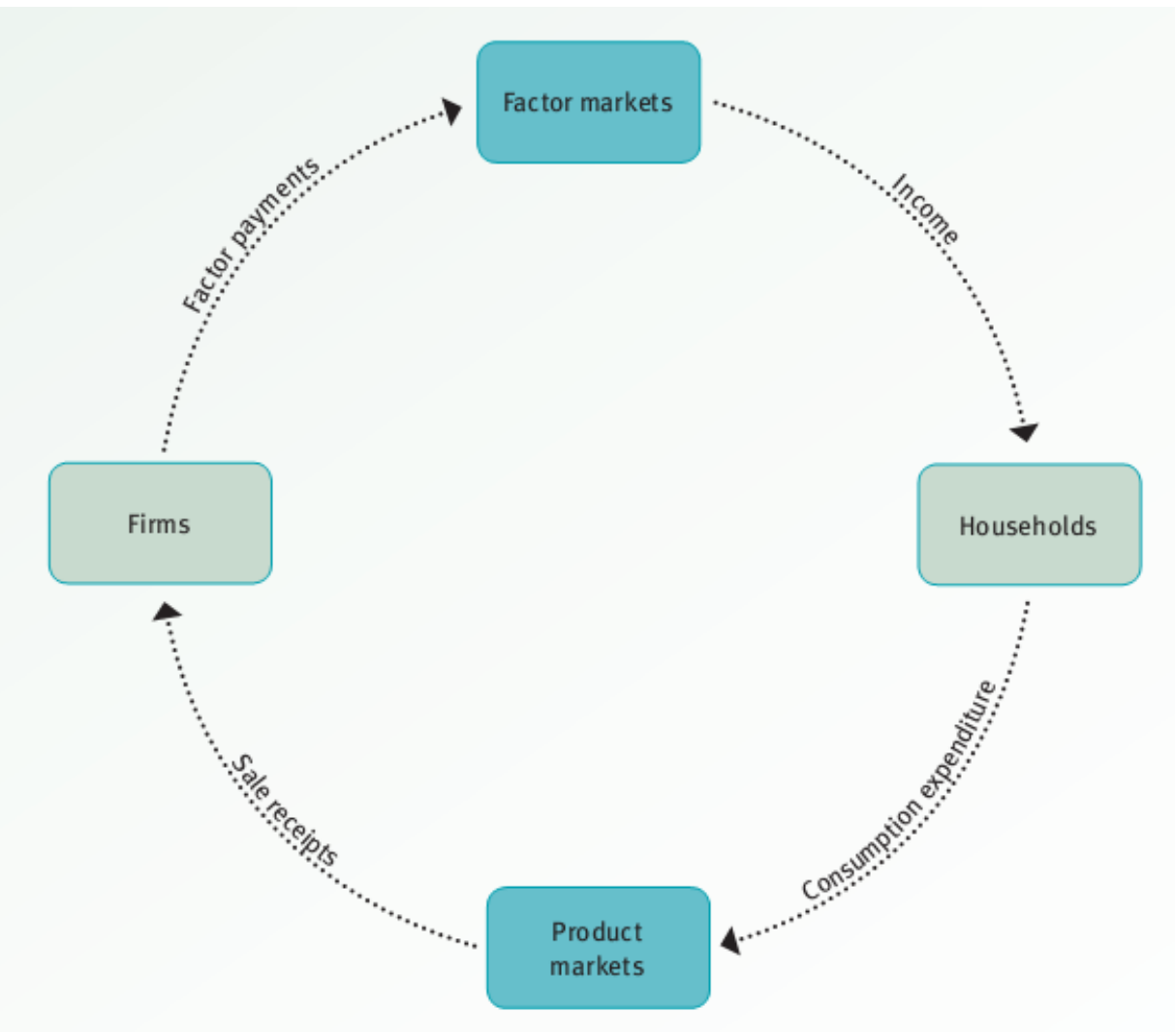
The circular flow diagram shows how the economy connects through two main markets:
Factor markets
This is where households sell their labour, land, and other resources to firms. In return, they receive:
- Wages for their work
- Rent for their property
- Interest on their savings
- Profits from business ownership
Product markets
This is where firms sell their finished goods and services to households, government, and other buyers. The money flows back to firms as revenue from these sales.
Note
The continuous cycle works like this:
- Households provide factors of production to firms through factor markets
- Firms pay households for these factors (wages, rent, etc.)
- Households use this income to buy goods and services in product markets
- The money returns to firms as sales revenue
- The cycle continues
This circular flow explains how money and resources move through the economy, connecting all the different participants we discussed earlier.
Summary
Key Points to Remember:
- Economic goods require effort and resources to produce, unlike free goods which are naturally abundant
- Intermediate goods are used to make other products, while final goods go directly to the end consumer
- The same item can be both intermediate and final depending on how it's used
- Four main groups buy final goods: households (C), businesses (I), government (G), and foreign sector (X), with imports (Z) flowing the opposite direction
- The circular flow shows how money and resources move continuously between households, firms, and markets in the economy