International Trade and World Markets (Grade 11 NSC Matric Geography): Revision Notes
📚Revision Notes
International Trade and World Markets
What is trade?
Trade forms the foundation of how people and countries meet their needs and wants. At its most basic level, trade involves the exchange of goods, services, capital, labour and information between two parties. This can happen at any scale - from children swapping toys in a playground to countries exchanging millions of tonnes of resources across continents.
When we think about everyday examples, trade is everywhere around us. You buying a snack from a street vendor represents a simple form of trade. On a larger scale, when South Africa sells maize to Mozambique, this demonstrates how trade helps countries access what they cannot produce themselves or what they can obtain more efficiently from others.
Understanding international trade
International trade takes the concept of trade and applies it across country borders. This type of trade involves the exchange of goods, services, capital, labour and information between different countries. The beauty of international trade lies in how it creates mutual benefits - both trading partners gain something they cannot produce domestically or can obtain more efficiently from abroad.
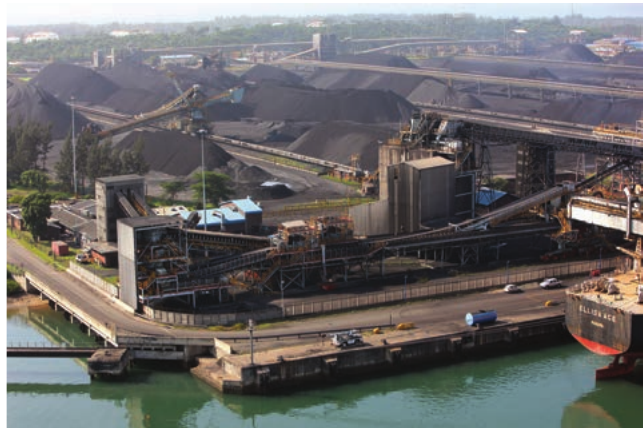
The image above shows a major port facility designed for handling bulk commodities like coal. Such infrastructure represents the physical systems that make international trade possible, connecting domestic production with global markets.
Note
International trade operates through what we call markets. A market isn't necessarily a physical place you can visit, but rather represents the systems and structures that enable buying and selling to occur. These systems include everything from shipping networks and port facilities to banking systems and trade agreements that facilitate exchanges between countries.
Global trade patterns and economic groupings
The scale of international trade varies dramatically between different countries, creating distinct patterns in the global economy. When we examine trade data, we can observe clear groupings that reflect different levels of economic development and trade capacity.
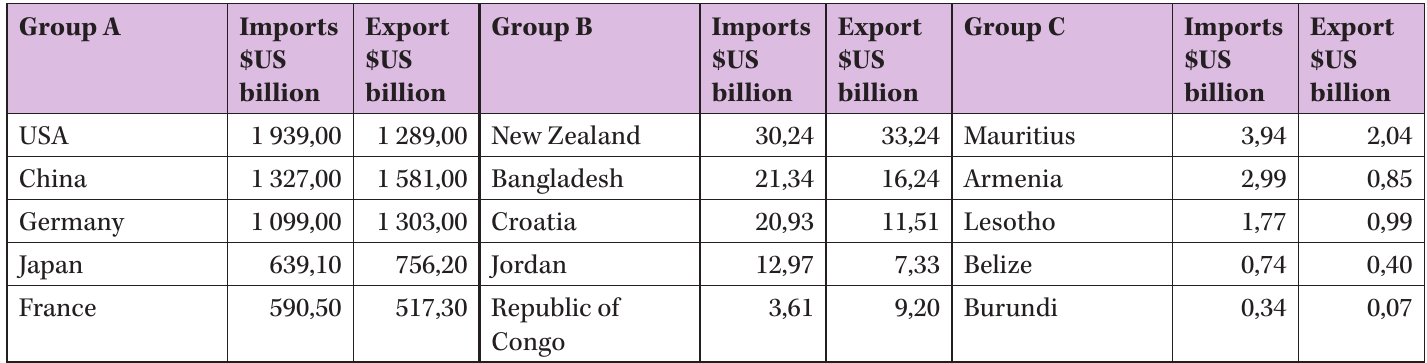
Looking at global trade patterns, countries fall into three main economic groups based on their trade volumes. The largest economies like the USA, China, Germany, Japan, and France handle trade worth hundreds to over a thousand billion dollars annually. These represent the world's major economic powers with highly developed industrial and service sectors.
Medium-sized economies such as New Zealand, Bangladesh, Croatia, and Jordan typically manage trade volumes in the tens of billions of dollars. These countries often have more specialized economies or are still developing their industrial capacity.
Smaller economies like Mauritius, Armenia, Lesotho, and Belize handle trade volumes under five billion dollars. While their absolute trade volumes are smaller, trade often represents a crucial proportion of their total economic activity.
Note
This pattern reveals how international trade reflects broader economic development levels. Countries with more developed economies tend to have higher trade volumes, while those still developing typically trade smaller amounts but may depend heavily on trade for their economic growth.
Types of commodities in international trade
Understanding what countries actually trade helps us grasp how international commerce works in practice. Commodities refer to the specific items - both goods and services - that countries exchange with each other. These range from raw materials extracted from the earth to sophisticated manufactured products.
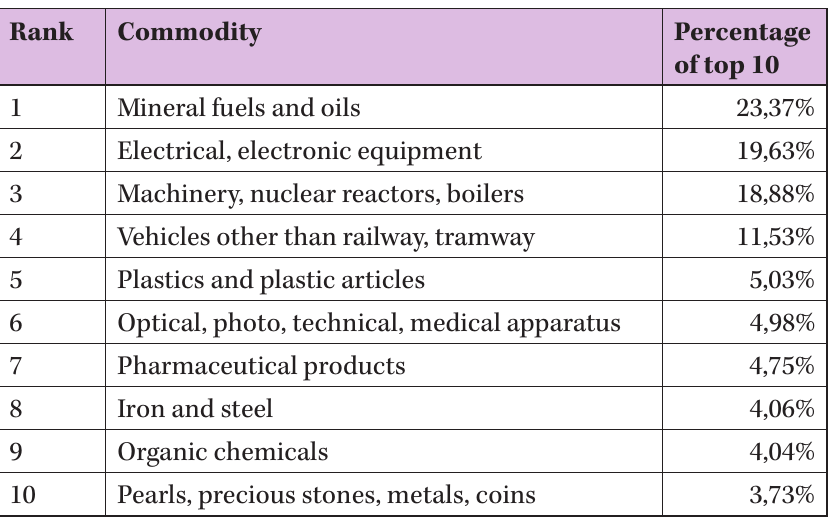
The global trade in commodities shows interesting patterns. The most traded commodity group consists of mineral fuels and oils, accounting for over 23% of major traded goods. This reflects the world's continued dependence on energy resources, with oil and gas flowing from producing nations to consuming countries worldwide.
Electrical and electronic equipment represents the second-largest category at nearly 20% of trade. This includes everything from smartphones and computers to industrial electrical systems. The prominence of this category reflects our increasingly technology-dependent global economy.
Machinery, nuclear reactors, and boilers make up the third-largest group at about 19% of global trade. This category represents the tools and equipment that drive industrial production worldwide, showing how countries specialize in manufacturing different types of machinery.
Important
An important insight emerges when we examine these commodities more closely. Only three of the top ten commodity groups represent raw materials in their unprocessed form. This means that approximately three-quarters of major international trade involves goods that have been processed or manufactured in some way.
This pattern reflects a crucial aspect of global economic development. Less economically developed countries (LEDCs) often export mainly raw materials and unfinished goods, while more economically developed countries (MEDCs) tend to export processed commodities and manufactured products. Since processed goods typically sell for higher prices than raw materials, this difference affects how much countries can earn from their exports.
Terms of trade concept
The terms of trade (TOT) provides a valuable tool for understanding a country's trading position. This concept measures the ratio between the value of what a country exports compared to what it imports. Understanding TOT helps us see whether a country's trade situation strengthens or weakens its economic position.
The calculation for terms of trade follows a straightforward formula: we divide the value of exports by the value of imports, then multiply by 100 to express the result as an index number.
When interpreting TOT results, the number 100 serves as our reference point. If imports and exports have equal value, the TOT equals exactly 100, indicating balanced trade. When TOT exceeds 100, this signals favourable terms of trade - the country earns more from exports than it spends on imports. Conversely, when TOT falls below 100, this indicates unfavourable terms of trade - the country spends more on imports than it earns from exports.
Example
Worked Example: Calculating Terms of Trade
If we examine a country's trade where exports total $2.04 billion and imports cost $3.94 billion, the calculation would be:
This result below 100 shows unfavourable terms of trade, meaning the country spends significantly more on imports than it earns from exports.
Countries with favourable terms of trade often benefit from exporting high-value processed goods or possessing valuable natural resources in high demand. Those with unfavourable terms of trade might rely heavily on importing expensive manufactured goods while exporting lower-value raw materials.
Important
The terms of trade concept becomes particularly important when analyzing development patterns. Many developing countries struggle with persistently unfavourable terms of trade, which can limit their ability to accumulate capital for further development. Understanding these patterns helps explain why some countries find it challenging to improve their economic situations through trade alone.
Summary
Key Points to Remember:
-
Trade fundamentals: International trade involves exchanging goods, services, capital, labour and information across country borders, creating mutual benefits for trading partners.
-
Economic groupings matter: Countries fall into distinct trade volume categories that reflect their economic development levels, from billion-dollar major economies to smaller specialized traders.
-
Processed goods dominate: About three-quarters of major international trade involves processed or manufactured commodities rather than raw materials, giving advantages to countries that can add value to their exports.
-
Terms of trade reveal trading strength: TOT calculation (exports ÷ imports × 100) shows whether countries have favourable (above 100) or unfavourable (below 100) trading positions.
-
Infrastructure enables trade: Physical systems like ports, shipping networks, and processing facilities form the backbone that makes international trade possible on a massive scale.