Energy Management in South Africa (Grade 11 NSC Matric Geography): Revision Notes
📚Revision Notes
Energy Management and the Move Towards Greener Economies
South Africa's energy challenges
South Africa has historically relied on cheap and abundant coal for electricity generation, which meant there was little motivation to invest in greener technologies. However, this heavy dependence on fossil fuels has made South Africa one of the world's largest carbon producers, ranking as the thirteenth-highest per capita carbon producer globally.
Note
Greener technologies refer to industrial machines and processes that cause less pollution and use fewer non-renewable resources. South Africa now needs to transition towards these cleaner alternatives to reduce its environmental impact.
Two pathways to a greener economy
South Africa can move towards a more sustainable energy future through two main approaches: changing the fuel mix and using available energy more efficiently.
1. Changing the fuel mix
Currently, South Africa's energy mix is heavily dominated by coal, but the country is working to diversify its energy sources for a more balanced approach by 2030.
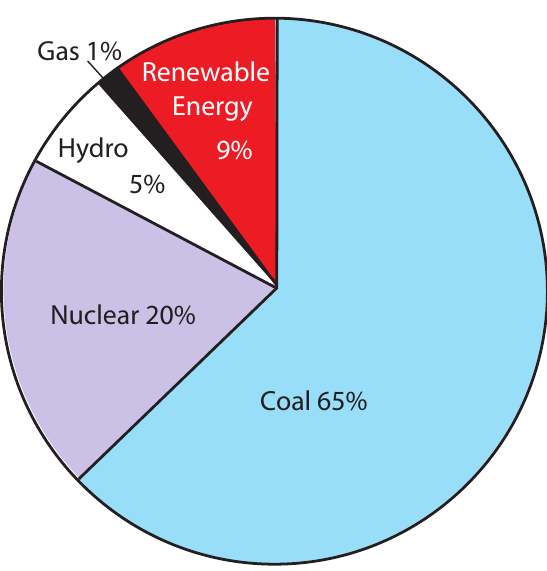
The current energy breakdown shows that coal provides 65% of the country's energy needs, with nuclear power contributing 20%, renewable energy at 9%, hydroelectric power at 5%, and natural gas making up only 1%. This heavy reliance on coal needs to change to reduce carbon emissions and environmental damage.
Important
This heavy dependence on coal makes South Africa one of the world's most carbon-intensive economies and poses significant environmental and health risks that must be addressed through urgent energy transition.
2. Using available energy more efficiently
Energy efficiency improvements could deliver significant benefits for South Africa. By upgrading inefficient technologies, the country could potentially save 12% of its total energy consumption. This approach offers both economic and environmental advantages:
Economic benefits:
- Reducing energy costs by approximately R18 billion over 25 years
- Making energy more affordable for businesses and households
Environmental benefits:
- Cutting CO2 emissions by 770 million tonnes over 25 years
- Reducing local air pollution and improving public health
Key areas for improving energy efficiency
Energy efficiency improvements can be achieved through several key strategies:
Changing human behavior: Simple actions like switching off lights and water geysers when not in use, and managing electricity consumption more carefully.
Promoting energy-efficient appliances: Encouraging the use of energy-saving light globes, fuel-efficient transport, and other efficient technologies.
Adopting low-carbon technologies: Installing solar geysers, upgrading to more fuel-efficient power stations, and implementing cleaner industrial processes.
Comprehensive strategies for sustainable energy
Different sectors of society have important roles to play in South Africa's energy transition:
Residential sector strategies:
- Installing solar water heaters and geyser blankets for more efficient water heating
- Using energy-efficient lighting and appliances throughout homes
- Improving house insulation, particularly proper ceiling insulation
- Switching from electricity to gas for certain household needs
- Taking advantage of government subsidies to support cleaner technology adoption
Industry and business approaches:
- Implementing more efficient industrial technologies to reduce national energy consumption by up to 12%
- Following government regulations and policies that enforce energy efficiency standards
- Investing in cleaner production processes and equipment
Alternative energy development:
- Biofuels: Developing biodiesel and other biofuels with potential annual growth rates of 30%, while ensuring food security is not compromised
- Renewable energy expansion: Increasing solar thermal, wind, and small hydroelectric projects as technology costs decrease with global production growth
- Nuclear power growth: Planning for at least 9.6 MW of new nuclear capacity by 2030, with six new 1,600 MW reactors scheduled from 2023
- Regional energy imports: Increasing hydroelectricity imports from southern African countries and importing natural gas to provide 5,850 MW of combined cycle gas turbines
Government policy interventions:
- Implementing fuel-input taxes on coal used for electricity generation
- Changing legislation to allow independent power producers to supply electricity to municipalities and Eskom
- Providing subsidies and incentives to encourage industries and individuals to adopt more efficient and greener technologies
Note
The success of South Africa's energy transition depends on coordinated action across all these sectors, with government policy providing the framework and incentives for change while businesses and households make practical improvements in their energy use.
The role of government support
The South African government plays a crucial role in encouraging the transition to greener energy through financial incentives and policy support.
Example
Government Subsidy Program: Solar Water Heaters
The government offers cash subsidies to households and businesses that replace their electric water heaters with solar geysers. This type of financial support helps make cleaner technologies more accessible and affordable for ordinary citizens, demonstrating how policy interventions can accelerate the adoption of sustainable technologies.
Summary
Key Points to Remember:
- South Africa currently depends heavily on coal (65%) for energy, making it the 13th highest per capita carbon producer globally
- Two main approaches to greener economies are changing the fuel mix and improving energy efficiency
- Energy efficiency improvements could save 12% of national energy consumption and R18 billion over 25 years
- Success requires cooperation between residential users, businesses, and government through policies and incentives
- The transition involves expanding renewable energy, nuclear power, biofuels, and regional energy imports while reducing coal dependence