Managing the Effects of Soil Erosion (Grade 11 NSC Matric Geography): Revision Notes
📚Revision Notes
Managing the Effects of Soil Erosion
Introduction to soil erosion management
Managing soil erosion requires a comprehensive approach that combines different strategies. The Department of Agriculture has emphasized that preventing soil erosion needs political, economic, and technical changes to farming and land management practices in South Africa. This multi-faceted approach recognizes that soil conservation cannot be achieved through technical methods alone.
Note
Effective soil erosion management is not just about farming techniques - it requires coordinated efforts across political, economic, and technical dimensions to create lasting change in land management practices.
Political and economic management approaches
Land reform and distribution policies
Land distribution and land reform represent crucial political solutions for managing soil erosion. When available farmland is divided among a greater number of farmers, it can reduce the pressure on individual plots of land. This approach helps prevent overuse of soil resources that often leads to degradation and erosion.
Financial incentives and support systems
Governments can offer farmers financial incentives to adopt better farming practices. These economic incentives make it more affordable for farmers to invest in soil conservation techniques that might otherwise be too expensive to implement. Small-scale and subsistence farmers particularly benefit from this type of support, as they often lack the resources to make necessary changes on their own.
Note
Financial support is especially critical for small-scale and subsistence farmers who want to implement conservation practices but lack the initial capital investment required.
Education and training programs
Education and training initiatives play a vital role in making farmers more aware of the causes and effects of soil erosion. When farmers understand how their practices impact soil health, they are more likely to adopt sustainable methods. These programs teach farmers about the long-term benefits of conservation practices and how to implement them effectively.
Implementation of prevention techniques
Political commitment ensures that techniques for preventing soil erosion are actually implemented rather than just recommended. This involves creating policies that support conservation agriculture and providing the institutional framework needed for widespread adoption of erosion control measures.
Important
Without political commitment and institutional support, even the best technical solutions for soil erosion will fail to achieve widespread implementation and lasting impact.
Technical management approaches
Technical solutions for managing soil erosion involve specific farming and land management techniques. These methods work together to protect soil from wind and water erosion while maintaining agricultural productivity.
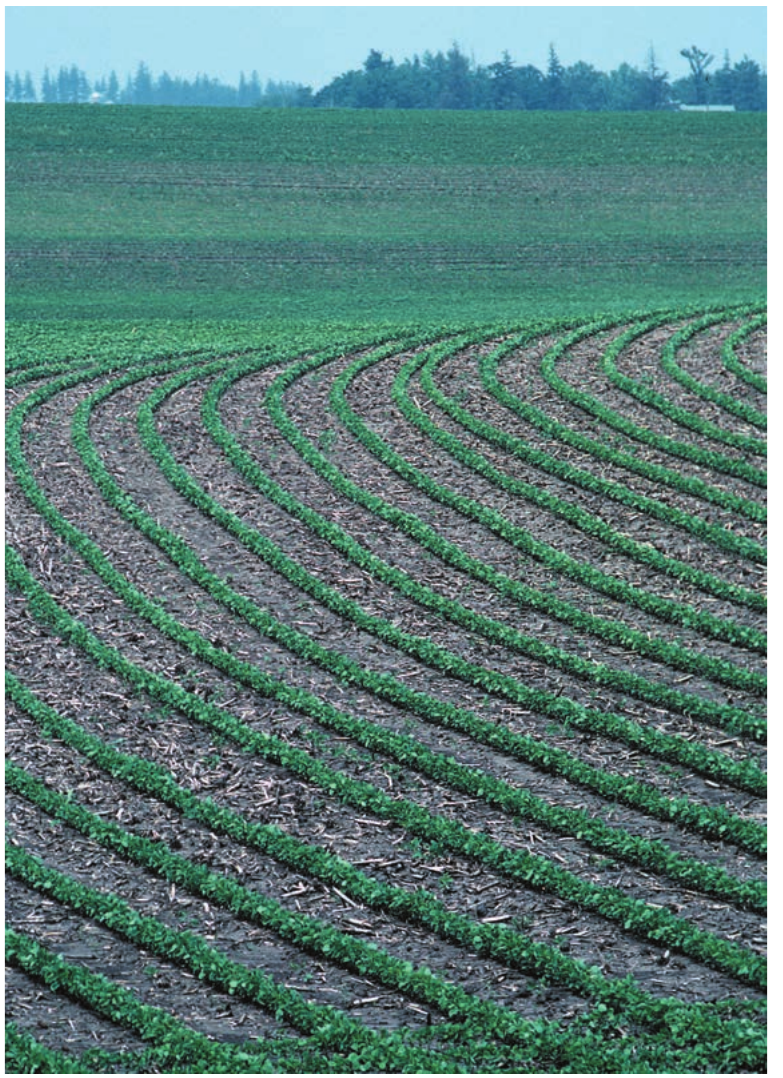
Contour ploughing methods
Contour ploughing involves ploughing on slopes that follows the natural contour lines of the land. This technique prevents water from running straight down slopes, which would carry away topsoil. Instead, the curved furrows created by contour ploughing slow down water flow and encourage it to soak into the ground. This method is particularly effective on gently sloping farmland where straight-line ploughing would create channels for water erosion.
Example
Worked Example: Contour Ploughing in Action
Step 1: Survey the land to identify natural contour lines
Step 2: Mark curved ploughing lines that follow these contours
Step 3: Plough along these curved lines instead of straight up and down the slope
Step 4: The resulting curved furrows act as small dams that slow water flow and reduce soil loss by up to 50%
Wind breaks and shelter belts
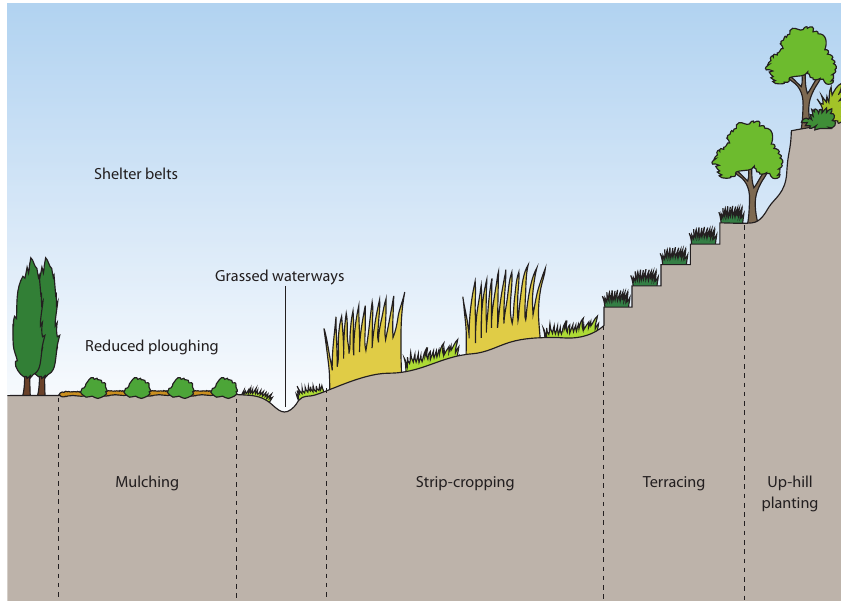
Building wind breaks helps reduce the force of wind that can blow away topsoil. Shelter belts consist of rows of trees or shrubs planted strategically to block strong winds. These barriers not only prevent wind erosion but also create microclimates that can be beneficial for crop growth. The trees in shelter belts can also provide additional benefits such as timber, fruit, or habitat for beneficial insects.
Strip cropping techniques
Strip cropping involves growing cultivated crops in alternating strips with grass or other ground cover. This technique reduces erosion and water loss by ensuring that some areas of land always have vegetation cover to protect the soil. The grass strips act as barriers that slow down water flow and trap any soil particles that might be carried away from the cultivated areas.
Terracing systems
Terracing involves creating stepped levels on steep slopes, which dramatically reduces the speed of water flowing down hillsides. Each terrace acts like a series of small flat fields that can hold water and allow it to soak into the soil rather than rushing downhill. This ancient technique remains one of the most effective methods for preventing erosion on steep terrain.
Note
Terracing is particularly valuable for steep slopes where other erosion control methods may not be sufficient. While it requires significant initial investment and labor, terraces can last for generations when properly maintained.
Additional conservation methods
Several other technical approaches complement the main erosion control methods. Leaving unploughed grass strips between ploughed areas helps hold soil together and retain water. Ensuring that land always has some form of vegetation cover prevents soil from being exposed to erosion forces. Enriching soil with humus - decaying plant and animal remains such as leaf litter and animal dung - improves soil structure and its ability to resist erosion.
Comprehensive soil conservation strategies
Effective soil erosion management requires combining multiple techniques across different types of terrain. A comprehensive approach might include reduced ploughing in flatter areas, grassed waterways in natural drainage channels, mulching around crops, strip-cropping on moderate slopes, and terracing on steeper areas.
Avoiding harmful practices
Managing soil erosion also means avoiding practices that increase erosion risk. Preventing overgrazing and overcropping helps maintain soil health. Allowing indigenous plants to grow along riverbanks instead of ploughing right up to water edges protects these vulnerable areas from erosion.
Important
Common Mistakes to Avoid:
- Ploughing right up to riverbanks and water edges
- Allowing continuous overgrazing that removes protective vegetation
- Overcropping without allowing soil recovery periods
- Using only straight-line ploughing on sloped terrain
Encouraging biological diversity
Planting several different types of plants together encourages biological diversity, which creates more stable soil conditions. Different plants have different root systems that help bind soil in various ways, making the entire system more resistant to erosion.
Wetland conservation
Conserving wetlands plays an important role in managing soil erosion across broader landscapes. Wetlands act as natural buffers that slow down water flow and trap sediment, preventing eroded soil from reaching rivers and dams.
Building barriers in waterways
Constructing small dam walls or barriers across streams can reduce stream flow and slow down soil removal. These structures allow sediment to settle out of flowing water, reducing the amount of eroded soil that gets carried away to other areas.
Summary
Key Points to Remember:
-
Political and economic support is essential: Land reform, financial incentives, and education programs create the foundation for successful soil erosion management.
-
Technical methods work best in combination: Using multiple techniques like contour ploughing, strip cropping, and terracing together provides better protection than any single method alone.
-
Prevention focuses on slowing water and wind: Most technical solutions work by reducing the speed and force of water and wind that cause erosion.
-
Vegetation cover is crucial: Keeping soil covered with plants, mulch, or crop residues provides the most fundamental protection against erosion forces.
-
Comprehensive landscape management: Effective erosion control requires thinking about the entire landscape, including wetlands, waterways, and different terrain types working together as a system.