Using Resources (Grade 11 NSC Matric Geography): Revision Notes
📚Revision Notes
Exploitation and Depletion of Resources
What happens when we use too many resources?
Every single day, humans use natural resources for survival and development. However, problems arise when we use resources in very large quantities, leading to what scientists call resource depletion. This means that the long-term supply of these resources becomes threatened or completely exhausted.
Example
Real-World Example: Overfishing Crisis
Overfishing has become a serious global issue, where fishing companies have been taking far too many fish from the sea for many years. This has caused fish populations to drop dramatically, and in some areas, the fishing industry has virtually collapsed because there simply aren't enough fish left to catch.
The terms resource exploitation and resource depletion are commonly used when discussing farming practices, forestry management, mining operations, and energy resources. Understanding these concepts helps us recognize why sustainable resource management is so crucial for our planet's future.
What causes resource exploitation?
Several factors contribute to the overuse and mismanagement of our planet's resources. These causes often work together, creating complex environmental challenges:
Note
These seven main factors rarely work in isolation - they often combine to create even more serious environmental problems than any single cause would create alone.
Poor resource management practices can lead to significant environmental damage. For instance, farming methods that don't protect soil properly can cause erosion, making the land less productive over time.
Unnecessary resource consumption occurs when people use more than they actually need, often driven by consumerism and wasteful habits in developed countries.
Population growth puts increasing pressure on available resources. As more people need food, water, shelter, and energy, the demand on natural systems grows.
Poverty can force people to use resources unsustainably just to survive. When families are struggling to meet basic needs, long-term environmental considerations often become secondary.
Unequal resource distribution means that some areas have abundant resources while others face shortages, leading to overexploitation in certain regions.
Large-scale industrial development and urbanization can rapidly consume natural resources and transform entire landscapes, often faster than ecosystems can recover.
Pollution of existing resources makes them unusable, forcing people to find alternative sources and putting additional pressure on remaining clean resources.
Understanding different types of resources
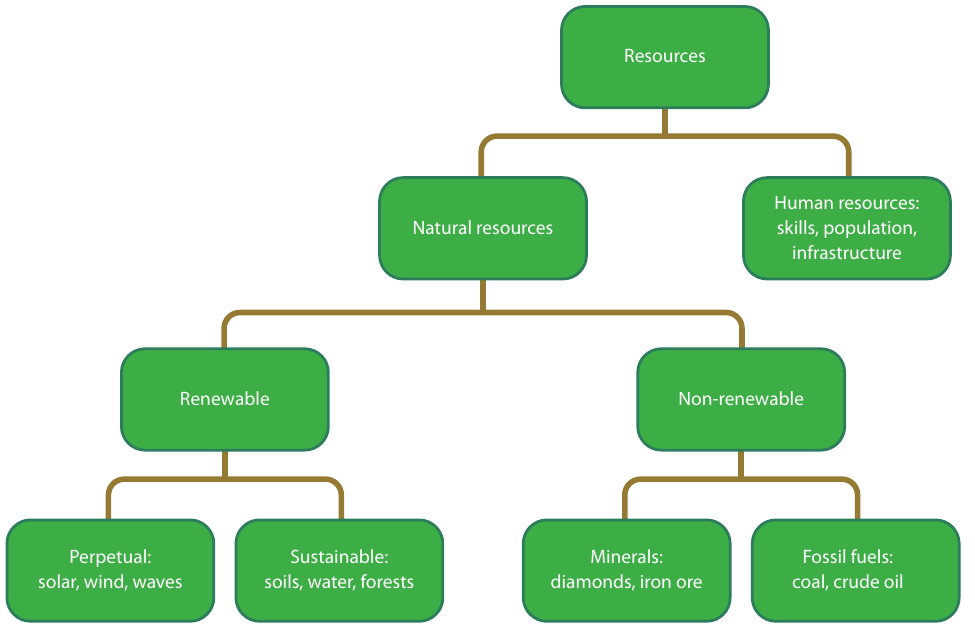
Resources can be organized into a clear classification system that helps us understand their availability and sustainability. This system is essential for making informed decisions about resource management.
Note
While human resources (skills, population, and infrastructure) are crucial for developing and managing natural resources, understanding the classification of natural resources is key to preventing depletion and ensuring sustainability.
At the broadest level, we can divide resources into natural resources (things that come from the environment) and human resources (skills, population, and infrastructure that people provide). Our focus here is primarily on natural resources and how they can become depleted.
Renewable versus non-renewable resources
The most important distinction in resource classification is between renewable and non-renewable resources.
Non-renewable resources have a limited supply that cannot be replaced within a human timeframe. These resources formed over millions of years through natural processes, but once we use them up, they're gone forever. Examples include mineral resources like diamonds and iron ore, as well as fossil fuels such as coal and crude oil.
Important
Critical Timeline Alert:
- Oil reserves: estimated to last only until around 2040
- Natural gas: estimated to last until 2050
- Coal: estimated to last until 2200
These timelines represent a serious challenge for future energy security and make the transition to renewable energy sources urgent.
Renewable resources, on the other hand, can theoretically be replenished or replaced over time. However, this doesn't automatically mean they're unlimited or that we can't overuse them. The key word here is "theoretically" – poor management can still lead to depletion of renewable resources.
Perpetual resources: nature's endless gifts
Perpetual resources represent nature's most reliable offerings. These resources exist regardless of human actions, and people have virtually no control over their availability. The movement of ocean currents, solar radiation from the sun, and wind patterns continue regardless of what humans do on Earth.

Note
Perpetual resources are becoming increasingly important as sources of renewable energy. As fossil fuels become scarcer and more expensive, these natural forces offer hope for sustainable energy solutions that will never run out.
These perpetual resources include wind farms, solar panels, and wave energy systems that help us harness natural forces to generate electricity without depleting the resource itself.
Sustainable resources: a delicate balance
Sustainable resources can theoretically continue supporting constant use without their supply being significantly reduced. Water systems, soil fertility, and forest ecosystems all fall into this category. However, the word "theoretically" is crucial here – these resources can become unsustainable or even non-renewable if they're poorly managed.
Example
Forest Management Example:
Forests can provide timber, paper, and other products indefinitely if they're managed properly through selective cutting and replanting programs. However, clear-cutting entire forest areas without replanting can turn this renewable resource into a depleted landscape that takes decades or centuries to recover.
Similarly, freshwater systems can provide clean water indefinitely if pollution is controlled and extraction rates don't exceed natural recharge rates. But over-pumping groundwater or contaminating water sources can quickly turn this sustainable resource into a depleted one.
Important
The sustainability of these resources depends entirely on human management decisions and practices. This makes education and responsible resource management policies absolutely essential for maintaining these resources for future generations.
Key Takeaways
Summary
Essential Points to Remember:
-
Resource depletion occurs when we use resources faster than they can be naturally replenished, leading to long-term supply problems and environmental damage.
-
Multiple factors cause resource exploitation, including poor management practices, population growth, poverty, and unequal distribution of resources around the world.
-
Non-renewable resources like fossil fuels have strict time limits – oil may run out by 2040, natural gas by 2050, making the transition to renewable energy sources urgent.
-
Perpetual resources such as solar, wind, and wave energy offer unlimited potential for sustainable development because they exist regardless of human actions.
-
Sustainable resources like forests and freshwater can last forever with proper management, but poor practices can quickly turn them into depleted, unusable resources.