Africa's Climate Regions (Grade 11 NSC Matric Geography): Revision Notes
📚Revision Notes
Africa's Climate Regions
What is a climate region?
Important
A climate region refers to an area where weather conditions, particularly temperature and rainfall patterns, are very similar throughout that area. These regions are clearly different from neighboring areas in terms of their climate characteristics.
Understanding climate regions helps us make sense of Africa's diverse weather patterns and predict what conditions to expect in different parts of the continent.
Note
The concept of temperature range is crucial when studying climate regions. This term describes the difference between the highest and lowest temperatures experienced in an area, whether during a day or across seasons.
Overview of Africa's climate regions
Africa is a vast continent that spans from about 35°N to 35°S latitude, which means it experiences an incredible variety of climate conditions. The continent can be divided into six distinct climate regions, each with its own unique characteristics.
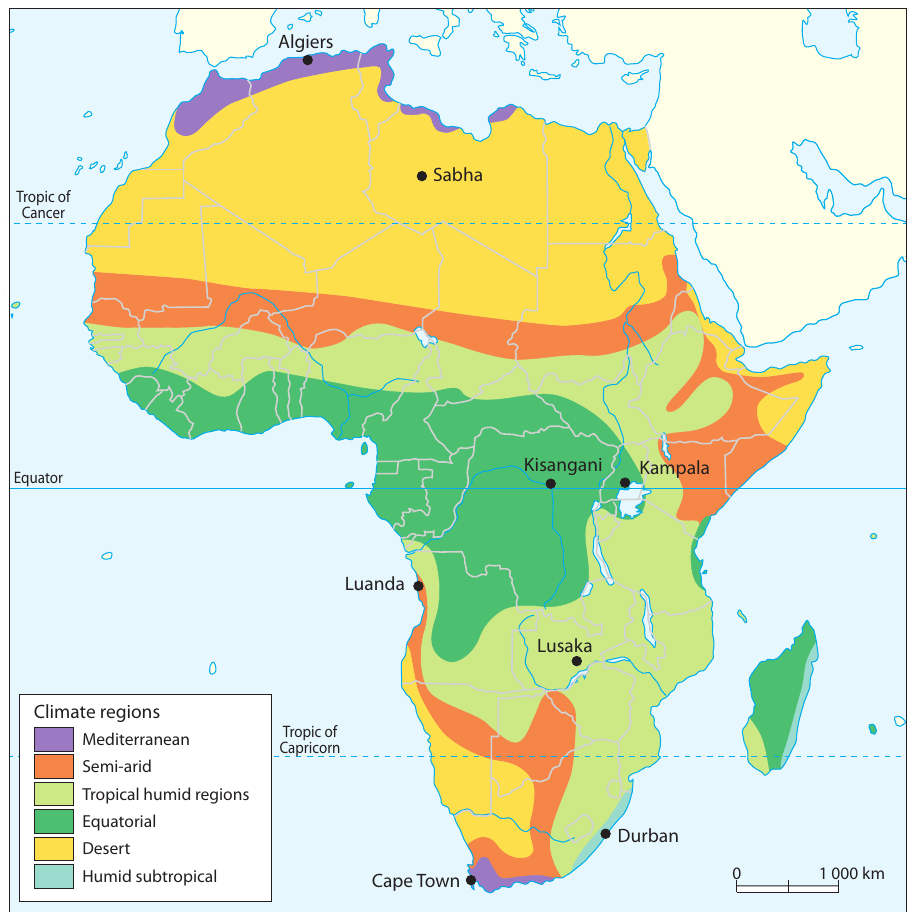
This map shows how these six climate regions are distributed across Africa, influenced by factors such as latitude, proximity to the equator, and distance from oceans.
Desert and semi-desert regions
The desert and semi-desert regions are among the most challenging environments on Earth. These areas are characterized by extremely low rainfall - true desert regions receive less than 250mm of rain per year, while semi-desert areas get between 250mm and 500mm annually. To put this in perspective, this is less water than many places receive in just one or two months.
What makes these regions particularly harsh is their large temperature range. During the day, temperatures can soar to uncomfortable levels, but at night they can drop dramatically. This happens because the dry air and lack of cloud cover allow heat to escape quickly once the sun sets.
Note
The desert regions are primarily located around 30° north and south of the equator, with the massive Sahara Desert dominating northern Africa.
Equatorial climate region
The equatorial climate region presents a complete contrast to the desert areas. Located close to the equator, this region experiences consistently high temperatures throughout the year with very little variation - hence the small temperature range. What truly defines this region is its exceptional rainfall, often exceeding 2000mm per year.
This high rainfall occurs because the area receives intense solar heating, which causes air to rise rapidly, cool, and form clouds that produce frequent heavy rainfall. The result is the lush tropical rainforests found in central Africa, particularly around the Congo Basin.
Note
The consistent warmth and abundant moisture create ideal conditions for dense vegetation and incredible biodiversity.
Mediterranean climate regions
Africa has two Mediterranean climate regions, which might surprise some students since we often associate this climate type with countries around the Mediterranean Sea. These regions have a distinctive seasonal rainfall pattern - they receive most of their rain during winter months and experience very dry summers.
This pattern occurs because of shifting wind patterns and pressure systems throughout the year. During winter, these areas are influenced by weather systems that bring moisture, while summer brings dry, stable conditions.
Note
The Mediterranean climate regions in Africa are relatively small compared to other climate zones but are important for agriculture and human settlement.
Tropical humid regions
The tropical humid regions occupy large areas of sub-Saharan Africa and represent a middle ground between the extremely wet equatorial areas and the dry desert regions. These areas typically receive between 800mm and 1200mm of rainfall per year, which is enough to support substantial vegetation but not quite enough for rainforest conditions.
Many tropical humid regions experience distinct wet and dry seasons. During the wet season, rainfall can be quite heavy, while the dry season may have little to no precipitation. This seasonal variation is crucial for agriculture and determines when crops can be planted and harvested.
Note
The temperatures remain warm throughout the year, but there's usually more variation than in equatorial regions.
Subtropical humid regions
The subtropical humid regions are found in limited areas of Africa, primarily in the southeast. These regions receive rainfall throughout the year, which distinguishes them from the seasonal patterns seen in tropical areas. They experience warm summers but have cooler winters compared to tropical regions, giving them a greater temperature range.
The year-round rainfall and moderate temperature variations make these areas particularly suitable for certain types of agriculture and support diverse ecosystems. The cooler winters are still mild compared to temperate regions but provide enough seasonal variation to affect plant growth cycles.
Understanding climate patterns through graphs
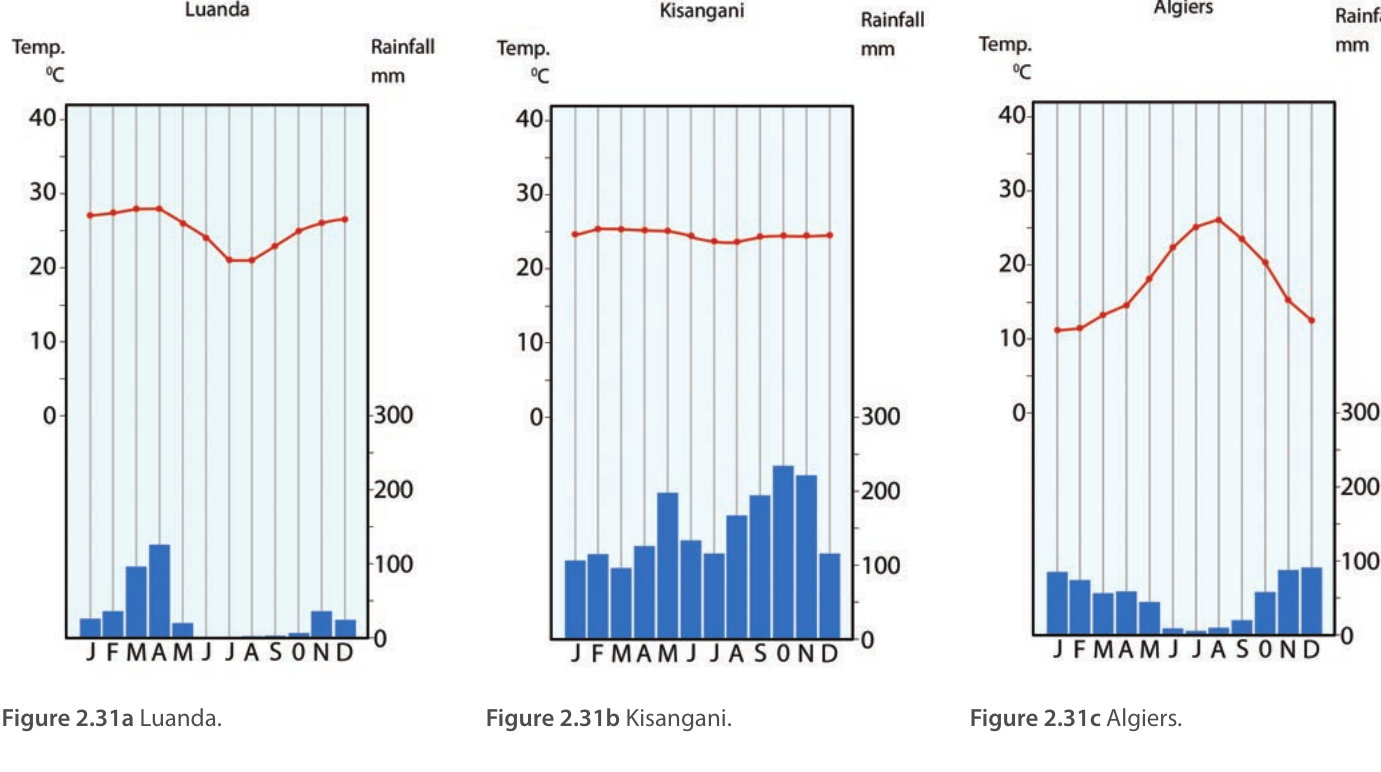
Climate graphs, also called climatographs, are essential tools for understanding and comparing different climate regions. These graphs display both temperature (shown as a line) and rainfall (shown as bars) throughout the twelve months of the year.
Example
Reading Climate Graphs: Understanding Regional Patterns
Each city's climate graph tells a story about its climate region:
- Luanda shows the extreme conditions of a desert climate with minimal rainfall throughout the year and high temperature variations
- Kisangani demonstrates the equatorial pattern with high rainfall and steady temperatures
- Algiers displays the Mediterranean pattern with winter rainfall and summer drought
Key Questions to Ask:
- Does rainfall occur year-round or seasonally?
- How much does temperature vary between the hottest and coolest months?
- Are there clear wet and dry seasons?
These questions help identify which climate region each location belongs to.
Summary
Key Points to Remember:
- Climate regions are areas with similar temperature and rainfall patterns that differ from neighboring regions
- Africa has six main climate regions: desert/semi-desert, equatorial, Mediterranean, tropical humid, subtropical humid, and humid subtropical
- Desert regions are extremely dry (less than 250mm rainfall annually) with large temperature ranges between day and night
- Equatorial regions have consistently high temperatures and very high rainfall (over 2000mm annually) with small temperature ranges
- Mediterranean regions receive most rainfall in winter and have dry summers, while tropical humid regions often have distinct wet and dry seasons