Subsidence and Convergence (Grade 11 NSC Matric Geography): Revision Notes
📚Revision Notes
Subsidence and Convergence
Understanding Africa's rainfall through global circulation patterns
Africa's weather and climate patterns are strongly influenced by two key atmospheric processes: subsidence and convergence. These processes work together as part of the global circulation system to create distinct wet and dry regions across the continent. Understanding how these systems operate helps explain why some areas of Africa receive high rainfall while others remain dry throughout much of the year.
Note
The global circulation system creates a predictable pattern where certain latitudes experience rising air (convergence) while others experience sinking air (subsidence). This fundamental atmospheric behavior directly controls where Africa experiences its wettest and driest conditions.
Subsidence and dry conditions
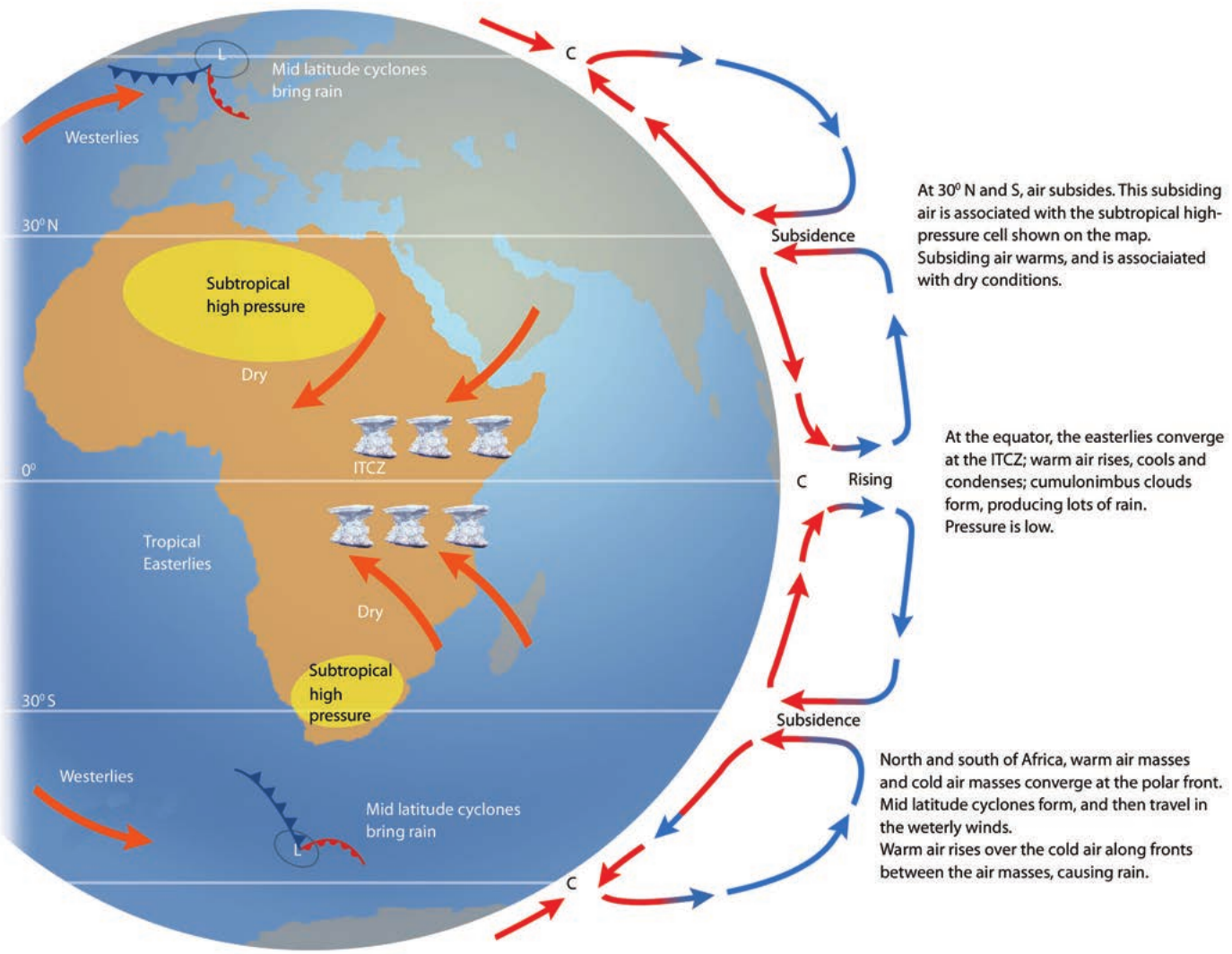
Subsidence occurs when air masses sink downward in the atmosphere, typically around 30 degrees north and south of the equator. When air subsides, it becomes compressed and warms up as it approaches the Earth's surface. This warming process reduces the air's ability to hold moisture, creating dry conditions.
In Africa, the areas around 30°N and 30°S are dominated by subtropical high-pressure systems where subsidence is the dominant process. These regions include North Africa (encompassing the Sahara Desert) and parts of southern Africa. The subsiding air creates stable, clear weather conditions with very little rainfall.
Important
The subtropical high-pressure cells act like atmospheric "deserts" where the sinking air prevents cloud formation and precipitation. This explains why the Sahara Desert and the arid regions of southern Africa experience such consistently dry conditions throughout much of the year.
Convergence and wet conditions
Convergence happens when air masses move together and are forced to rise upward. The most important convergence zone for Africa is the Intertropical Convergence Zone (ITCZ), located near the equator. At this location, the trade winds from both hemispheres meet and converge, forcing the warm, moist air to rise rapidly.
When air rises through convergence, it cools as it gains altitude. This cooling causes the water vapor in the air to condense, forming towering cumulonimbus clouds that produce heavy rainfall. The ITCZ is characterized by low atmospheric pressure and abundant precipitation.
Important
Critical Process: The convergence process at the ITCZ creates the high rainfall regions of equatorial Africa. Countries in central Africa, including parts of the Democratic Republic of Congo, Cameroon, and Gabon, experience heavy rainfall because they are frequently influenced by this convergence zone.
Seasonal movement and Africa's rainfall patterns
The position of the ITCZ is not fixed throughout the year. Instead, it follows the thermal equator, which moves north and south with the seasons as the sun's direct rays shift between the Tropics of Cancer and Capricorn. This seasonal migration of the ITCZ is crucial for understanding Africa's rainfall patterns.
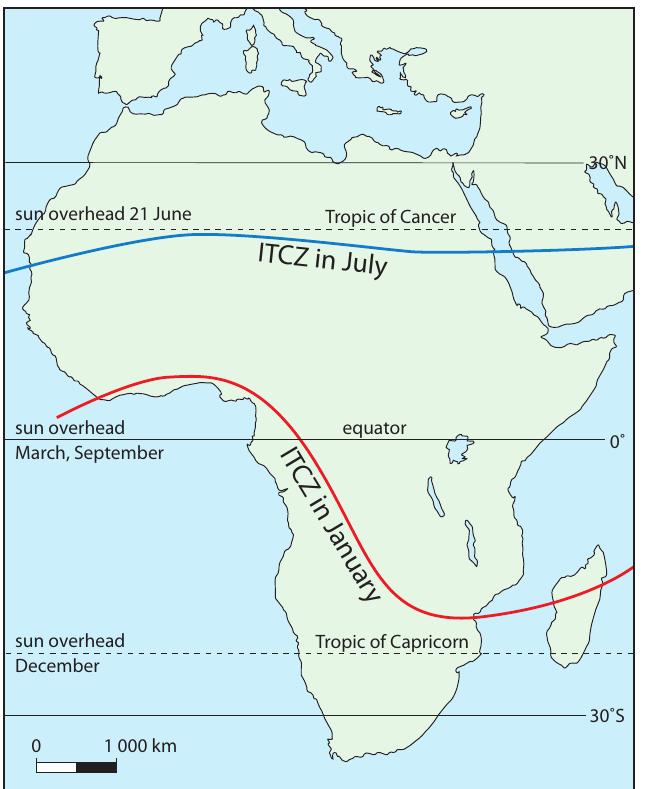
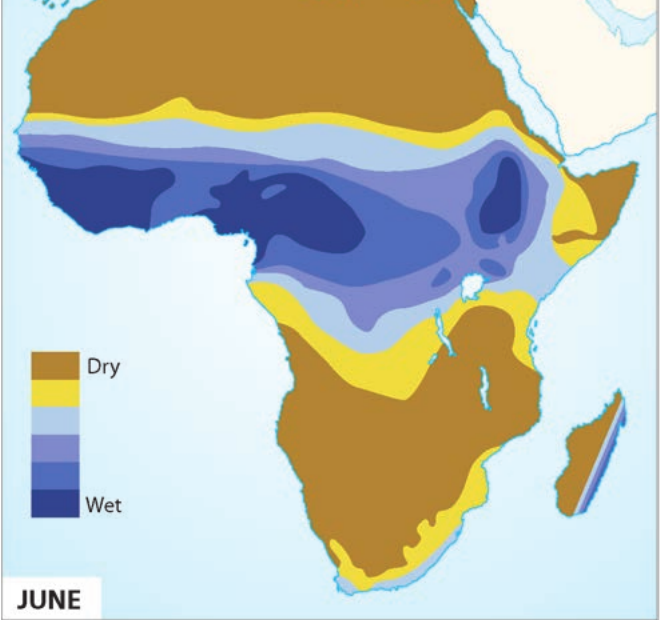
During June, when the sun is overhead at the Tropic of Cancer, the ITCZ shifts northward. This brings the convergence zone and its associated rainfall further north into regions like the Sahel and parts of West Africa. At the same time, southern Africa moves under the influence of the subtropical high-pressure systems, experiencing dry winter conditions.
Note
Seasonal Pattern: In December, the pattern reverses. The sun is overhead at the Tropic of Capricorn, pulling the ITCZ southward. Now southern Africa experiences its wet season as the convergence zone brings rainfall to countries like South Africa, Zimbabwe, and Botswana. Meanwhile, northern regions like the Sahel enter their dry season as they come under the influence of subsiding air from the subtropical highs.
Regional impacts across the continent
The seasonal shift between subsidence and convergence creates distinct rainfall patterns across different regions of Africa:
Northern Africa: The Sahara Desert remains dry year-round due to persistent subsidence from subtropical high pressure. However, the edges of this region experience slight seasonal variations as the ITCZ moves north and south.
West Africa and the Sahel: These regions experience a clear wet season (roughly May to October) when the ITCZ moves north, bringing convergence and rainfall. The dry season occurs when the ITCZ retreats south, leaving these areas under the influence of subsiding air.
Equatorial Africa: The regions closest to the equator experience two rainy seasons as the ITCZ passes over them twice during its annual migration. These areas remain relatively wet throughout the year.
Southern Africa: Countries in southern Africa experience their main wet season during the southern hemisphere summer (October to March) when the ITCZ is positioned over the region. Their dry season corresponds with the southern hemisphere winter when subsidence dominates.
Eastern Africa: The rainfall patterns in East Africa are influenced by both the ITCZ migration and local factors like the monsoon winds and topography, creating complex seasonal patterns.
The connection between pressure systems and weather
The relationship between subsidence, convergence, and weather patterns demonstrates how atmospheric pressure systems control climate. High-pressure areas, created by subsiding air, are associated with stable, dry conditions. These systems tend to deflect weather disturbances and maintain clear skies.
Low-pressure areas, created by converging and rising air, are associated with unstable, wet conditions. These systems encourage the formation of clouds and precipitation systems. The strength and position of these pressure systems determine not only where it rains but also how much rainfall different regions receive.
Note
Understanding this connection helps explain why weather forecasters can predict seasonal rainfall patterns months in advance by tracking the expected positions of major pressure systems like the subtropical highs and the ITCZ.
Summary
Key Points to Remember:
-
Subsidence creates dry conditions - Air sinking at 30°N and 30°S warms and creates high-pressure systems that prevent rainfall
-
Convergence creates wet conditions - Air rising at the ITCZ cools and forms clouds that produce heavy rainfall
-
The ITCZ follows the seasons - It moves north in June and south in December, following the overhead sun
-
Africa's rainfall patterns are predictable - The seasonal movement of pressure systems creates distinct wet and dry seasons across different regions
-
Pressure systems control weather - High pressure means dry conditions, while low pressure means wet conditions