Drought and Desertification Management Strategies (Grade 11 NSC Matric Geography): Revision Notes
📚Revision Notes
Drought and Desertification Management Strategies
Understanding management approaches
Managing drought and desertification requires a comprehensive approach that combines multiple strategies. There are four main ways that people and governments can address these environmental challenges and reduce their impacts on communities and ecosystems.
Note
Effective management of drought and desertification requires an integrated approach rather than relying on single solutions. Each strategy complements the others to create a robust defense against environmental degradation.
1. Prevention strategies
Preventing drought challenges
Preventing drought presents significant challenges because we cannot currently stop droughts from happening entirely. However, there are important steps we can take to reduce the likelihood of severe droughts occurring in the future. Efforts to slow down global warming through reducing greenhouse gas emissions may help prevent really serious droughts from developing. This shows how climate change mitigation and drought prevention are closely connected.
Desertification prevention methods
Unlike drought, desertification can be prevented through careful land management practices. The most effective prevention methods focus on sustainable farming techniques and responsible land use. Key approaches include using improved farming methods that work with natural soil processes rather than against them. Farmers should avoid cultivating land that is not suitable for growing crops, as this often leads to soil degradation and erosion.
Another crucial prevention strategy involves protecting existing vegetation, particularly trees. Cutting down trees removes the natural protection they provide against soil erosion and reduces the land's ability to retain moisture. Trees also play an important role in maintaining local climate conditions and preventing the spread of desert-like conditions.
Important
Critical Prevention Principle: Trees provide multiple protective functions - they prevent soil erosion, retain moisture, and maintain local climate conditions. Deforestation accelerates desertification processes and should be avoided in vulnerable areas.
Addressing underlying causes
While poor farming practices directly cause desertification, several deeper issues make the problem worse. These underlying causes must be addressed for prevention efforts to succeed. Poverty often forces people to use unsustainable farming methods because they have few alternatives for making a living. High population growth puts pressure on limited land resources, leading to overuse and degradation.
Limited access to land means that some communities are forced to farm marginal areas that are not suitable for agriculture. Additionally, lack of knowledge about good farming practices and lack of alternative income sources contribute to the problem. Successful prevention requires tackling these social and economic factors alongside the environmental ones.
2. Prediction strategies
Climate pattern prediction
Being able to predict when and where droughts might occur allows communities and governments to prepare more effectively. Scientists have developed better understanding of the climate processes that lead to drought conditions, making more accurate predictions possible.
One important breakthrough involves understanding the connection between drought patterns and changes in ocean conditions. The alternating high and low pressure systems that move across the Pacific Ocean are linked to El Niño and La Niña weather patterns. When scientists observe changes in sea surface temperatures and atmospheric pressure in the Pacific, they can use this information to predict drought conditions in other parts of the world. This knowledge helps communities prepare for potential water shortages before they become severe.
Note
Understanding Climate Connections: The Pacific Ocean's temperature and pressure patterns serve as early warning signals for drought conditions worldwide. This demonstrates how global climate systems are interconnected and how monitoring one region can help predict conditions in distant areas.
Vulnerability assessment
Different areas have varying levels of vulnerability to desertification based on their natural characteristics. Scientists can now predict which regions are most at risk by studying soil types and vegetation patterns. Areas with certain soil characteristics or sparse vegetation cover are more likely to experience desertification when subjected to drought or poor farming practices.
This predictive capability allows for targeted prevention efforts, focusing resources on the most vulnerable areas before problems become severe.
Agricultural impact prediction
Understanding how different farming methods perform under drought conditions helps predict which approaches will be most successful during water shortages. Scientists study the impact of various crop types and livestock management practices on land degradation. This knowledge enables farmers and agricultural advisors to choose the methods that cause least environmental harm while still providing adequate food production during difficult periods.
3. Planning and preparation strategies
Water management systems
When drought can be predicted, communities can put strategies in place to prepare for water shortages. Both governments and local communities play important roles in these preparation efforts. Building storage systems for water and food creates reserves that can be used during drought periods when normal supplies are disrupted.
Moving water from areas with plenty to drier regions requires infrastructure development. This includes constructing canals and pipelines that can transport water across long distances to where it is needed most. These systems require significant planning and investment but provide crucial support during drought emergencies.
Note
Infrastructure Investment: Water transportation systems like canals and pipelines require substantial upfront investment but provide long-term security against drought impacts. The planning phase is crucial as these systems must be designed to serve communities effectively during emergency periods.
Resource development
Preparation also involves developing new water sources through digging wells and sinking boreholes. These underground water sources can provide reliable supplies even when surface water becomes scarce during droughts.
Agricultural preparation focuses on developing drought-resistant crops and livestock breeds that require less water while still providing adequate nutrition. Teaching people how to use these new varieties and techniques ensures that communities can maintain food production even under difficult conditions. This knowledge transfer is as important as developing the technologies themselves.
4. Lessening the impacts
Emergency response measures
When drought and desertification do occur, immediate action is needed to help affected communities cope with the impacts. During drought emergencies, many people require assistance with basic necessities including food, clean water, and medical care. Malnutrition and related illnesses often increase during droughts, making healthcare support particularly important.
Important
Emergency Response Priority: Coordination between government agencies, international organizations, and local communities is essential to ensure aid reaches those who need it most quickly and efficiently. Poor coordination can delay critical assistance during life-threatening situations.
Recovery and rehabilitation
Beyond immediate emergency aid, longer-term recovery strategies help restore degraded environments and rebuild community resilience. Active restoration projects, such as tree planting programs, help rehabilitate damaged landscapes and prevent future environmental degradation.
These recovery efforts work best when they combine scientific knowledge with local expertise and community participation. Successful rehabilitation creates more resilient ecosystems that can better withstand future drought and desertification challenges.
Case study: Half-moon beds in the Sahel
Traditional knowledge often provides effective solutions for managing drought and desertification. In the Sahel region of Africa, farmers have revived an almost forgotten farming practice called building half-moon beds to combat drought effects. This indigenous technique demonstrates how traditional methods can be both environmentally sustainable and economically beneficial.
Example
Worked Example: Half-moon Bed Technique
Step 1: Site Preparation Farmers dig half-moon shaped basins on gentle slopes in areas that have become degraded and unproductive.
Step 2: Soil Management They use the excavated soil to build low walls around the hollow areas.
Step 3: Water Collection When rainfall occurs, water collects in these basins instead of running off the surface. The water then soaks into the soil gradually, improving soil moisture levels and reducing erosion.
Results Achieved:
- Erosion decreases significantly
- Soil moisture improves
- Crops can grow again in previously degraded areas
- One farmer harvested nearly two 100-kilogram bags of sorghum from land that had been unworkable for several years due to drought damage
Case study: Remote sensing for desertification assessment
Modern technology provides powerful tools for understanding and managing desertification risk. Researchers have used remote sensing and Geographic Information Systems (GIS) to study desertification sensitivity along Egypt's northern coast, demonstrating how scientific methods can support management decisions.
Example
Worked Example: GIS-Based Desertification Assessment
Step 1: Indicator Identification Researchers identified soil and vegetation quality as key indicators of how sensitive land is to desertification.
Step 2: Data Collection They gathered information about soil characteristics like depth and texture, along with vegetation features including cover density and root system strength using both fieldwork and remote sensing instruments.
Step 3: GIS Analysis Using GIS techniques, researchers created separate layers for each indicator and then combined them to show overall soil and vegetation quality patterns across the study area.
Step 4: Sensitivity Mapping From these detailed quality assessments, they developed a comprehensive map showing sensitivity to desertification across the region.
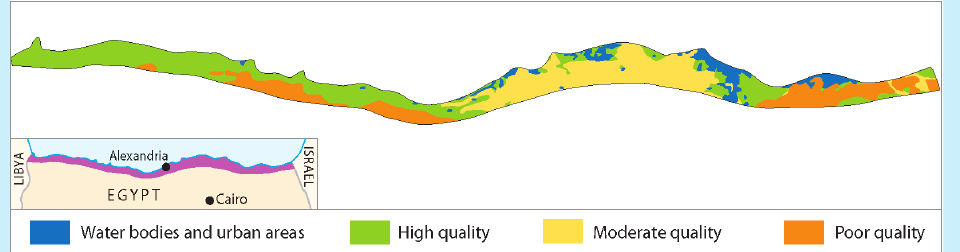
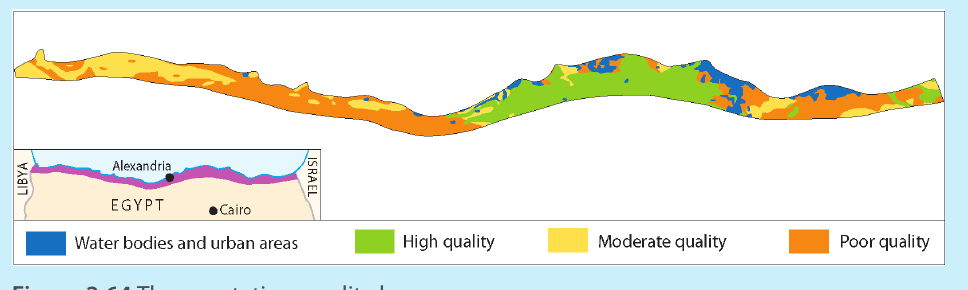
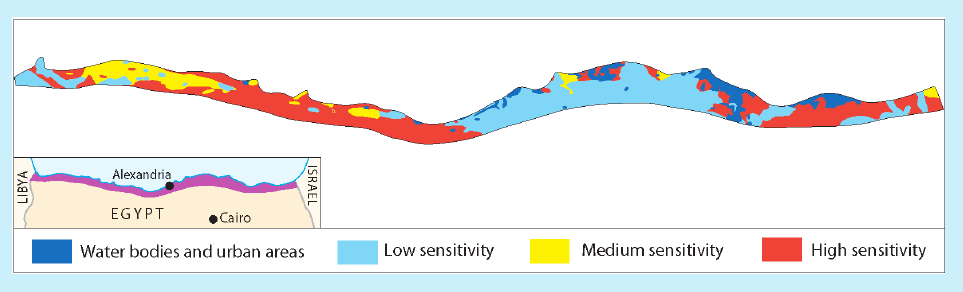
This type of scientific mapping helps decision-makers identify which areas need priority attention for desertification prevention and which management strategies would be most effective in different locations. The combination of satellite technology and computer analysis makes it possible to assess large areas quickly and accurately, supporting more effective management planning.
Summary
Key Points to Remember:
-
Prevention works differently for drought and desertification - while we cannot prevent droughts from occurring, desertification can be prevented through sustainable farming practices and addressing underlying social causes like poverty and lack of education
-
Prediction enables preparation - understanding climate patterns like El Niño and La Niña, along with local soil and vegetation characteristics, helps communities prepare for drought conditions before they become severe
-
Multiple strategies work together - effective management combines prevention, prediction, planning, and impact reduction rather than relying on any single approach
-
Traditional knowledge complements modern science - indigenous techniques like half-moon beds can be highly effective and should be valued alongside technological approaches like remote sensing
-
Addressing root causes is essential - successful management must tackle underlying social and economic factors like poverty, population pressure, and lack of alternative livelihoods, not just environmental symptoms