Earth's Energy Balance (Grade 11 NSC Matric Geography): Revision Notes
📚Revision Notes
Earth's Axis and Revolution
Introduction to solar energy and Earth's heating
Understanding how our planet receives and uses energy from the sun is essential for explaining weather patterns and seasonal changes. The sun acts as Earth's primary energy source, sending radiation through space to warm our atmosphere and surface.
Radiation refers to the transfer of energy through electromagnetic waves. When we talk about energy from the sun, we call this solar radiation. The sun produces short-wave radiation because it's extremely hot. In contrast, Earth emits terrestrial radiation, which has longer wavelengths because our planet is much cooler than the sun.
Note
The key difference between solar and terrestrial radiation lies in their wavelengths. Solar radiation is short-wave (high energy) due to the sun's extreme temperature of about 6,000°C, while terrestrial radiation is long-wave (lower energy) because Earth's surface temperature averages around 15°C.
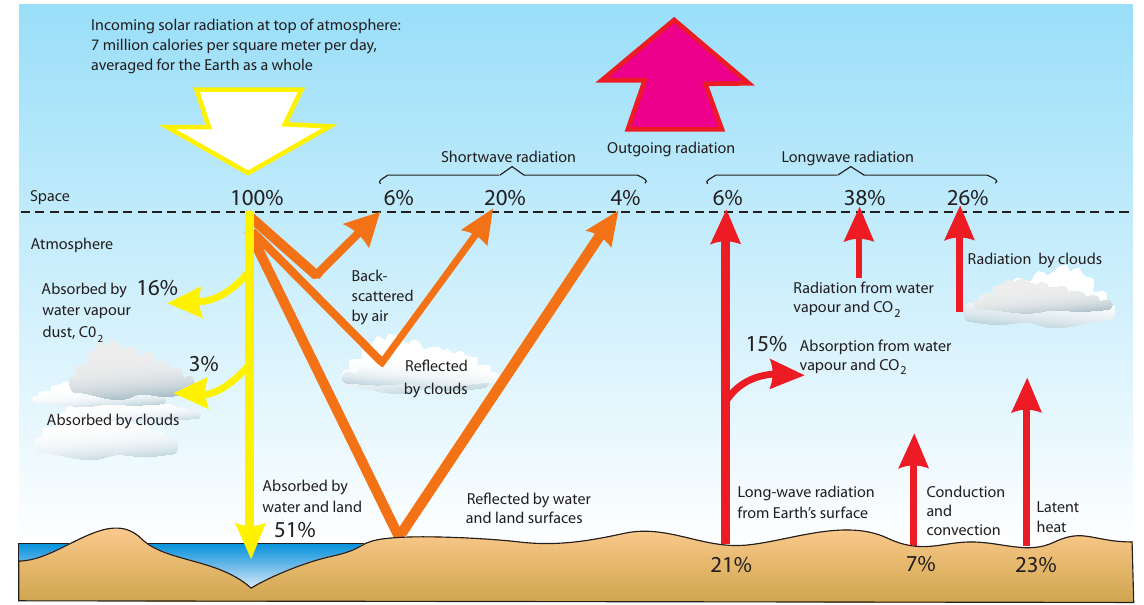
The atmosphere receives heat from Earth's surface in several ways:
- Radiation: Earth's surface absorbs solar energy and re-emits it as longer-wave radiation, which the atmosphere can absorb more easily
- Convection: Warm air near the surface expands and rises, carrying heat upward
- Conduction: Heat transfers directly between air molecules and Earth's surface through contact
- Latent heat release: When water vapour condenses in the atmosphere, it releases stored energy that was absorbed during evaporation
Note
These four heat transfer processes work together to distribute solar energy throughout Earth's atmosphere. Without these mechanisms, our planet would have extreme temperature differences between day and night sides.
Factors affecting solar radiation received
The amount of solar energy that reaches different parts of Earth's surface varies significantly. Two main factors control how much solar radiation any location receives:
Important
Two Critical Factors Determine Solar Energy Reception:
- Length of day and night - determines total exposure time
- Angle of the sun's rays - determines energy concentration per unit area
Understanding these factors is essential for explaining seasonal temperature variations and climate patterns.
Length of day and night
Earth only receives solar radiation during daylight hours. Areas with longer days naturally receive more total solar energy than places experiencing shorter daylight periods. This factor becomes especially important when we consider seasonal changes.
Angle of the sun's rays
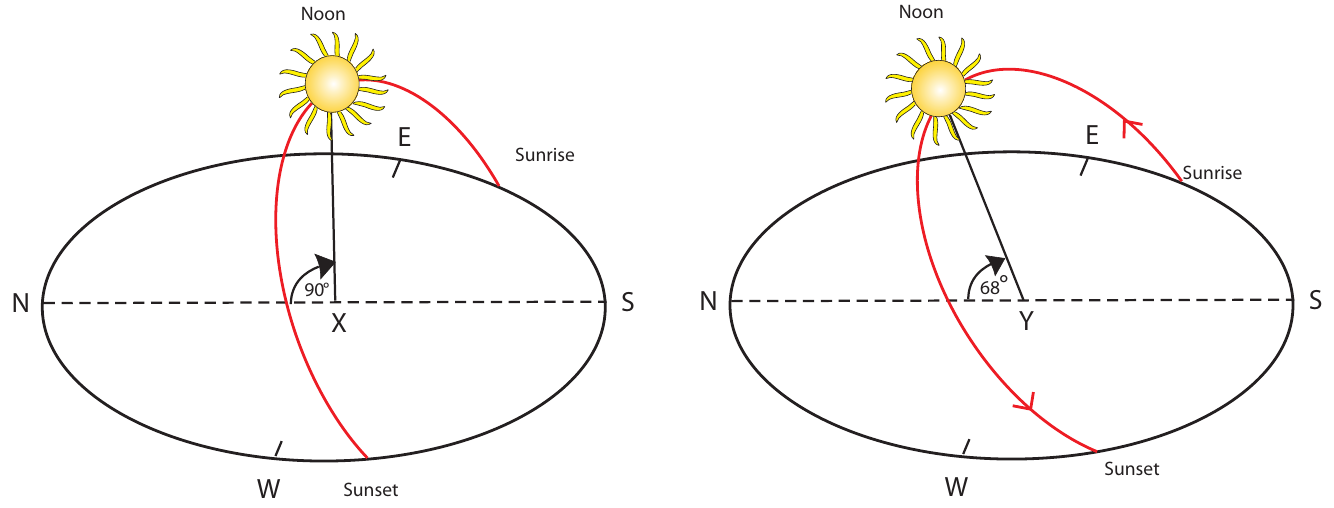
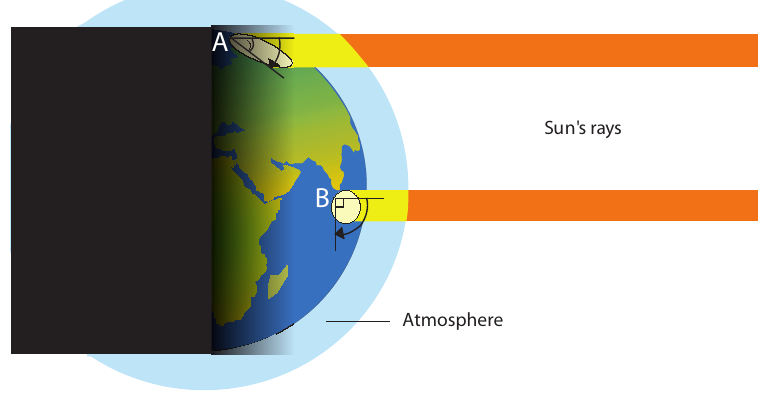
The angle at which sunlight strikes Earth's surface dramatically affects heating efficiency. When the sun is directly overhead ( angle), its rays are most concentrated and provide maximum heating. When the sun appears lower in the sky (smaller angles), the same amount of energy spreads over a larger area, reducing the heating effect per square metre.
Example
Worked Example: Sun Angle Effects
Imagine 1 unit of solar energy hitting Earth's surface:
- At (sun directly overhead): Energy concentrated in 1 square metre = maximum heating
- At : Same energy spread over approximately 1.4 square metres = reduced heating
- At : Same energy spread over 2 square metres = minimal heating
This explains why tropical regions (high sun angles) are consistently warmer than polar regions (low sun angles).
Additionally, when sunlight strikes Earth at lower angles, it must pass through more atmosphere before reaching the surface. This longer path means more energy gets absorbed or scattered by atmospheric particles, further reducing the amount that reaches the ground.
Earth's revolution and the parallelism of the axis
Earth takes approximately 365.25 days to complete one full orbit around the sun. During this journey, our planet maintains a crucial characteristic that creates the seasons we experience.
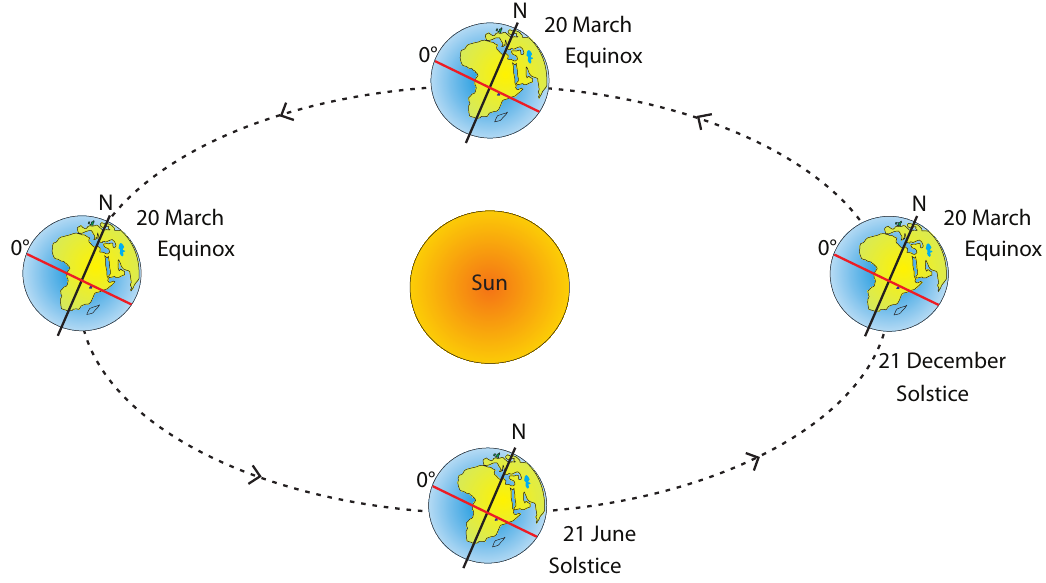
Parallelism of the axis describes how Earth's rotational axis always points in the same direction as our planet moves around the sun. Imagine Earth as a spinning top that maintains its tilt throughout its entire orbital path. This consistent tilt is what creates our seasonal variations.
Note
The spinning top analogy helps visualize parallelism of the axis. Just as a spinning top maintains its orientation while moving across a table, Earth maintains its tilt while orbiting the sun. This constant tilt direction is what causes different parts of Earth to receive varying amounts of solar energy throughout the year.
The orbit brings us to four key dates each year:
Solstices occur on 21 June and 21 December. During solstices, one hemisphere tilts toward the sun (experiencing summer) while the other tilts away (experiencing winter).
Equinoxes happen on 20 March and 22 September. At these times, neither hemisphere tilts toward or away from the sun, resulting in roughly equal day and night lengths globally.
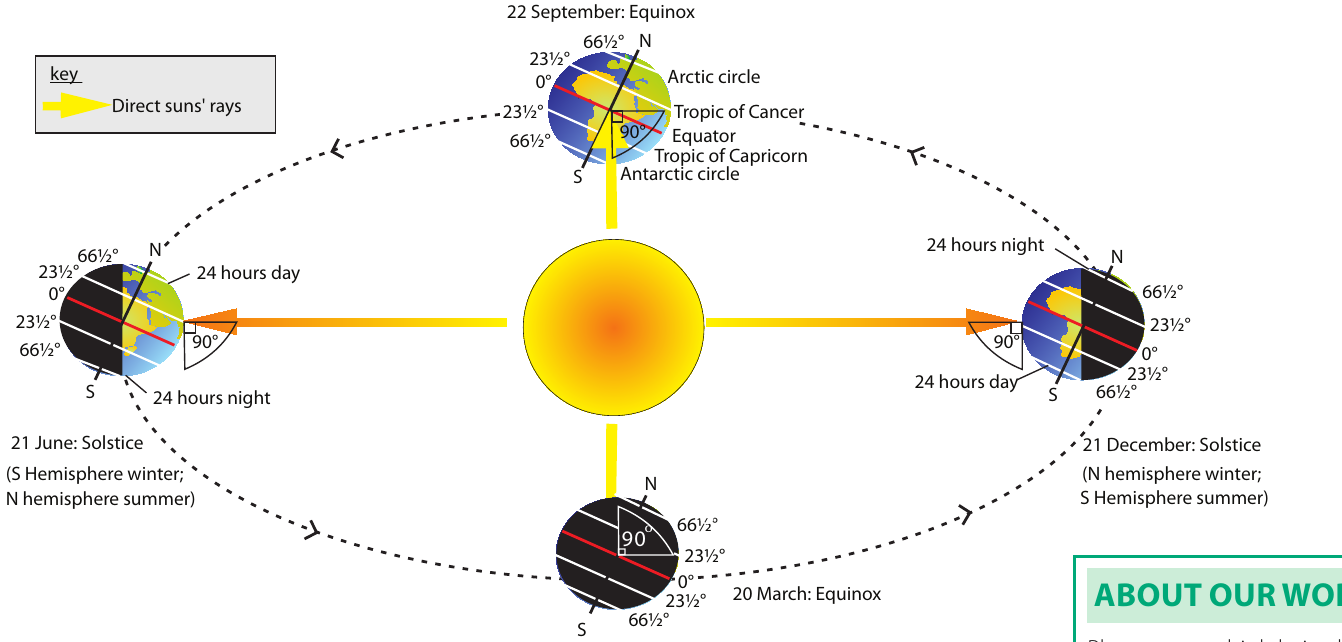
Effects of Earth's revolution on day length and sun angles
Earth's tilted axis and orbital movement create predictable changes in both daylight duration and the sun's apparent position throughout the year.
Changes in day and night length
The circle of illumination represents the boundary line separating Earth's lit and dark halves at any given moment. Due to our planet's axial tilt, this line affects different latitudes differently throughout the year.
Important
Critical Pattern: Day Length Variations
The circle of illumination creates predictable patterns that directly impact global weather and climate systems. These variations are not random but follow precise astronomical rules based on Earth's position in its orbit.
Key patterns include:
- At equinoxes: Day equals night everywhere on Earth (12 hours each)
- At solstices: The hemisphere tilted toward the sun experiences longer days and shorter nights, while the opposite hemisphere has shorter days and longer nights
- At polar regions: During summer, some areas experience 24 hours of daylight, while in winter, they may have 24 hours of darkness
Changes in the angle of the sun's rays
The apparent migration of the sun describes how the sun seems to move between the Tropic of Cancer (N) and the Tropic of Capricorn (S) throughout the year. This apparent movement results from Earth's orbital position and axial tilt.
| Date | Sun's Position | Tropic of Capricorn Angle |
|---|---|---|
| 21 June | Above Tropic of Cancer | |
| 22 September | Above Equator | |
| 21 December | Above Tropic of Capricorn | |
| 20 March | Above Equator |
These angle changes explain why different regions experience varying seasonal temperatures. When the sun appears higher in the sky, that location receives more concentrated solar energy and experiences warmer conditions.
Summary
Key Points to Remember:
-
Parallelism of the axis means Earth's rotational axis always points the same direction as it orbits the sun, creating our seasons
-
Solstices (21 June and 21 December) mark when one hemisphere tilts most toward or away from the sun
-
Equinoxes (20 March and 22 September) occur when neither hemisphere tilts toward the sun, creating equal day and night lengths globally
-
The angle of sun's rays affects heating efficiency - higher angles mean more concentrated energy and greater warming
-
Day length variations throughout the year result from Earth's tilted axis, with longer days in summer and shorter days in winter for each hemisphere