Global Circulation as a Response to Unequal Heating (Grade 11 NSC Matric Geography): Revision Notes
📚Revision Notes
Global Circulation as a Response to Unequal Heating
What is global air circulation?
Global air circulation refers to the large-scale movement of air masses across our planet. Think of it as a massive conveyor belt system that moves air around the Earth. Winds can travel thousands of kilometres, carrying air masses from one continent to another. This happens because different parts of Earth receive different amounts of solar energy, creating temperature differences that drive air movement.
Note
Think of global air circulation like a giant conveyor belt system - just as a conveyor belt moves items from one place to another, the atmosphere moves air masses across vast distances around our planet.
The most important thing to understand is that this circulation system exists because Earth is heated unevenly. The equator receives much more direct sunlight than the poles, creating temperature differences that cause air to move in predictable patterns.
The unicellular model of global circulation
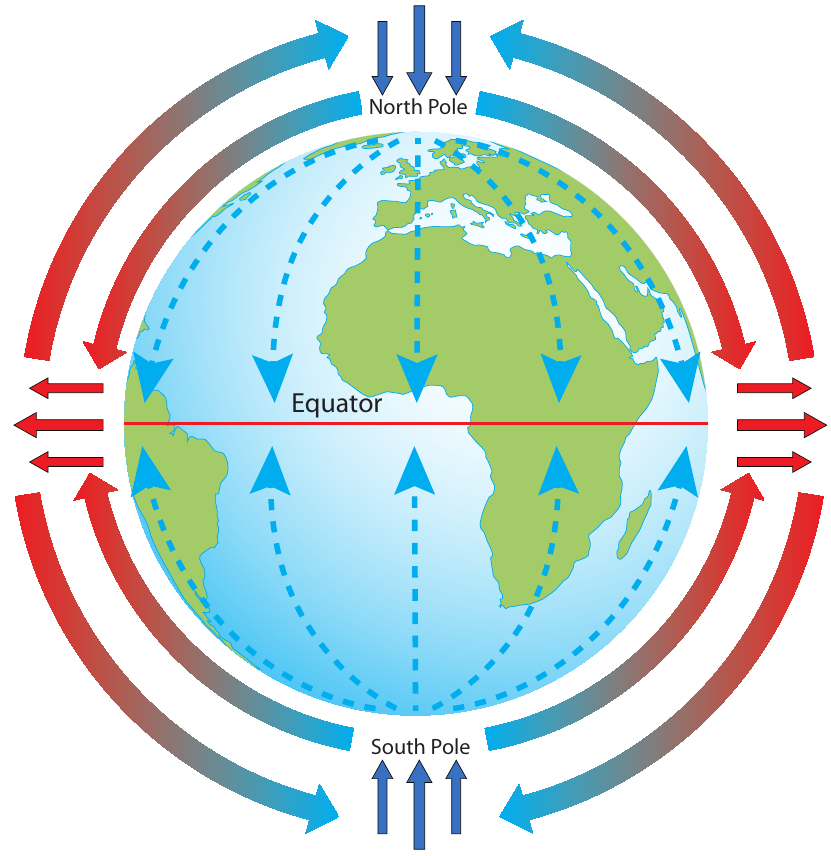
Scientists use a simplified model called the unicellular model to help us understand how global air circulation works. This model shows what would happen if Earth's circulation system operated as simply as possible.
Key features of the unicellular model
In this model, each hemisphere (northern and southern) has just one large circulation cell. Here's how it works:
Example
How the Unicellular Model Works: Step by Step
Step 1: At the equator - Warm air rises because hot air is less dense than cold air
Step 2: Moving poleward - This rising air moves towards the poles in the upper atmosphere
Step 3: At the poles - The air becomes colder and sinks back down to the surface
Step 4: Returning to equator - The cold air travels back towards the equator along the ground, completing the circulation loop
This creates a simple convection system - similar to how air moves in a room when you turn on a heater, but on a global scale.
Why this model is important
Important
The unicellular model helps us understand the basic principle behind all atmospheric circulation: unequal heating creates air movement. While the real atmosphere is much more complex, this model shows us the fundamental driving force.
Vertical and horizontal air movement
Air in our atmosphere moves in two main directions: vertically (up and down) and horizontally (sideways across Earth's surface).
Vertical air movement
Ascending air (moving upward):
- Occurs when air is heated and becomes less dense
- Rising air cools as it goes higher in the atmosphere
- Cool air can hold less moisture, so clouds and precipitation often form
- In the unicellular model, this happens at the equator
Subsiding air (moving downward):
- Occurs when air cools and becomes more dense
- Sinking air warms as it moves closer to Earth's surface
- Warm air can hold more moisture, so clear, dry conditions typically result
- In the unicellular model, this happens at the poles
Horizontal air movement (wind)
Air also moves horizontally across Earth's surface, which we experience as wind.
Convergence: When air moves towards the same location, we say it converges. This is like people walking towards the same meeting point.
Divergence: When air moves away from one location in different directions, we say it diverges. This is like people leaving a meeting and walking in different directions.
The connection between vertical and horizontal movement
Important
These two types of air movement are closely linked. When you have one type of movement, you must have the other to balance it out.
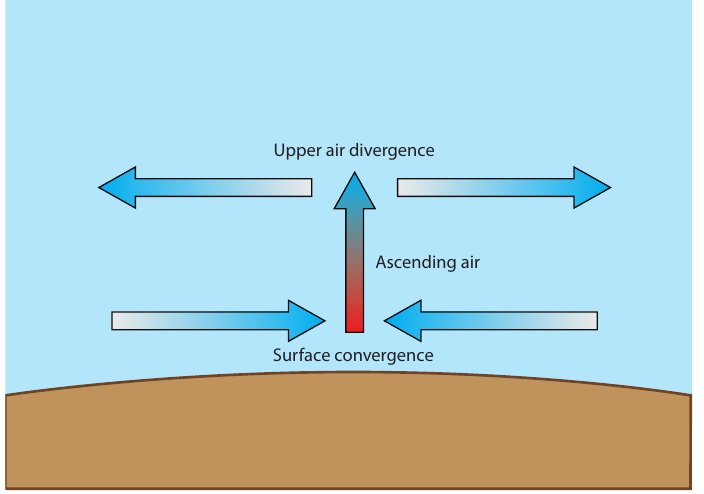
Surface convergence leads to ascending air:
- When air converges at the surface, it has nowhere to go but up
- This creates ascending air and upper air divergence
- Example: Air converging at the equator rises and then spreads out in the upper atmosphere
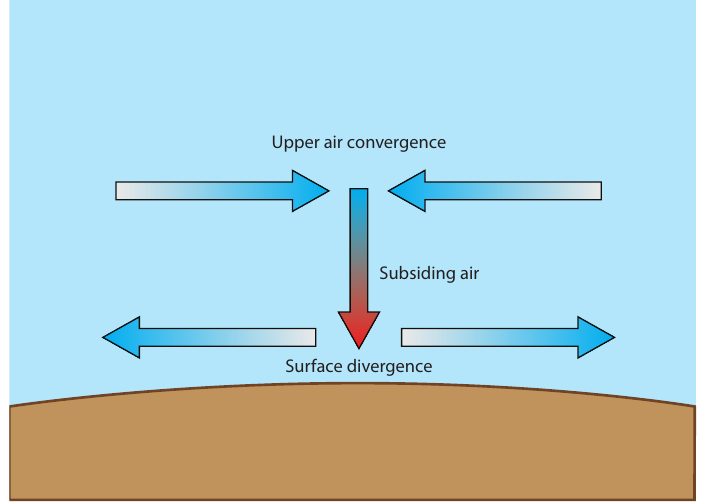
Surface divergence comes from subsiding air:
- When air sinks from above, it must spread out at the surface
- This creates subsiding air and surface divergence
- Example: Air sinking at the poles spreads out along the ground
Weather impacts of air circulation
Understanding air circulation helps explain different weather patterns:
Rising air creates wet conditions
- Ascending air cools as it rises
- Cool air cannot hold as much water vapour
- Water vapour condenses to form clouds and precipitation
- Areas with rising air tend to have more rainfall
Sinking air creates dry conditions
- Subsiding air warms as it descends
- Warm air can hold more water vapour without condensing
- This prevents cloud formation
- Areas with sinking air tend to have clear, dry weather
Note
Remember this simple pattern: Rising air = Rainy weather, Sinking air = Sunny weather. This relationship helps explain why some parts of the world are naturally wetter or drier than others.
Summary
Key Points to Remember:
- Global air circulation is driven by unequal heating of Earth's surface - hot air rises at the equator, cold air sinks at the poles
- The unicellular model shows one simple circulation cell in each hemisphere, helping us understand the basic principle
- Vertical movement: Air ascends (rises) when heated and subsides (sinks) when cooled
- Horizontal movement: Air converges (comes together) and diverges (spreads apart) to balance vertical movements
- Weather connection: Rising air generally brings wet weather, while sinking air brings dry conditions