The Tri-Cellular Model (Grade 11 NSC Matric Geography): Revision Notes
📚Revision Notes
The Tri-Cellular Model
The tri-cellular model helps us understand how air moves around our planet in a predictable pattern. This model shows that Earth's atmosphere has three main circulation cells in each hemisphere - the Hadley cell, Ferrel cell, and Polar cell. Each cell works like a giant conveyor belt, moving warm air towards the poles and cold air towards the equator.
Understanding the three circulation cells
The tri-cellular model is based on patterns of air rising (ascent) and sinking (descent), as well as air moving towards each other (convergence) and away from each other (divergence). These movements create three identical circulation cells in both the northern and southern hemispheres.
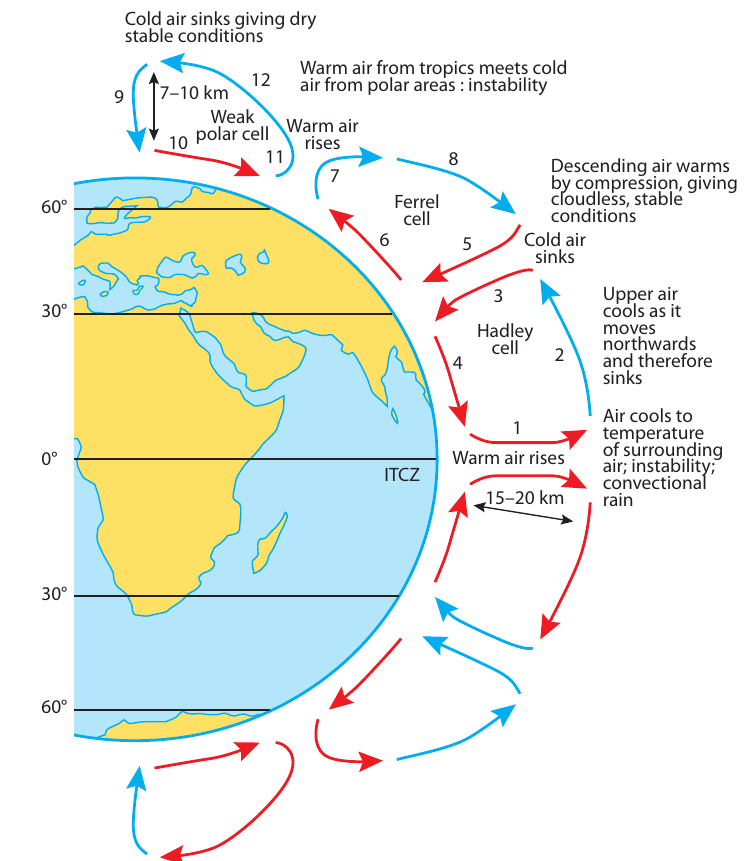
Each circulation cell has four main components:
- Two types of horizontal air movement (air moving along Earth's surface)
- Two types of vertical air movement (air rising and sinking)
Note
As air moves through these cells, it transports warm air towards the poles and cold air towards the equator, helping to balance temperatures across our planet. This heat transport mechanism is essential for maintaining Earth's climate system.
The Hadley cell
The Hadley cell operates between the equator and 30° latitude in both hemispheres. Here's how it works:
Example
Worked Example: Hadley Cell Circulation Process
Step 1: Hot air rises from Earth's surface at the equator. As this warm, moist air rises, it cools and forms tall cumulonimbus clouds that bring heavy rainfall.
Step 2: The risen air spreads out (diverges) in the upper atmosphere and moves towards the poles, cooling further as it travels.
Step 3: At about 30° latitude, this cooled air sinks back down to Earth's surface (subsides).
Step 4: At the surface, this subsiding air splits - some returns towards the equator, completing the Hadley cell circulation.
The area where the two Hadley cells (northern and southern) meet is called the Intertropical Convergence Zone (ITCZ). Here, winds from both cells converge, causing air to rise rapidly. This creates an area of low pressure where warm, moist air cools and releases latent heat, often producing heavy thunderstorms and rainfall.
Important
The ITCZ is a critical feature of global climate, as it's responsible for the seasonal monsoons and tropical rainfall patterns that billions of people depend on for agriculture and water resources.
The Ferrel cell
The Ferrel cell operates between 30° and 60° latitude in both hemispheres:
Example
Worked Example: Ferrel Cell Circulation Process
Step 5: Air subsides at 30° latitude, warms up due to compression, and then spreads out (diverges) at the surface.
Step 6: Some of this warmed air moves towards the poles.
Step 7: At about 60° latitude, this poleward-moving warmer air meets cold air that is moving towards the equator from the poles. When these different air masses meet, the air is forced to rise (convergence causes air to rise).
Step 8: In the upper atmosphere, this rising air diverges. Some moves towards the equator and then subsides at 30°, completing the Ferrel cell.
The Polar cell
The Polar cell operates between 60° latitude and the poles:
Example
Worked Example: Polar Cell Circulation Process
Step 9: Cold air subsides over the poles, creating high pressure areas.
Step 10: At the surface, this cold air moves towards the equator and meets the warm air from the Ferrel cell at about 60° latitude.
Step 11: The converging air at 60° rises into the upper atmosphere.
Step 12: This air then moves back towards the poles, completing the Polar cell circulation.
Air masses and fronts
The tri-cellular model creates large volumes of air with similar characteristics called air masses. These air masses have particular temperature and moisture properties depending on where they form.
When air masses with different characteristics meet, they create a boundary called a front. The most important front in this system is the Polar front, which forms at about 60° north and south where warm air from the tropics meets cold air from the polar regions.
Note
Understanding air masses and fronts is crucial for weather forecasting, as the interaction between different air masses often leads to the formation of weather systems like storms, rain, and temperature changes.
How the cells work together
The three circulation cells work together to transport heat from the equator (where Earth receives most solar energy) towards the poles (which receive less solar energy). This helps balance global temperatures and creates predictable weather patterns:
Note
Climate Patterns by Latitude:
- Equatorial regions: Rising air creates low pressure and wet conditions
- 30° latitude: Sinking air creates high pressure and dry conditions (many of the world's deserts are found here)
- 60° latitude: Converging air masses create changeable weather conditions
- Polar regions: Sinking cold air creates high pressure and dry conditions
The tri-cellular model connects closely with global pressure patterns, which influence wind systems and weather patterns around the world.
Summary
Key Points to Remember:
- The tri-cellular model consists of three circulation cells in each hemisphere: Hadley, Ferrel, and Polar cells
- Each cell has four components: two horizontal movements and two vertical movements
- The ITCZ is where the two Hadley cells meet, creating an area of rising air and heavy rainfall
- Air masses are large volumes of air with similar characteristics, and fronts form where different air masses meet
- The system helps transport heat from the equator to the poles, balancing global temperatures