Failure of Provisional Government and the Return of Lenin (Grade 11 NSC Matric History): Revision Notes
📚Revision Notes
Failure of Provisional Government and the Return of Lenin
Why the Provisional Government failed
The Provisional Government, established after Tsar Nicholas II's abdication in February 1917, faced insurmountable challenges that ultimately led to its downfall. Understanding these failures is crucial for grasping how the Bolsheviks gained power in October 1917.
Structure and leadership of the Provisional Government
The Provisional Government was led by Alexander Kerensky and consisted mainly of wealthy middle-class politicians who had previously served as ministers in the Duma.

This government was designed to be temporary, ruling only until a Constituent Assembly could be elected to decide Russia's permanent political future.
Note
This temporary arrangement created a fundamental weakness from the start. The government lacked legitimate authority since it had not been elected by the people, making it difficult to implement effective policies or maintain public support.
The problem of dual power
A critical flaw in the new system was the existence of dual power. The Provisional Government shared authority with the Petrograd Soviet, which represented workers and soldiers. This created a confusing and unstable political situation where two different bodies claimed to speak for the Russian people.
The Petrograd Soviet wielded enormous influence through Soviet Order Number 1, issued in March 1917. This order was revolutionary because it:
- Transferred power from army officers to committees of common soldiers
- Gave the Petrograd Soviet's commands priority over the government's orders
- Resulted in the complete collapse of military discipline, leaving the government effectively powerless
Important
The dual power system created an impossible situation where neither body could govern effectively. This fundamental structural weakness would prove fatal to the Provisional Government's survival.
Key failures of the Provisional Government
The government's inability to address Russia's most pressing problems sealed its fate. Despite implementing some important reforms, it failed catastrophically in areas that mattered most to ordinary Russians.
Successful reforms included:
- Establishing equality before the law for all citizens
- Granting freedom of religion, speech and assembly
- Recognising workers' rights to organise trade unions and strike
- Introducing an eight-hour working day
- Releasing political prisoners and allowing exiles to return to Russia
Critical failures included:
- Continuing the unpopular war: The government refused to withdraw from World War I, despite massive casualties and war-weariness among soldiers and civilians
- Ignoring peasant land demands: Peasants desperately wanted land redistribution, but the government failed to confiscate and redistribute the large estates owned by the Tsar and nobility
- Postponing elections: The government repeatedly delayed elections for the Constituent Assembly, making itself appear undemocratic and illegitimate
Important
The Three Fatal Failures
The Provisional Government's refusal to address the three issues that mattered most to ordinary Russians - ending the war, redistributing land, and holding democratic elections - created the perfect conditions for revolutionary upheaval.
Economic and social deterioration after 1914
By 1917, Russia's participation in World War I had devastated the country's economy and society. The war had created a cascade of problems that the Provisional Government seemed powerless to address:
- The railway system for transporting food to cities had broken down completely
- Traders became increasingly corrupt, creating black markets
- Food prices soared, but peasants received no benefit from higher prices
- Peasants had no incentive to produce surplus crops for the cities
- Many soldiers (who were peasants' sons) returned from the war to help seize land from landlords
Note
These conditions created a revolutionary atmosphere where radical change seemed not just desirable but necessary for survival. The economic collapse had made the existing system unsustainable.
The return of Lenin and its impact
Lenin's return to Russia in April 1917 marked a turning point that would ultimately lead to the October Revolution. His radical ideas and strategic leadership provided the Bolsheviks with a clear path to power.
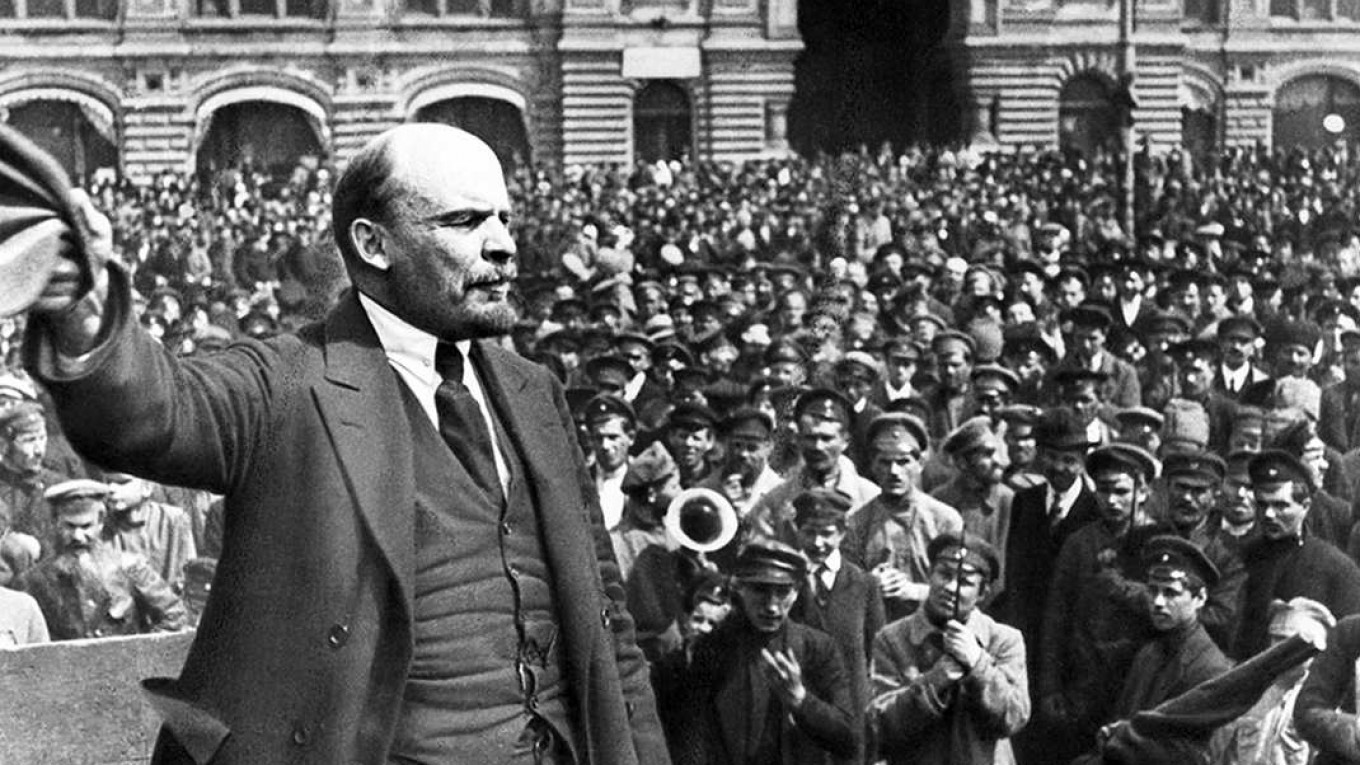
April 1917: political amnesty and Lenin's homecoming
As part of its liberal reforms, the Provisional Government granted amnesty to political exiles. Vladimir Lenin returned from exile in Switzerland, where many hoped he would help Russia find a way to exit World War I peacefully.
However, Lenin had very different plans. Rather than supporting the Provisional Government, he immediately began working to overthrow it.
Lenin's April Thesis
Upon his return, Lenin announced his revolutionary program that would reshape Russian politics.
Example
Lenin's "April Thesis" - Three Revolutionary Demands
Lenin's April Thesis contained three radical demands that shocked even his fellow Bolsheviks:
- Immediate overthrow of the Provisional Government
- Transfer all power to the soviets (workers' councils)
- Hand over all factories and land to peasants (following Marxist ideals)
These demands were far more radical than what most Russians expected, but they offered concrete solutions to Russia's crisis.
Lenin believed that successful revolution required dedicated revolutionary leadership rather than gradual democratic change.
Lenin's revolutionary strategy and beliefs
Lenin's approach to revolution was based on several key principles that distinguished him from other socialist leaders:
- Success required "a dedicated band of revolutionaries" rather than mass democracy
- The push for revolution should be immediate rather than waiting for ideal conditions
- His famous slogan "Peace! Land! Bread!" directly addressed Russians' three main concerns
This strategy proved highly effective because it offered simple, concrete solutions to Russia's most pressing problems, while the Provisional Government offered only vague promises of future improvement.
Events leading to the October Revolution
Throughout 1917, a series of crises weakened the Provisional Government while strengthening the Bolsheviks' position. Each event demonstrated the government's inability to control the deteriorating situation.
June 1917: the first All-Russia Congress of Soviets
In June 1917, representatives from soviets across Russia gathered in Petrograd for their first national congress. Although the Bolsheviks were in the minority at this gathering, Lenin's leadership helped them influence the proceedings significantly.

The Bolsheviks used this platform to openly call for civilians and soldiers to come onto the streets of Petrograd, condemn the Provisional Government, and demand an immediate end to the war.
Meanwhile, Minister of War Alexander Kerensky ordered a renewed military offensive against Austrian forces. This operation failed completely and further weakened Kerensky's position, demonstrating the government's continued military incompetence.
The July Days crisis
The July Days represented a series of anti-government demonstrations that nearly brought down the Provisional Government but ultimately backfired on the Bolsheviks.
What happened:
- Anti-government riots broke out in Russian cities
- These riots were inspired by Bolshevik slogans and anger over the failed war effort
- The riots caught Bolshevik leaders by surprise, showing they weren't yet ready to seize power
- The Provisional Government blamed the Bolsheviks for the violence
Consequences:
- Bolsheviks were banned as a political party
- Lenin was forced into exile once again
- Leon Trotsky, Lenin's important colleague, was imprisoned
- Many observers believed this marked the end of Bolshevik influence
Note
However, the July Days actually demonstrated the government's weakness and the growing popularity of Bolshevik ideas among ordinary Russians. What appeared to be a Bolshevik defeat was actually evidence of their increasing support.
The Kornilov Affair
The Kornilov Affair in August 1917 proved to be a decisive turning point that ultimately benefited the Bolsheviks despite their recent setbacks.
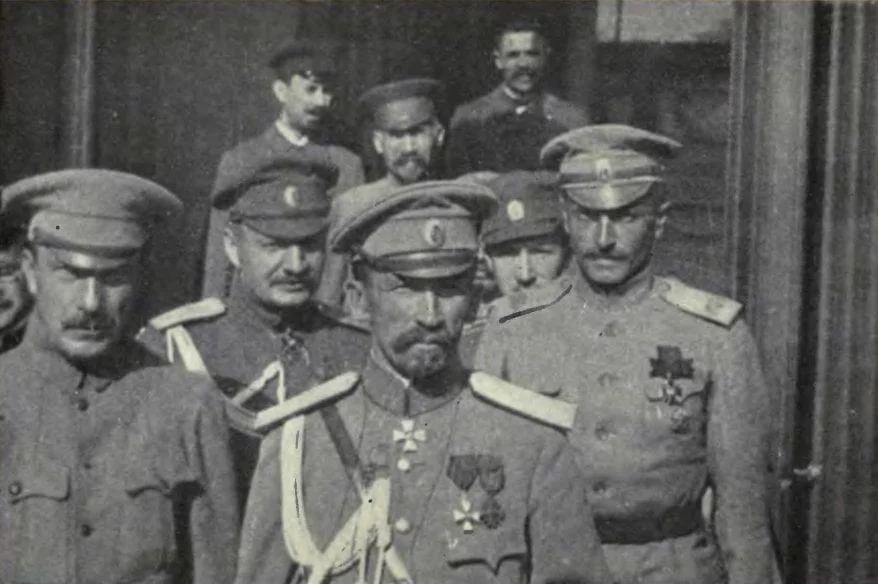
Background to the crisis:
- General Lavr Kornilov was appointed Commander-in-Chief of the Russian army by Kerensky in July 1917
- Kerensky hoped Kornilov would restore military discipline and effectiveness
- However, tensions developed between the two leaders over military strategy and political control
The attempted coup:
- Kornilov became convinced that Kerensky was plotting against him to establish a military dictatorship
- A member of the Provisional Government, Vladimir L'vov, deliberately created misunderstandings between Kerensky and Kornilov
- At the end of August, General Kornilov ordered his troops to march on Petrograd and declared martial law
The government's response: Faced with this military threat, the Provisional Government desperately called on the Petrograd Soviet for help. The Soviet's response was immediate and effective:
- Called a general strike and armed workers to stop Kornilov's advance
- Railway workers refused to move Kornilov's trains
- Workers took control of factories, electing committees to run them
- Peasants seized more land from landlords
- Many soldiers deserted to join the land seizures
Important
The Kornilov Affair's Unintended Consequences
This response effectively stopped Kornilov's coup, but it had unintended consequences that would prove fatal for the Provisional Government. By calling on the Soviet for help, the government had admitted its own powerlessness and strengthened the very forces that would soon overthrow it.
Lenin's opportunity emerges
After the Kornilov Affair, the political landscape had fundamentally changed. The balance of power had shifted decisively in favour of the radical left:
- Kerensky remained in government but was increasingly unpopular
- The Bolsheviks became more popular because they had helped stop Kornilov's military coup
- By September 1917, the Bolsheviks dominated the Petrograd and Moscow soviets
Lenin, who had been in hiding, returned to Petrograd in October and recognised this as the perfect moment to seize power. He planned to "seize power by force in the name of the soviets".
Opportunity vs Opposition:
- Lenin's opportunity: The Bolsheviks now had genuine popular support and controlled key soviets
- Opposition within the party: Many Bolsheviks felt the timing was still wrong and feared Lenin had no concrete plans for governing after seizing power
Despite internal opposition, Lenin convinced the majority of the Bolshevik Central Committee to support an armed uprising. Plans were carefully developed over the following two weeks.
Summary
Key Points to Remember:
-
Dual power weakened the Provisional Government - sharing authority with the Petrograd Soviet created confusion and prevented effective governance
-
The government's failure to end the war or redistribute land made it deeply unpopular with soldiers and peasants who formed the majority of Russia's population
-
Lenin's April Thesis and "Peace! Land! Bread!" slogan provided clear, radical alternatives to the government's failed policies
-
The Kornilov Affair backfired - intended to strengthen the government, it instead increased Bolshevik popularity and weakened the Provisional Government's military support