The Success of the February 1917 Revolution (Grade 11 NSC Matric History): Revision Notes
📚Revision Notes
The Success of the February 1917 Revolution
Background context - Russia's involvement in World War I
When World War I began, Russia entered the conflict alongside Britain and France. Initially, all political parties supported Russia's participation in the war. However, this decision would prove catastrophic for the Tsarist regime.

Note
The initial unity behind the war effort would quickly dissolve as military disasters and economic hardship mounted, creating the conditions for revolutionary upheaval.
Early military disasters
- 1915 saw a series of crushing military defeats for Russian forces
- These defeats forced Russia into full mobilisation - organising massive numbers of soldiers for war
- The Duma (Russian parliament) established special committees to coordinate the war effort across defence, industry, transportation and agriculture
- Russian factories doubled their production of armaments and weapons
Economic and social crisis
Despite increased war production, the mobilisation effort created severe problems by 1916:
Economic breakdown
The war's demands on Russia's resources created a cascade of economic problems that would ultimately doom the Tsarist system.
Important
The combination of military mobilisation and economic mismanagement created a perfect storm of conditions that made revolution almost inevitable.
- Severe food shortages developed across the country
- Strikes and public violence became common occurrences
- The situation in Petrograd (the capital) became extremely difficult for ordinary people
- War had caused low food supplies, high unemployment and uncontrolled inflation
- Wages failed to keep pace with rising prices
- Foodstuffs became scarce and famine threatened the population
Social unrest
The combination of these economic hardships created a powder keg situation in Petrograd, where hungry and angry people were reaching breaking point.
The unplanned uprising begins
Important
The February Revolution was not a carefully planned political coup. Instead, it began as an unplanned uprising of hungry, angry people in Petrograd.
How it started
The revolution began in an unexpected way:
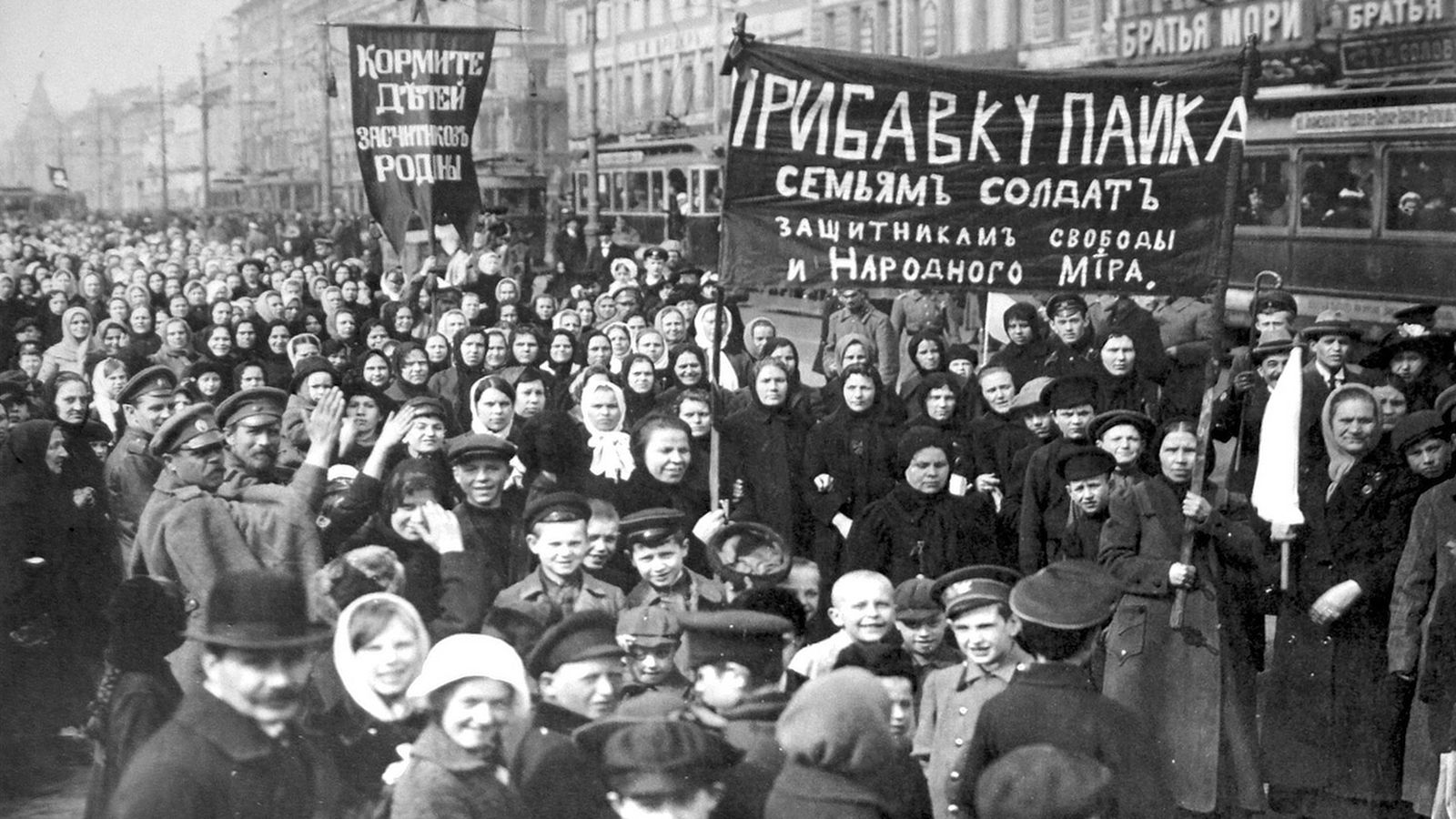
- February 1917 - Women gathered in Petrograd to mark St Peter's day
- This gathering turned into a protest calling for 'bread and peace'
- The women were soon joined by men, calling for an end to the war and monarchy
Government response fails
- Crowds and violence grew, forcing Petrograd factories to close
- The Tsar ordered police and army to intervene to stop the protesters
- However, police and army mutinied and joined the protesters instead of stopping them
Note
This military mutiny was crucial to the revolution's success - without loyal forces, the Tsar's government could not maintain control.
Complete collapse of authority
By October 1917 (using the old Russian calendar), the situation had spiralled completely out of control:
- Over 80,000 troops had mutinied
- Rioting was widespread across the capital
- Police were powerless to control the crowds
- Workers captured police stations, destroyed buildings and seized weapons
The government's desperate plea
Prime Minister Mikhail Rodzianko sent an urgent telegram to Tsar Nicholas II, warning:
Note
Rodzianko's Desperate Warning:
The situation is serious. The capital is in a state of anarchy. The Government is paralysed. Transport service and the supply of food and fuel have become completely disrupted. General discontent is growing... There must be no delay. Any procrastination is tantamount to death.
The Tsar's fatal mistakes
Ignoring the crisis
Despite this desperate warning, the Tsar ignored the situation and underestimated its severity. His response showed he was completely out of touch with reality.
Failed attempts at control
Important
The Tsar's Critical Errors:
The Tsar's response to the crisis only made the situation worse, demonstrating his complete failure to understand the gravity of the situation.
The Tsar made several critical errors:
- He ordered the Duma to disband rather than working with them
- The Duma continued to meet secretly and agreed that unrest would continue while the Tsar remained in power
- The Petrograd Soviet (dominated by Mensheviks) began calling for revolution and an end to monarchy
- When the Tsar ordered soldiers to restore order, they ignored his commands and joined the revolutionaries
- The Duma declared a provisional government to replace Tsarist rule
The final collapse
Abdication
On 14 March 1917, Tsar Nicholas II abdicated, ending over 300 years of Romanov rule in Russia.

Consequences
Note
The End of Imperial Russia:
The abdication marked not just the end of Nicholas II's reign, but the complete collapse of the centuries-old Romanov dynasty and the imperial system in Russia.
- The Tsar's brother refused to take leadership, leaving Russia without a monarch
- The Tsar and his family were banished to Siberia in 1918 and eventually murdered
- Two competing authorities emerged: the Provisional Government and the Petrograd Soviet, creating a situation known as "dual power"
Why the February Revolution succeeded
The revolution succeeded because of several key factors working together:
Economic desperation
The severe food shortages and economic hardship created massive popular discontent that the government could not ignore or suppress.
Military breakdown
The crucial factor was the mutiny of police and army units. Without loyal forces, the Tsar's government had no way to maintain order or suppress the uprising.
Government weakness
The Tsar and his government were completely unprepared for the crisis and made poor decisions that only made the situation worse.
Popular unity
Different groups - women, workers, soldiers - came together around the simple demands of "bread and peace", creating an unstoppable movement.
Lack of planning worked in their favour
Because the revolution was unplanned and spontaneous, the government had no advance warning and could not prepare counter-measures.
Summary
Key Points to Remember:
- The February Revolution began as an unplanned uprising by hungry women in Petrograd demanding "bread and peace"
- The revolution succeeded because police and army mutinied and joined the protesters instead of suppressing them
- Economic crisis from WWI created the conditions for revolution - food shortages, inflation, and unemployment
- Tsar Nicholas II abdicated on 14 March 1917, ending centuries of Romanov rule
- The revolution created dual power between the Provisional Government and the Petrograd Soviet, setting up future conflicts