The Origins of Afrikaner Nationalism (Grade 11 NSC Matric History): Revision Notes
📚Revision Notes
The Origins of Afrikaner Nationalism
How Afrikaner nationalism began to develop
Afrikaner nationalism, known as Volkseeenheid, emerged as a political movement during the late 19th century. However, its foundations were established much earlier through two crucial historical developments that shaped Afrikaner identity and consciousness.
The Great Trek and Boer Republics
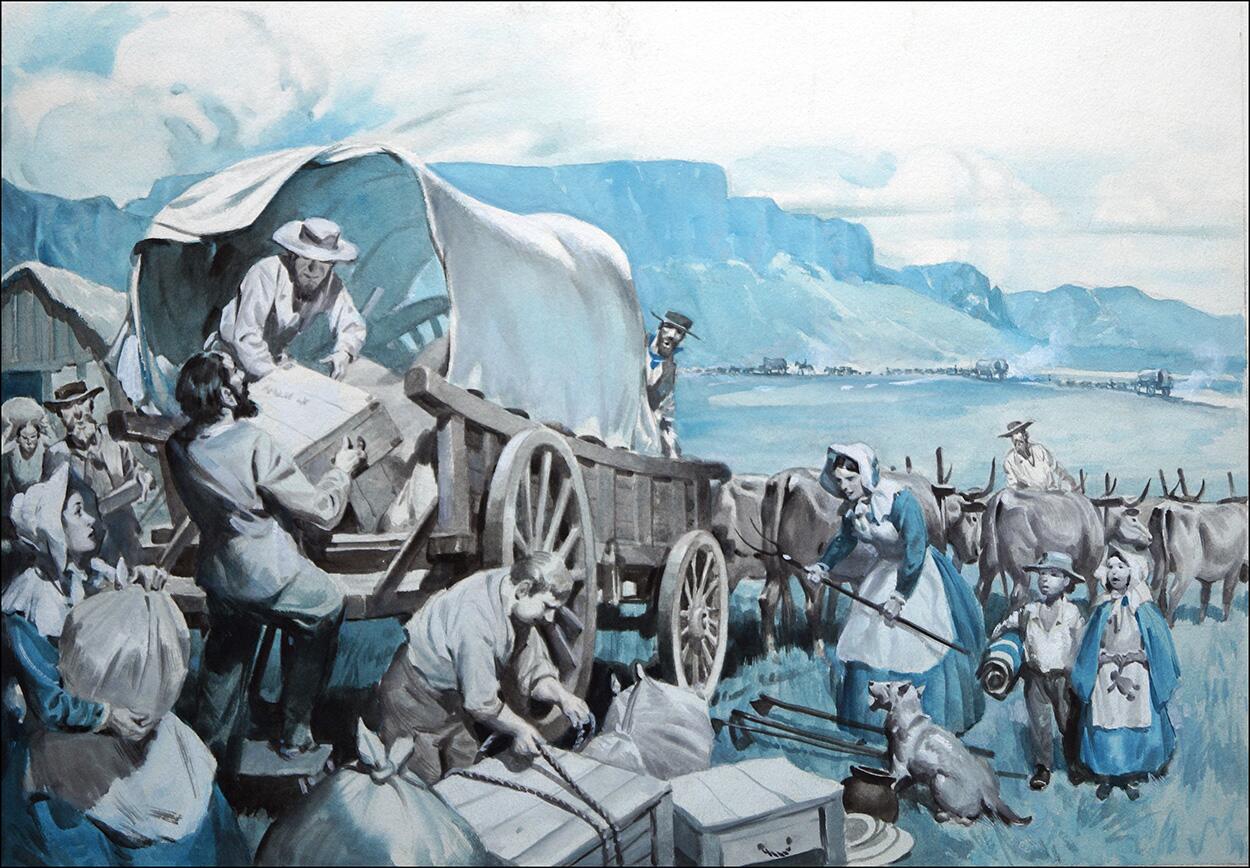
The Great Trek (1835-1846) served as the foundational event for Afrikaner nationalism. This mass migration involved Dutch-speaking colonists moving from the Cape Colony into the interior of southern Africa. The trekkers were primarily motivated by their desire to find new land and establish their own homeland, free from British control and interference.
Important
The Great Trek became a powerful symbol representing the determination and courage of the Boer people. It embodied their yearning for independence and freedom from foreign rule, establishing the ideological foundation for future Afrikaner nationalist movements.
This historic journey helped establish the Boer Republics during the 19th century, where Afrikaners could govern themselves according to their own values and traditions. Through these experiences, Boers began to define themselves in opposition to both British colonial authorities and African populations.
Note
The concept of Afrikaners as a 'chosen people' with a special destiny in South Africa emerged from these early experiences of independence and self-governance in the interior regions.
Early nationalist influences
Several factors contributed to strengthening this sense of Afrikaner identity:
- The Afrikaner Bond (late 1800s to 1910) played a crucial role in early political organisation
- Strong anti-British feelings developed, particularly after the experiences of the Boer Wars
- A desire emerged to maintain Afrikaners as a distinct group, separate from both English-speaking whites and African populations
This early nationalism initially took two different forms: a narrow, exclusive version that wanted nothing to do with other groups, and a more moderate approach that was open to collaboration with others.
Stephanus du Toit's contributions
Stephanus du Toit, a minister in the Dutch Reformed Church, became the first major champion of Afrikaner nationalism. His most significant achievement was establishing the Society of True Afrikaners (Die Genootskap van Regte Afrikaners) in Paarl on 14 August 1875.
Du Toit promoted the revolutionary idea that Afrikaners constituted a distinct nationality with their own fatherland (South Africa) and unique language (Afrikaans). He believed that the Afrikaner people had a destiny to rule South Africa.

Note
Through his publication of Die Patriot, the first Afrikaans-language newspaper, du Toit created a powerful tool for promoting Afrikaner language and nationalist ideas. This newspaper became widely read and helped spread nationalist ideology throughout Afrikaner communities.
The development of Afrikaner political movements
Political divisions emerge
Du Toit's vision of Afrikaner nationalism eventually led to significant political divisions. In 1934, a group of narrow Afrikaner nationalists, led by Dr DF Malan and including 19 Afrikaner MPs, broke away from more moderate Afrikaner leaders like Barry Hertzog and Jan Smuts.
This breakaway group formed the Purified National Party (PNP) after the moderate leaders merged with others to create the United Party. The PNP did not initially have support from all Afrikaners, as only a few accepted the party's vision of a 'pure' Afrikaner nation.
Important
However, the PNP emphasised unity among all Afrikaans-speaking white people against 'foreign' elements, including black South Africans, Jewish people, and English-speaking South Africans. By 1948, the Purified National Party had mobilised enough support from the majority of Afrikaans speakers to win elections and rule South Africa until 1994.
Economic and cultural drivers
Several factors explain why Afrikaner nationalism gained such strong appeal across different groups:
Note
Economic concerns: Many Afrikaner farmers and businessmen felt that the economy was dominated by English-speaking and foreign companies. They believed government economic policies favoured these English and foreign business interests, making it difficult for Afrikaner businessmen to advance. This created a strong desire to see Afrikaners gain control of government as an economic solution.
Note
Impact of the Great Depression: Poor whites and black workers were driven off farms and forced to move to cities to seek employment. This created competition between different racial groups for jobs. The PNP promised to keep black people out of certain jobs and employ Afrikaners instead, appealing to poor Afrikaner whites who were struggling economically.
Note
Cultural factors: Various movements were founded to advance Afrikaner language, culture, and religion. These portrayed Afrikaners as an exclusive nation with their own distinct identity, making culture a key driver of nationalist sentiment.
Afrikaans language movements
The importance of language unity
During the 19th century, there was no single unified Afrikaner language. Recognising that language could create cultural and national unity among all Afrikaners, organised movements developed to establish Afrikaans as a distinct language.
First Afrikaans Language Movement (1875-1900)
The movement began with the establishment of Die Genootskap van Regte Afrikaners (GRA) in Paarl in 1875. The term 'Afrikaner' began to develop a narrower association with white Afrikaans speakers, despite people of different races and ethnicities speaking the language.
The GRA aimed to create an Afrikaans language specifically for white Afrikaners, distinct from Dutch. However, this First Afrikaans Language Movement had limited appeal and functioned mainly in the Paarl area. It only had one publication, Die Patriot, and began to collapse towards the end of the 19th century.
Second Language Movement (1900-1930)
The Peace of Vereeniging (31 May 1902) ended the South African War, and Lord Milner promised that Dutch would be maintained as an official language. However, he broke this promise, and the government instead pursued a policy of anglicisation.
Important
This anglicisation process continued in the former Boer Republics, forcing all Afrikaners to speak English. Milner's administration targeted schools particularly, and English also became the official language in Transvaal and Natal.
Legislation did provide for Dutch language rights in administration, justice, and education, but English remained dominant. The struggle to establish Afrikaans resumed with greater vigour. Parents and teachers, aided by supporters from the Netherlands, began setting up private schools where the curriculum could focus on Christian Afrikaner nationalism.
The Union of South Africa formation (1910) helped advocate for establishing Afrikaans as an alternative written medium.
Note
Recognition achieved: Through the Act of Parliament in 1925, Afrikaans obtained official recognition. The Bible was translated into Afrikaans in 1933, and Afrikaans developed rapidly as both a literary medium and a medium for science and technology. This led to the establishment of four Afrikaans-speaking universities.
Cultural and organisational developments
The Afrikaner Broederbond
Jong Zuid Afrika (Young South Africa) was formed in 1918 by a small group of Afrikaner intellectuals dedicated to advancing Afrikaner interests. By 1919, it became the Afrikaner Broederbond.

The Broederbond operated as a secret society of carefully selected Afrikaner men. Their aims included furthering Afrikaner nationalism in South Africa and gaining control of the South African government. They sought to build a united Afrikaner nation based on conservative, puritanical religion, develop and promote the Afrikaans language, keep Afrikaner workers away from socialist trade unions, and promote Afrikaner business interests.
Note
During the 1930s, the Broederbond grew rapidly and developed an exclusive Afrikaner nationalist ideology designed to appeal to all Afrikaners. The organisation was structured to appeal to businessmen, professionals, farmers, and workers who felt excluded from the current political system. Almost every Afrikaans-speaking leader became a member, and they tried to influence thinking and policies with their ideas at every opportunity.
Federation of Afrikaner Cultural Associations
The Broederbond established separate Afrikaner institutions to help achieve their aims. These included separate cultural institutions alongside existing ones, such as transforming Boy Scouts into Voortrekkers, Red Cross into Noodhulpliga, and the National Union of South African Students into the Afrikaner Studentebond.
Note
The Federation of Afrikaner Cultural Associations (FAK) coordinated cultural activities, ensuring that Afrikaner nationalist ideology and the creation of a distinct Afrikaner identity were fostered and encouraged at every level of society.
Economic nationalism
The government under Barry Hertzog adopted affirmative action policies in the 1930s to uplift the poorest whites, who were mainly Afrikaans-speaking. Public services and state-owned corporations like South African Railways, Iron and Steel Corporation (ISCOR), and Electricity Supply Commission (ESCOM) adopted racial employment policies that favoured white workers over black and coloured workers.
Volkskapitalisme emerged as an economic movement with two main organisations:
- Broederbond: Not anti-capitalist but strongly opposed to foreign capital
- Reddingsdaadbond: Formed by Afrikaner businessmen who called on Afrikaner workers to save in Afrikaner banks, shop in Afrikaner shops, and buy insurance from Afrikaner insurance companies
Media and cultural identity
The spread of Afrikaner nationalism was greatly assisted by new emerging print media. The Broederbond started nationalistic Afrikaans language newspapers, including Die Burger (with DF Malan as first editor) and Die Transvaler.
Note
Afrikaner nationalists constructed an 'imagined community' by depicting Afrikaners through stories as a unified nation with a heroic past, moral purpose, and special place among other nations. These ideas spread through print media, including the Christian-nationalistic journal Koers (Direction) and books published by Burger Boekhandel publishing house.
Important
This exclusive type of nationalism regarded only Afrikaners as belonging to the nation, designed to keep economic and political power in Afrikaner hands while keeping black people excluded from all aspects of life in South Africa.
Summary
Summary
Key Points to Remember:
-
Afrikaner nationalism originated from the Great Trek (1835-1846) and the establishment of Boer Republics, which created a sense of Afrikaner identity separate from British rule
-
Stephanus du Toit was the first major champion of Afrikaner nationalism, establishing the Society of True Afrikaners and publishing Die Patriot newspaper in 1875
-
Language movements were crucial for unifying Afrikaners, with the Second Language Movement (1900-1930) successfully establishing Afrikaans as an official language in 1925
-
The Afrikaner Broederbond became a powerful secret society that influenced politics and culture, helping to spread exclusive nationalist ideology throughout Afrikaner society
-
Economic competition and the Great Depression drove many Afrikaners to support nationalist parties that promised jobs and protection from foreign economic domination