The Establishment of Israel and the 1948 War (Grade 11 NSC Matric History): Revision Notes
📚Revision Notes
The Establishment of Israel and the 1948 War
Background to the conflict
The creation of Israel in 1948 was the result of competing nationalist movements that developed in the Middle East during the late 19th and early 20th centuries. Understanding these origins is crucial to grasping why the 1948 War occurred.
Note
The competing claims to the same territory by both Jewish and Arab nationalist movements created an inevitable conflict that would shape Middle Eastern politics for decades to come.
Jewish nationalism and Zionism
Zionism emerged in the 1890s as a response to widespread anti-Semitism in Europe. Jewish communities had been scattered across the world in what is known as the diaspora since Roman times, often facing persecution and discrimination.
Key developments in Zionism included:
- 1897: Jewish leaders met in Basel, Switzerland, led by Theodor Herzl, to discuss creating a Jewish homeland
- The Basel Program proposed finding a legal refuge for Jews in Israel
- Zionists claimed the land of Israel based on biblical grounds
- The movement had two main strategies:
- Encourage Jewish immigration to Palestine
- Lobby governments in Europe and the USA for support
Note
Not all Jews supported this movement initially, as many had integrated into their local communities and adopted new languages and customs during the diaspora. This created divisions within Jewish communities about whether a separate homeland was necessary or desirable.
Arab nationalism
Arab nationalism developed as a reaction to Ottoman rule and later European colonialism. Key points include:
- Arabs had been under Turkish Ottoman rule since the 1500s
- 1913: The First Arab National Congress led to the Arab Nationalist Manifesto in 1914
- Arabs wanted to create a single, united Arab nation independent from Turkish control
- During World War I, Arabs helped Britain defeat the Turks, expecting independence in return
However, Britain, France and Russia had different plans and signed the Sykes-Picot Treaty to divide Turkish territories among themselves.
The Balfour Declaration (1917)
This was a crucial turning point in the conflict. In 1917, British Foreign Secretary Lord Arthur James Balfour wrote to Lord Rothschild, a leader of the British Jewish community, promising support for a Jewish state in Palestine after World War I.

Important
The Balfour Declaration created conflicting commitments that would prove impossible to reconcile. Britain simultaneously promised support for a Jewish homeland while also encouraging Arab nationalism against the Ottoman Empire, setting up the fundamental contradiction that would lead to decades of conflict.
Why did Britain make this promise?
- Britain wanted to win Jewish support in the USA during the war
- Britain was simultaneously trying to gain Arab support against Turkey
- The declaration clashed with Britain's promises to Arabs about Middle Eastern independence
Palestinian Arab reactions
Palestinian Arabs argued that Britain planned to create a Jewish state in Palestine as a way of securing its imperial ambitions in the Middle East. They saw this as a betrayal of earlier promises of Arab independence.
The League of Nations mandate
After World War I, the League of Nations gave Britain and France mandates to rule over former Ottoman territories:
- Britain received mandates over Palestine, Trans-Jordan, and Iraq
- France controlled Syria and Lebanon
- Only Saudi Arabia became an independent Arab kingdom
Britain's Palestinian mandate specifically required implementing the Balfour Declaration. Zionists interpreted this as international support for creating a Jewish national home in Palestine.
Rising tensions and violence
The period between the wars saw increasing conflict as both communities became more organized and militant in pursuing their nationalist goals.
Important
The escalating cycle of violence during the 1920s and 1930s established patterns of retaliation and counter-retaliation that would characterize the conflict for generations. Each community's actions reinforced the other's sense of being under existential threat.
Key events included:
- 1921 and 1929: Palestinian Arab uprisings against British rule led to violent clashes
- 1930s: Jewish immigration increased as Hitler began persecuting Jews in Germany
- 1936: Another major Palestinian uprising coordinated by the Arab Higher Committee
- Britain struggled to balance Jewish and Arab demands
By 1937, Britain proposed partitioning Palestine into separate Jewish and Arab states, but this was rejected by Palestinian Arabs.
The UN Partition Plan (1947)
After World War II, the Holocaust had killed 6 million Jews, increasing international sympathy for Zionism. The issue was handed to the United Nations.
The UN proposal
-
April 1947: The UN considered the Palestinian question
-
The partition plan allocated more than half of Palestine to the proposed Jewish state
-
The plan was supported by the USA, Soviet Union, and other Western powers

Reactions to the partition plan
The partition plan revealed the irreconcilable differences between the two communities and set the stage for immediate conflict.
Note
Jewish response: Jews accepted the plan in principle but disagreed with some proposed borders. They viewed it as international recognition of their right to statehood, even if the proposed boundaries were not ideal.
Note
Arab response: Palestinian Arabs and their allies completely rejected the plan, insisting Palestine should remain part of Syria. They viewed the UN decision as illegitimate interference by foreign powers in their homeland.
Violence escalates
The immediate aftermath of the UN decision saw the breakdown of any remaining cooperation between the communities:
- Palestinian groups attacked British and Jewish installations
- The Haganah (Jewish armed group) retaliated by attacking Arab communities
- 1946: The Irgun (another Jewish armed group) led by Menachem Begin bombed British military headquarters in Jerusalem, killing over 100 people
- Britain lost control and began withdrawing its 100,000 troops in May 1948
Declaration of Israel and the 1948 War
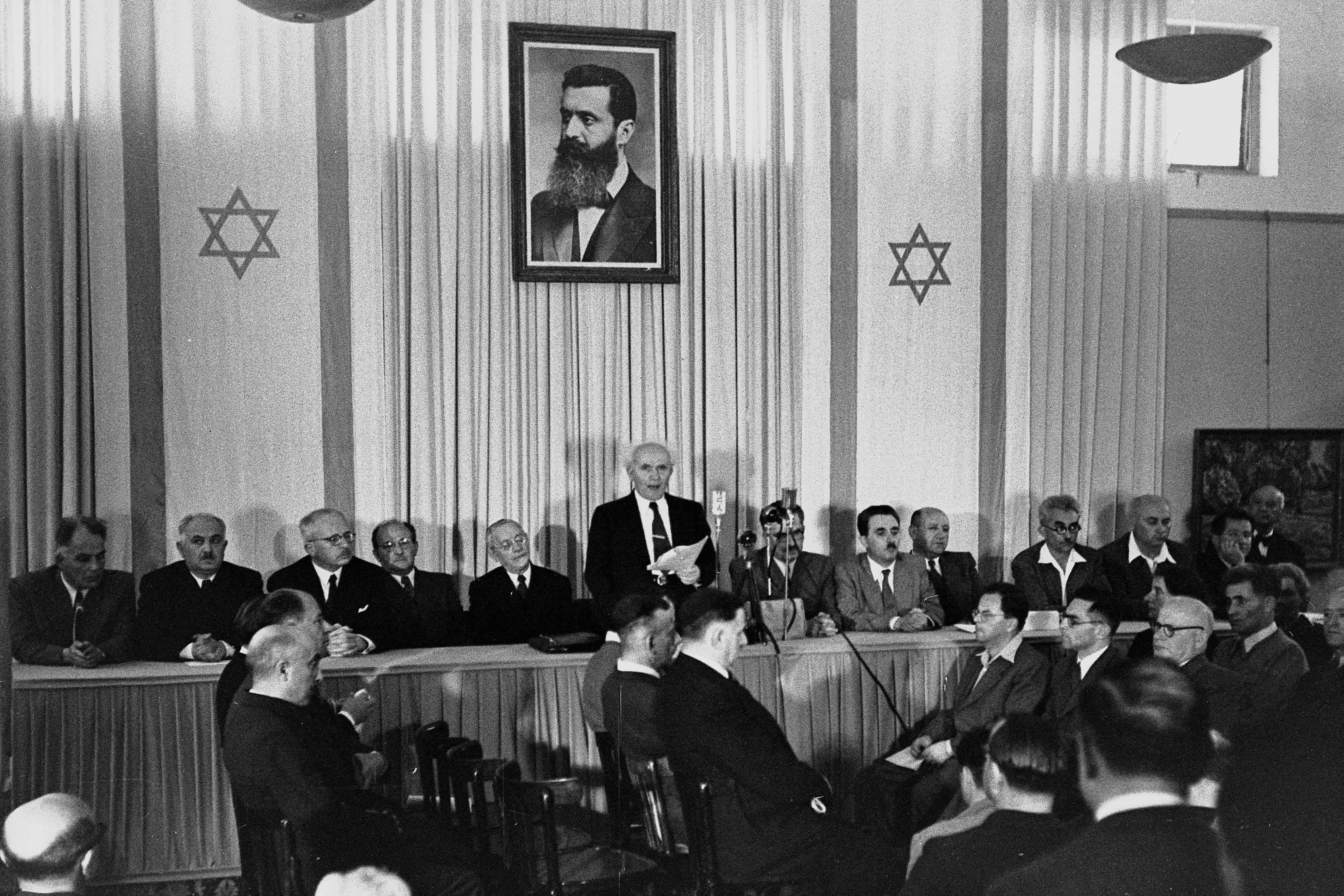
On 14 May 1948, David Ben-Gurion declared the establishment of the state of Israel based on the UN partition plan. This was immediately recognised by Western countries and the Soviet Union.
The war begins
A coalition of seven Arab states declared war on Israel, aiming to create a 'United State of Palestine' instead of the two-state UN plan.
Arab forces: Lebanon, Syria, Iraq, Egypt, Jordan, plus volunteers from Saudi Arabia, Libya, and Yemen, along with numerous kibbutzim (Jewish settlements).
Israeli forces: The Israeli army was strengthened by the daily arrival of 1,000 Jewish immigrants from the diaspora.
War outcomes
Example
Timeline of Armistice Agreements:
The war ended in 1949 with Israel signing separate armistices with:
Step 1: Egypt (24 February)
Step 2: Lebanon (23 March)
Step 3: Jordan (3 April)
Step 4: Syria (20 July)
Result: Israel's territory increased by about one-third more than originally allocated under the UN partition plan.
Contrasting perspectives on the 1948 War
The 1948 War created two fundamentally different narratives that continue to shape the conflict today.
The Israeli perspective
Note
The Israeli Narrative: War of Independence
Israelis viewed the war as a fight for survival and independence:
- They saw Palestinian attacks as evidence of Arab anti-Semitism
- Believed they had no choice but to fight to win
- Argued they were defending themselves after being attacked
- Claimed international support justified their cause
- Some extremist actions occurred but were exceptions, not policy
The Palestinian Arab perspective
Note
The Palestinian Narrative: An-Nakba (The Catastrophe)
Palestinians called the events of 1948 "An-Nakba" (the catastrophe):
- Blamed Britain for the marginalisation of Palestinians
- Argued the UN partition plan was completely unjust
- Claimed Jewish tactics amounted to ethnic cleansing
- Villages were destroyed and Palestinians became refugees without compensation
- Saw themselves as treated like second-class citizens in their own land
Long-term consequences
The war created the Palestinian refugee crisis that continues today. UN Resolution 194 stated refugees should be allowed to return home, but parts of this resolution were never implemented.
Summary
Key Points to Remember:
- The Balfour Declaration (1917) promised British support for a Jewish homeland, creating conflicting commitments to Jews and Arabs
- Zionism emerged in response to European anti-Semitism, while Arab nationalism developed against Ottoman and later European rule
- The UN Partition Plan (1947) allocated more than half of Palestine to the proposed Jewish state, leading to civil war when Arabs rejected it
- 14 May 1948: David Ben-Gurion declared Israeli independence, immediately triggering war with seven Arab states
- The war ended with Israeli victory and territorial expansion, but created the ongoing Palestinian refugee crisis - Palestinians call these events "An-Nakba" (the catastrophe)