Biodiversity and Organism Classification (Grade 11 NSC Matric Life Sciences): Revision Notes
📚Revision Notes
Biodiversity and Organism Classification
Introduction to biodiversity
Life on Earth comes in an incredible variety of forms, from the tiniest bacteria to the largest whales. Biodiversity describes this amazing range of living things found in different areas around our planet. When we look closely at nature, we discover that many organisms are so small they cannot be seen without a microscope - these are called micro-organisms.
These tiny creatures play vital roles in our world. Some micro-organisms can be harmful and cause diseases, but many others are extremely beneficial. For example, certain types of yeast are essential for baking bread, showing how these small organisms contribute to our daily lives.
Note
Micro-organisms are everywhere around us - in the air we breathe, the soil beneath our feet, and even inside our own bodies! The human body contains roughly the same number of bacterial cells as human cells, highlighting just how interconnected we are with the microbial world.
Micro-organisms can exist as single cells or as groups of many cells working together. Understanding these differences helps us appreciate the diversity of life forms around us.
Key terminology
To understand biodiversity and classification properly, we need to learn some important terms that scientists use:
Unicellular organisms are living things made up of just one cell that carries out all the functions needed for life. These single cells can be surprisingly complex and capable of surviving on their own.
Multicellular organisms consist of many cells working together, with different cells often specialised for different jobs. Humans are multicellular organisms, with billions of cells working together to keep us alive.
Biodiversity encompasses all the different types of plants, animals, and micro-organisms that exist in a particular area or across the entire Earth. This variety is what makes ecosystems stable and resilient.
Example
Worked Example: Comparing Cell Types
Unicellular Example: An amoeba is a single cell that can move, find food, reproduce, and respond to its environment all on its own.
Multicellular Example: A human has specialised cells - nerve cells carry messages, muscle cells create movement, and blood cells transport oxygen. Each cell type has a specific job that contributes to the whole organism's survival.
The classification system
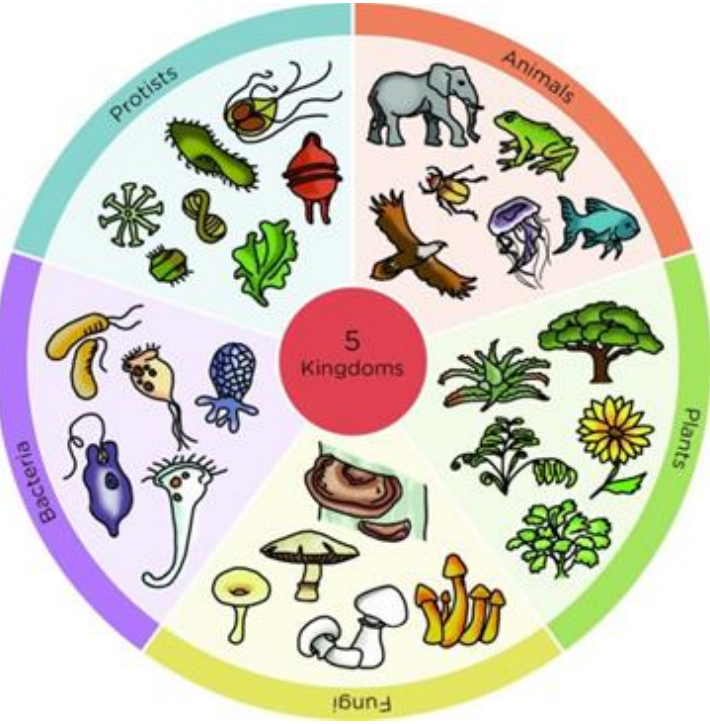
Scientists have developed an organised way to study and understand the vast number of living things on Earth. They group all organisms into five major categories called kingdoms. This system makes it much easier for researchers to study different types of life and understand how they relate to each other.
Important
The Five Kingdoms Classification System
All life on Earth is organised into these five distinct kingdoms based on fundamental differences in cell structure, nutrition, and reproduction:
- Kingdom Monera - This includes all bacteria, which are unicellular organisms without a nucleus
- Kingdom Protista - Single-celled organisms that have a nucleus, such as amoebas and algae
- Kingdom Fungi - Organisms like mushrooms, moulds, and yeasts that absorb nutrients from their environment
- Kingdom Plantae - All plants that make their own food through photosynthesis
- Kingdom Animalia - All animals that move around and consume other organisms for food
The role of taxonomists
Taxonomists are scientists who specialise in identifying and classifying organisms. They study the characteristics of different living things and decide which kingdom and other groups they belong to. This work is crucial because it helps us understand the relationships between different species and how life has evolved over time.
Taxonomists look at many features when classifying organisms, including their cell structure, how they obtain food, and their genetic makeup. Their work continues to evolve as new organisms are discovered and our understanding of life improves.
Note
Every year, taxonomists discover and name thousands of new species! It's estimated that we've only identified about 10-20% of all species on Earth, meaning there are millions of organisms still waiting to be discovered and classified.
Understanding the diversity of life
The classification system helps us appreciate just how diverse life on Earth really is. Each kingdom represents a fundamentally different way of being alive. Bacteria might seem simple, but they have survived for billions of years and can live in environments that would be impossible for other forms of life.
Plants provide the foundation for most food chains by converting sunlight into energy, while animals have developed incredible variety in how they move, hunt, and survive. Fungi play essential roles in breaking down dead material and recycling nutrients, and protists fill many important niches in aquatic environments.
This diversity is not just fascinating to study - it's essential for maintaining healthy ecosystems that support all life, including humans.
Summary
Key Points to Remember:
- Biodiversity refers to the variety of all living organisms found in an area or on Earth
- Organisms can be unicellular (one cell) or multicellular (many cells working together)
- All life is classified into five kingdoms: Monera (bacteria), Protista, Fungi, Plantae, and Animalia
- Taxonomists are scientists who study and classify organisms into these groups
- This classification system helps us understand relationships between different forms of life and appreciate the incredible diversity of our planet