Viruses and Bacteria (Grade 11 NSC Matric Life Sciences): Revision Notes
📚Revision Notes
Viruses and Bacteria
Viruses
What are viruses?
Note
Viruses occupy a unique position in biology because they display characteristics of both living and non-living things. Unlike other organisms, viruses are not classified within any of the traditional kingdoms of life. Instead, they exist in their own separate group due to their unusual properties.
Key terminology
Understanding viruses requires familiarity with several important terms:
| Term | Definition |
|---|---|
| Capsid | The protective protein shell that surrounds the genetic material of a virus |
| Acellular | Not made up of cells; lacking cellular structure |
| Obligate parasite | An organism that must live inside another organism (host) to complete its life cycle |
| Host | The living organism that provides shelter and resources for a parasite |
| Pathogenic | Capable of causing disease in other organisms |
| Bacteriophage | A specialised type of virus that specifically attacks and infects bacterial cells |
| Nucleoid | The region in prokaryotic cells where genetic material is located (not enclosed by a membrane) |
Structure and characteristics of viruses
Viruses are incredibly small microorganisms, measuring only 20-300 nanometers. This means they can only be observed using powerful electron microscopes, not ordinary light microscopes.
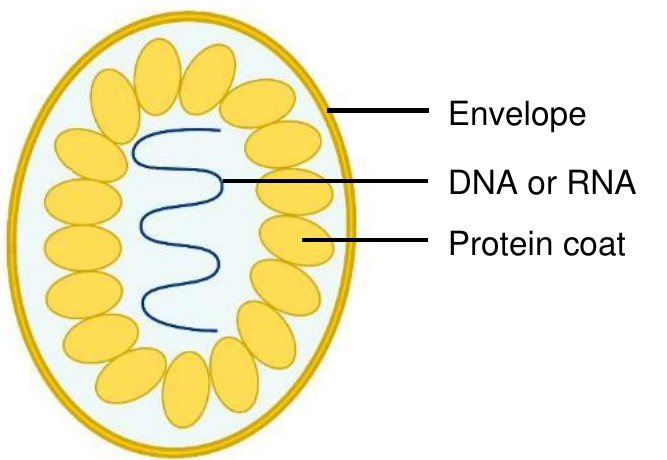
The basic structure of a virus consists of three main components:
- Genetic material: Either DNA or RNA (but never both) located at the centre
- Protein coat (capsid): Surrounds and protects the genetic material
- Envelope: An outer protective layer (present in some viruses)
Key characteristics of viruses
Important
Viruses have several distinctive features that set them apart from living organisms. Understanding these characteristics is essential for distinguishing viruses from other microorganisms.
Non-living characteristics:
- They are acellular - they do not have a cellular structure
- They cannot carry out basic life processes like respiration, feeding, or waste excretion
- They lack cytoplasm and membrane-bound organelles like mitochondria or nuclei
- They do not contain chlorophyll and cannot perform photosynthesis
Unique genetic properties:
- Viruses contain either DNA or RNA as genetic material, but never both
- This is different from all living organisms, which contain both DNA and RNA
Parasitic lifestyle:
- All viruses are obligate internal parasites, meaning they absolutely must infect living host cells to reproduce
- They cannot multiply or carry out life processes outside of a host organism
- When unable to find a suitable host, viruses can become dormant (inactive)
Host range and diseases:
- Viruses can infect various types of organisms including bacteria, plants, animals, and protists
- Bacteriophages are viruses that specifically target bacterial cells
- In humans, viruses cause diseases such as HIV/AIDS, influenza, chickenpox, herpes, and poliomyelitis
- All viruses are considered pathogenic because they cause diseases in their hosts
Example
Common Viral Diseases in Humans:
- Respiratory system: Influenza, common cold, COVID-19
- Immune system: HIV/AIDS
- Nervous system: Poliomyelitis, rabies
- Skin: Chickenpox, herpes, measles
Each of these diseases demonstrates how viruses target specific host cells and organ systems.
Bacteria
Introduction to bacteria
Bacteria belong to the Kingdom Monera and are among the most abundant organisms on Earth. They can be found in virtually every environment - from soil and water to inside other living organisms. While some bacteria cause diseases like tuberculosis, the majority are beneficial and play crucial roles in ecosystems.
Key terminology
Here are essential terms for understanding bacteria:
| Term | Definition |
|---|---|
| Prokaryotic | Cells where genetic material is not enclosed within a membrane-bound nucleus |
| Eukaryotic | Cells that have a membrane-bound nucleus containing their genetic material |
| Flagellum | Whip-like structures that help bacteria move through liquids |
| Autotrophic | Organisms that can make their own food (like green plants and some bacteria) |
| Heterotrophic | Organisms that must obtain food from their environment |
| Saprophytic | Organisms that feed on dead or decaying organic matter |
Additional important bacterial terms:
| Term | Definition |
|---|---|
| Binary fission | The method of asexual reproduction where one bacterial cell divides into two identical cells |
| Endospore | A tough, protective structure that some bacteria form to survive harsh conditions |
| Plasmid | Small, circular pieces of DNA found in bacteria that are separate from the main chromosome |
Characteristics of bacteria
Basic properties:
- Bacteria are unicellular (single-celled) organisms
- They are larger than viruses and can be observed using ordinary light microscopes
- Bacteria are prokaryotic, meaning their genetic material is not enclosed in a membrane-bound nucleus
Note
The key difference between prokaryotic and eukaryotic cells is the presence or absence of a membrane-bound nucleus. This fundamental distinction places bacteria in a separate domain from plants, animals, and fungi.
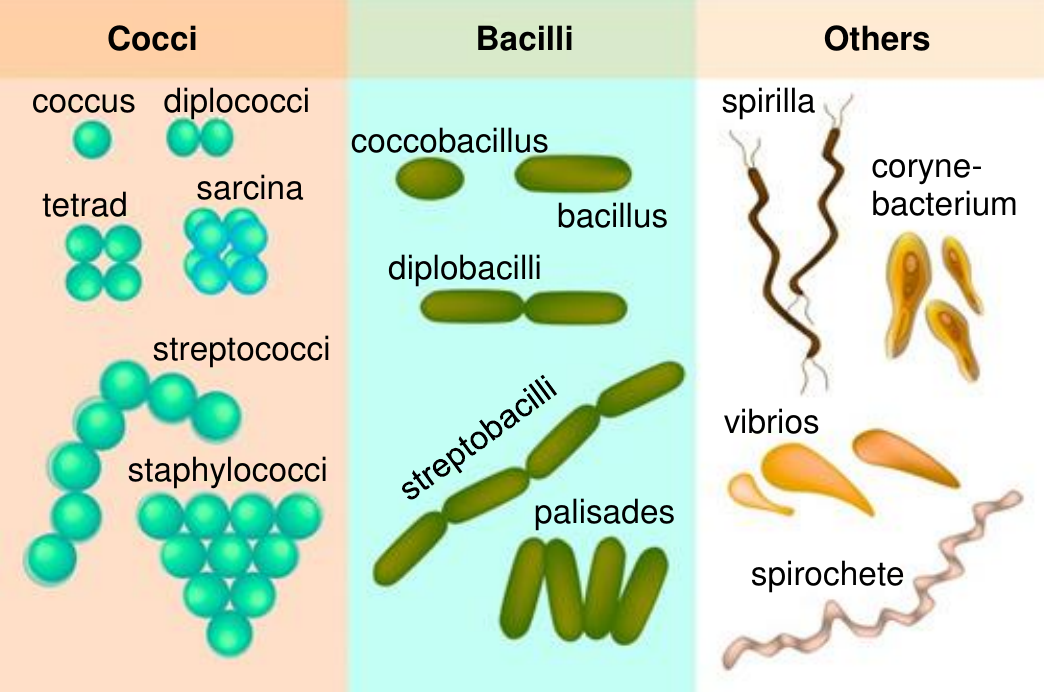
Classification by shape: Bacteria are classified into different groups based on their shapes:
- Coccus: Round or spherical bacteria
- Bacillus: Rod-shaped bacteria
- Spirillum: Spiral-shaped bacteria
- Vibrio: Comma-shaped bacteria
Structural characteristics
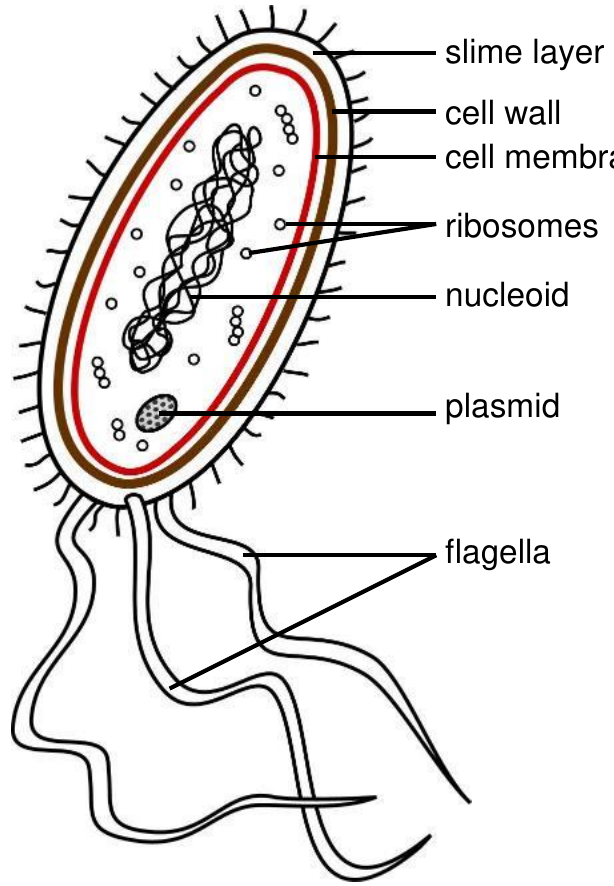
All bacterial cells share certain structural features that are essential for their survival and function:
Cell envelope:
- Cell wall: Made of polysaccharides, provides shape and protection
- Slime capsule: Some bacteria have this additional protective layer to prevent drying out
- Cell membrane: Controls what enters and leaves the cell
Internal structures:
- Cytoplasm: The gel-like substance inside the cell
- Ribosomes: Small structures scattered throughout the cytoplasm that make proteins
- Nucleoid: The irregularly-shaped region containing the main bacterial chromosome
- Plasmids: Small, circular DNA molecules that carry additional genes
Movement structures:
- Flagella: Whip-like structures that rotate to propel bacteria through liquids
- Not all bacteria have flagella - only those that need to move actively
Important
Critical Difference from Eukaryotic Cells: Unlike eukaryotic cells, bacteria do not have membrane-bound organelles such as mitochondria, chloroplasts, or a true nucleus. This is what makes them prokaryotic organisms.
Nutrition of bacteria
Bacteria have evolved different strategies for obtaining food and energy:
Autotrophic bacteria (can make their own food):
- Photosynthetic bacteria: Use sunlight energy to produce food
- Chemosynthetic bacteria: Obtain energy from chemical reactions
Heterotrophic bacteria (must obtain food from external sources):
- Parasitic bacteria: Get nutrients from living host organisms
- Saprophytic bacteria: Act as decomposers, feeding on dead organic matter from plants and animals - this role is crucial for recycling nutrients in ecosystems
- Mutualistic bacteria: Form beneficial relationships with other organisms where both species benefit
Note
Saprophytic bacteria play a vital ecological role as decomposers. Without them, dead organic matter would accumulate in ecosystems, and essential nutrients would not be recycled back into the environment.
Reproduction of bacteria
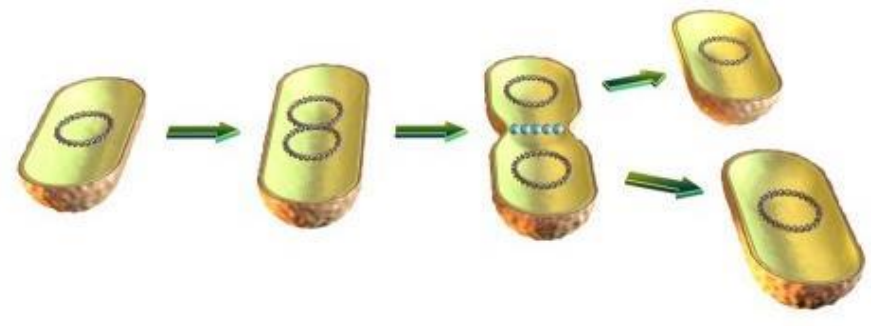
Bacteria reproduce very rapidly when conditions are favourable through a simple process called binary fission:
Example
Binary Fission Process:
Step 1: The bacterial chromosome duplicates
Step 2: The cell grows longer
Step 3: The cell membrane pinches inward
Step 4: Two identical daughter cells are formed
This rapid reproduction allows bacterial populations to grow exponentially under good conditions - a single bacterium can become millions in just hours!
Survival strategy: When environmental conditions become harsh (such as extreme heat, cold, or lack of nutrients), some bacteria form endospores. These are extremely tough, dormant structures that contain the bacterial DNA and some cytoplasm. Endospores can survive for years until conditions improve, at which point they germinate and become active bacteria again.
Summary
Key Points to Remember:
-
Viruses are acellular parasites that need host cells to reproduce and contain either DNA or RNA (never both)
-
Bacteria are prokaryotic, unicellular organisms that can be classified by their shapes: coccus (round), bacillus (rod), spirillum (spiral), and vibrio (comma)
-
Viruses are much smaller than bacteria and can only be seen with electron microscopes, while bacteria can be observed with light microscopes
-
Bacterial reproduction occurs through binary fission, creating two identical cells, while viruses reproduce only inside host cells
-
Bacteria have diverse nutrition methods - they can be autotrophic (make own food) or heterotrophic (obtain food from environment), while viruses cannot perform any metabolic processes independently