Body Plans (Grade 11 NSC Matric Life Sciences): Revision Notes
📚Revision Notes
Body Plans
Introduction to body plans
A body plan refers to the basic structural design and organisation of an animal's body. These structural characteristics help scientists classify animals into different groups and understand their evolutionary relationships. All animals belong to the Kingdom Animalia, which contains approximately 1.5 million recorded species that show incredible diversity in their body designs.
Note
Scientists use phylogenetic trees to show how different animal groups are related through evolution. A phylogenetic tree is a diagram that illustrates the evolutionary connections between ancestral groups and their descendants.
Animals are organised into major groups called phyla (singular: phylum), which is a taxonomic classification level that sits below kingdom and above class. Taxonomists are the biologists who specialise in identifying and grouping organisms based on their shared characteristics.
The major animal phyla include Porifera (sponges), Cnidaria (jellyfish), Platyhelminthes (flatworms), Annelida (earthworms), Arthropoda (insects), and Chordata (mammals). Each phylum represents animals that share similar fundamental body plan features.
Key features of body plans
Body plans are distinguished by several important structural characteristics that separate one group of organisms from another. Understanding these features helps us classify animals and understand how they have evolved over time.
The main features that define body plans include:
- Body symmetry and cephalisation - how the body can be divided and whether it has a distinct head region
- Tissue layers - the number of cell layers that form the body wall
- Number of gut openings - whether the digestive system has one or two openings
- Presence of a body cavity - whether there is a fluid-filled space inside the body
Note
Cephalisation refers to the evolutionary development of a distinct head region that contains most of the sense organs, feeding structures, and brain tissue. This feature first appeared in the flatworms (Platyhelminthes) and represents an important evolutionary advancement.
Animals can be sessile, meaning they remain permanently attached to one location and cannot move around freely (like sponges and barnacles), or they can be mobile and actively move through their environment.
The gut refers to the portions of the digestive system (alimentary canal) where food is processed and nutrients are absorbed.
Body symmetry and cephalisation
Symmetry describes how an organism's body can be divided into matching halves. An organism is symmetrical when it can be cut through one or more planes to create two identical halves. Animals display three main types of symmetry that reflect their lifestyle and evolutionary development.
Important
Animals with bilateral symmetry are typically more advanced and show cephalisation. Cephalisation occurs when the majority of sense organs, feeding structures, and brain tissue are concentrated near the front (anterior) end of the body. This arrangement is advantageous because these animals are usually active and constantly moving around to search for food, find mates, and respond to their environment.
Types of body symmetry
Asymmetrical animals have no regular symmetry pattern, meaning their bodies cannot be divided into matching halves in any plane. Sponges are the best example of asymmetrical animals - they grow in irregular shapes and their body structure is not organised around any central axis.

Note
Radially symmetrical animals have bodies that can be divided through multiple planes to create matching halves, all passing through a central axis. These animals typically show radial symmetry because they are often sessile (stationary) or move very slowly. Since they cannot actively pursue food, having sense organs and feeding structures arranged around their entire body helps them detect and capture food from any direction.

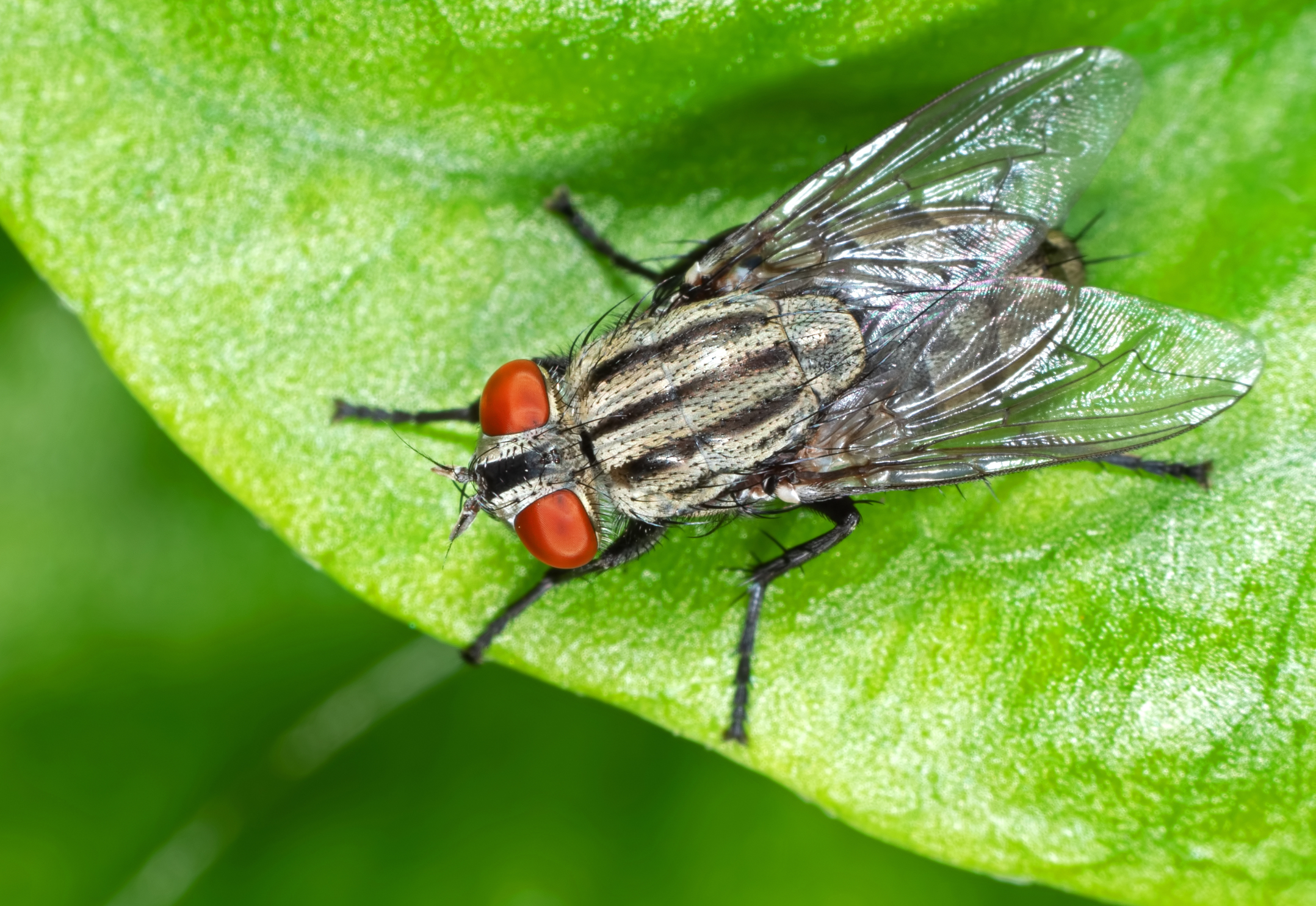
Bilaterally symmetrical animals can only be divided through one plane (the sagittal plane) to create two matching halves - a left side and a right side. These animals cannot be divided equally along their front-to-back axis because they have distinct anterior (front) and posterior (back) ends. Most animals, including all vertebrates, insects, and worms, show bilateral symmetry. This body plan is associated with active movement and cephalisation.
Tissue layers and embryonic development
During embryonic development, animals form distinct tissue layers called germ layers. These early tissue layers eventually differentiate and develop into all the organs and body systems of the adult animal. The number of germ layers an animal possesses is a fundamental characteristic used to classify different animal groups.
Primary germ layers
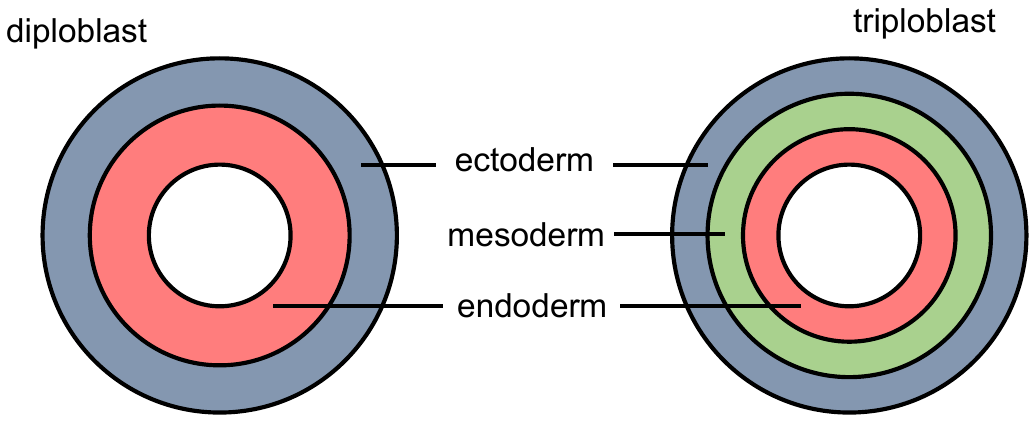
The two primary germ layers that develop first in animal embryos are the ectoderm (outer layer) and the endoderm (inner layer).
Note
The ectoderm forms the outer covering of the animal and develops into the skin or protective epithelium and the nervous system. This outer layer is responsible for detecting and responding to environmental changes.
The endoderm develops into the digestive system and associated organs. This inner layer is responsible for processing food and absorbing nutrients.
Important
Animals that possess only these two primary germ layers are called diploblastic animals. These animals have relatively simple body organisation and do not develop complex organ systems. Diploblastic animals are considered more primitive in evolutionary terms.
Secondary germ layers
More complex animals develop a third tissue layer called the mesoderm, which forms between the ectoderm and endoderm during embryonic development.
Important
Animals that develop from three germ layers (ectoderm, mesoderm, and endoderm) are called triploblastic animals. The mesoderm is crucial for forming more complex body structures and organ systems.
The mesoderm develops into:
- Connective tissues that support and connect other organs
- Bone and cartilage that provide structural support
- Blood and blood vessels for circulation
- Reproductive organs
- Lymphatic system components
Body cavities
In triploblastic animals, a fluid-filled space called a coelom often develops between the outer ectoderm and inner endoderm layers. This body cavity provides several important advantages:
- It allows internal organs to move independently of the body wall
- Hydrostatic force from the fluid can provide support and enable movement
- It facilitates peristalsis - the wave-like muscle contractions that move food through the digestive tract
- It provides space for organ development and circulation of body fluids
Note
The presence of a coelom represents another level of body plan complexity and is found in the most advanced animal groups.
Summary
Key Points to Remember:
-
Body plans are structural characteristics that help classify animals into different groups and show evolutionary relationships
-
Three types of symmetry exist: asymmetrical (sponges), radial (jellyfish, sea anemones), and bilateral (most animals including humans)
-
Bilateral symmetry is associated with cephalisation - having a distinct head region with concentrated sense organs and brain tissue
-
Animals develop from either two or three germ layers: diploblastic animals (ectoderm + endoderm) are simpler, while triploblastic animals (ectoderm + mesoderm + endoderm) are more complex
-
The coelom is a body cavity in advanced animals that provides space for organs and enables more sophisticated body functions like circulation and digestion