Modes of Living and Surafce Area to Volume (Grade 11 NSC Matric Life Sciences): Revision Notes
📚Revision Notes
Modes of Living and Surface Area to Volume
Understanding body plans and how animals live
The way an animal's body is organised - called its body plan - determines how that animal can live and survive in its environment. Different animals have evolved various body structures that allow them to find food, move around, and carry out life processes in their own unique ways.
When we study different animal groups (called phyla), we can see a fascinating progression from very simple organisms to highly complex ones. Each group has developed specific features that help them thrive in their particular lifestyle.
Note
Understanding body plans is fundamental to biology because it helps explain why different animals behave and live the way they do. The structure of an organism directly determines its function and survival strategies.
Animal phyla: from simple to complex
Animals can be organised into six major groups that show increasing complexity. Let's explore how their body plans relate to their modes of living:
| Phylum | Examples | Body Symmetry | Gut Openings | Tissue Layers | Coelom | Mode of Living |
|---|---|---|---|---|---|---|
| Porifera | Sponges | Asymmetrical | No gut | No true tissue | Acoelomate | Aquatic, sessile |
| Cnidaria | Jellyfish, sea anemone | Radial | One | Diploblastic | Acoelomate | Aquatic, sessile, free-floating, dimorphic lifecycle |
| Platyhelminthes | Flatworm, planarian, tapeworm | Bilateral, dorso-ventrally flattened | One | Triploblastic | Acoelomate | Most are internal parasites, some free-living |
| Annelida | Earthworm, leeches | Bilateral | Two | Triploblastic | Coelomate | Aquatic or terrestrial, can burrow in environments, highly mobile |
| Arthropoda | Spider, crab, insect | Bilateral | Two | Triploblastic | Coelomate | Aquatic or terrestrial, can survive in dry habitats |
| Chordata | Fish, frog, snake, mammal | Bilateral | Two | Triploblastic | Coelomate | Aquatic or terrestrial, can survive in dry and extreme habitats |
Key features that develop through evolution
As we move from simple sponges to complex vertebrates, several important features appear:
- Symmetry development: Starting with no symmetry in sponges, progressing to radial symmetry in cnidarians, and finally bilateral symmetry in more advanced animals
- Cephalisation: The development of a distinct head region with concentrated sensory organs and nervous tissue
- Digestive system improvement: From no gut in sponges to complete digestive systems with two openings in advanced animals
- Body cavity formation: The evolution of a coelom (body cavity) allows for more complex organ systems
- Tissue organisation: Progression from no true tissues to three tissue layers (triploblastic) that form different organ systems
Important
This evolutionary progression shows that complexity increases with lifestyle demands. Each new feature allows animals to exploit new environments and adopt more sophisticated survival strategies.
Each of these developments allows animals to live in more diverse environments and adopt more complex lifestyles.
Surface area to volume ratio
Understanding the relationship between an organism's surface area and volume is crucial for explaining many biological processes. The surface area to volume ratio compares how much outer surface an organism has relative to its internal volume.
Why this ratio matters in biology
The surface area to volume ratio has several important effects on how animals live:
- Gas exchange: Smaller organisms can rely on their body surface for breathing, whilst larger animals need specialised structures like lungs or gills
- Heat regulation: The ratio affects how quickly animals gain or lose heat from their environment
- Nutrient absorption: It influences how efficiently materials can move in and out of the organism
- Size limitations: This ratio helps explain why some animals cannot grow beyond certain sizes
Note
The surface area to volume ratio is one of the most important concepts in biology because it affects virtually every aspect of how organisms function, from breathing to feeding to maintaining body temperature.
The size relationship
As organisms get larger, their volume increases much faster than their surface area. This means:
- Large animals have less surface area per unit of volume
- Small animals have more surface area per unit of volume
- This difference affects many biological processes and explains why large and small animals often have very different body structures
Calculating surface area and volume
To understand these relationships mathematically, we need to know how to calculate both surface area and volume:
- Surface area = of all surfaces combined
- Volume =
Worked example with cube arrangements
Let's look at how different arrangements of the same number of unit cubes can have different surface area to volume ratios:
Example
Worked Example: Comparing Cube Arrangements
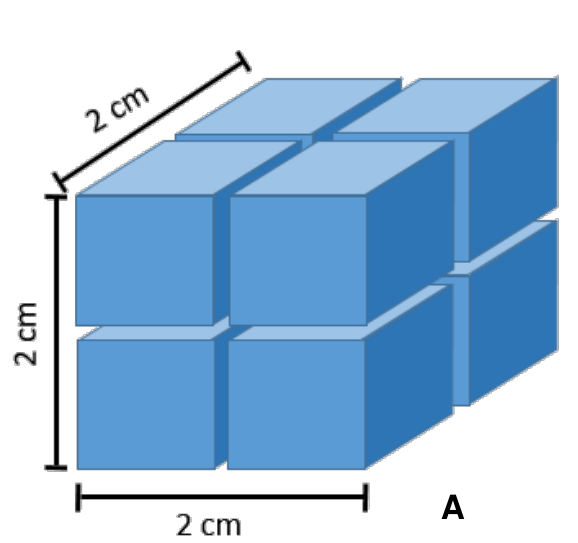
Model A: arrangement
- Volume =
- Surface area =
- Surface area to volume ratio =
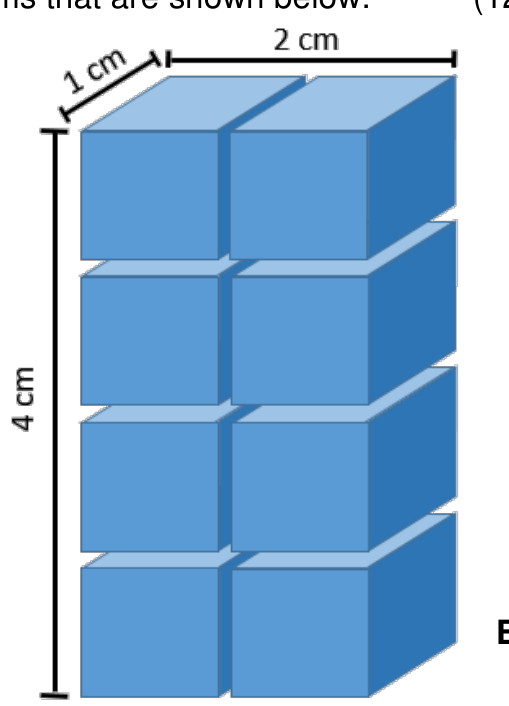
Model B: arrangement
- Volume =
- Surface area =
- Surface area to volume ratio =
Key observation: Even though both models have the same volume, Model B has a higher surface area to volume ratio because it's more elongated.
Biological applications
This mathematical relationship explains many features we see in living organisms:
- Flatworms have very thin, flat bodies to maximise their surface area for gas exchange
- Small organisms like bacteria can survive without complex transport systems
- Large mammals need lungs, circulatory systems, and other specialised structures to overcome their low surface area to volume ratio
- Many parasites are long and thin to increase their surface area for nutrient absorption
Important
Common misconception: Students often think that larger animals are "better" because they're more complex. In reality, both large and small animals are perfectly adapted to their environments - they just face different challenges due to their size.
Summary
Key Points to Remember:
- Body plans determine lifestyles: An animal's structure directly influences how it can live and what environments it can survive in
- Evolution shows progression: From simple sponges to complex vertebrates, we see increasing organisation and specialisation
- Size affects biology: The surface area to volume ratio explains why small and large animals have different structures and needs
- Mathematical relationships matter: Simple calculations help us understand complex biological processes
- Structure follows function: Animals have evolved body plans that suit their particular way of life and environmental challenges