The Gut (Grade 11 NSC Matric Life Sciences): Revision Notes
📚Revision Notes
The Gut
Understanding how animals process food and organise their body structure is essential for learning about biodiversity. The gut (digestive system) and body cavity arrangements show us how different animal groups have evolved various solutions for survival.
Note
The study of digestive systems and body cavities provides crucial insights into animal evolution and helps us understand why certain body plans have been more successful than others in different environments.
Opening to the gut
Animals have developed two main types of digestive systems based on the number of openings they possess. This fundamental difference affects how efficiently they can process food and manage waste.
One opening systems
Some animals have only a single opening that serves as both the entrance for food and the exit for waste. This arrangement is called a blind-ending gut because it resembles a closed tube with only one way in and out.
Animals with this system must follow a specific sequence: they consume food through their mouth opening, digest it completely, and then expel waste through the same opening before they can eat again. This creates a significant limitation because they cannot continuously feed - they must wait to finish processing one meal before starting another.
Important
The single opening creates a major disadvantage: animals cannot eat and eliminate waste simultaneously, which limits their feeding efficiency and growth potential.
The single opening leads to a gastrovascular cavity, which is a simple digestive chamber where both digestion and circulation of nutrients occur.
Example
Examples of One-Opening Systems:
Animals with blind-ending guts include:
- Cnidarians (jellyfish, sea anemones, corals)
- Platyhelminthes (flatworms)
- Simple sponges
These animals must complete digestion before consuming more food.
Two opening systems
More advanced animals have developed a through-gut system with two separate openings: a mouth for food intake and an anus for waste removal. This arrangement offers significant advantages over the single-opening system.
The through-gut system allows for continuous feeding because food moves in one direction through the digestive tract. While waste is being expelled from the anus, new food can simultaneously enter through the mouth. Additionally, different sections of the digestive system can specialise for specific functions - for example, the stomach focuses on breaking down food while the intestines concentrate on absorbing nutrients.
Note
The evolution of the through-gut system was a major breakthrough that allowed animals to become more efficient feeders and grow to larger sizes.
Body cavity organisation
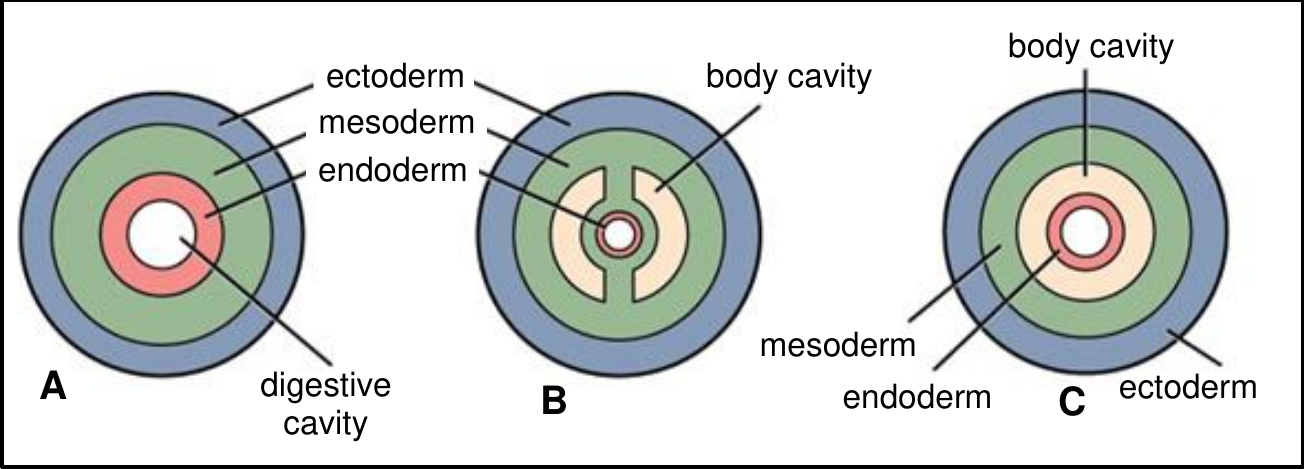
The arrangement of tissues and body cavities in animals provides important clues about their complexity and evolutionary relationships. Animals are classified into three main groups based on their body cavity structure.
Acoelomate animals
Acoelomate animals are those without a true body cavity or coelom. The term "acoelomate" literally means "without a cavity." These animals have a relatively simple body organisation.
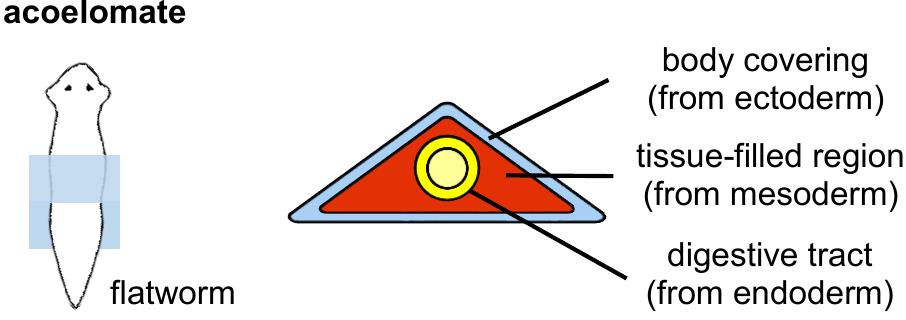
In acoelomate animals, the space between the outer body wall and the digestive tract is completely filled with tissue derived from the mesoderm layer. This solid tissue arrangement means there is no empty space or cavity within the body. Flatworms are excellent examples of acoelomate animals.
These animals can be either diploblastic (having two tissue layers) or triploblastic (having three tissue layers), but they are generally smaller and less mobile than animals with body cavities.
Coelomate animals
Coelomate animals possess a true body cavity called a coelom. This cavity develops within the mesoderm tissue layer and represents a significant evolutionary advancement.
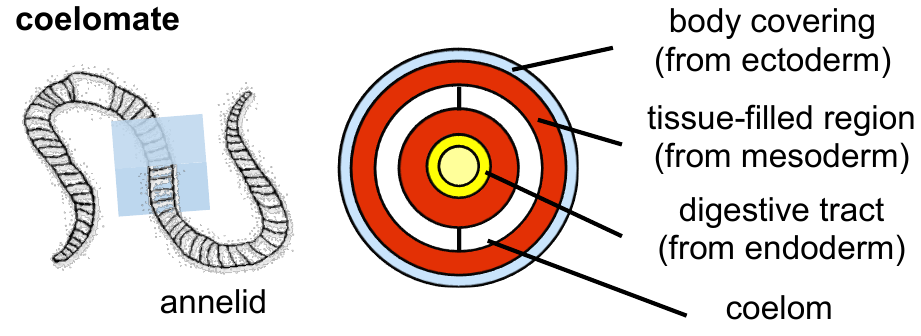
The coelom is a fluid-filled space that separates the digestive tract from the body wall. This arrangement creates distinct compartments within the body and allows for greater complexity in organ development. Segmented worms (annelids) like earthworms are classic examples of coelomate animals.
Pseudocoelomate animals
Some animals have what appears to be a body cavity, but it is not a true coelom. This pseudocoel (meaning "false cavity") is not completely surrounded by mesoderm tissue, which distinguishes it from a true coelom.
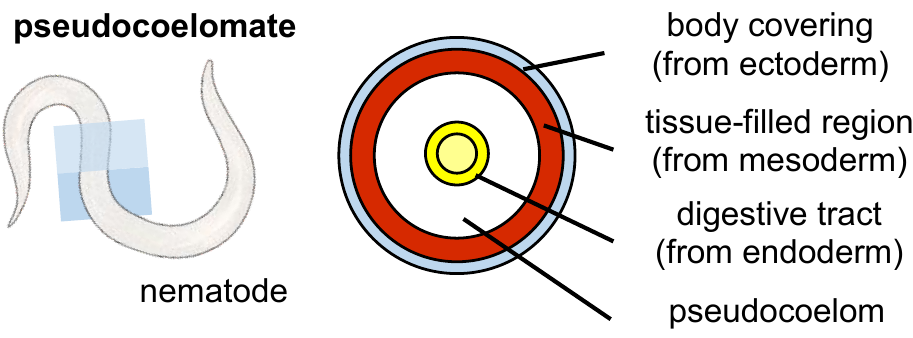
In pseudocoelomate animals like roundworms (nematodes), the body cavity exists between the mesoderm and endoderm layers. While this provides some of the benefits of having a body cavity, it is not as sophisticated as the true coelom found in more advanced animals.
Important
Understanding these three body cavity types - acoelomate, pseudocoelomate, and coelomate - is essential for classifying animals and understanding their evolutionary relationships.
Advantages of having a coelom
The evolution of a true coelom has provided several important advantages that have contributed to the success of coelomate animals:
Complex organ development: The coelom allows space for more sophisticated organs to develop, including advanced digestive systems, muscular systems, and circulatory systems. Organs can grow larger and more specialised when they have space to expand.
Enhanced movement: The coelom enables the creation of a hydrostatic skeleton in soft-bodied animals. The fluid-filled cavity can be compressed and expanded by surrounding muscles, creating pressure changes that facilitate movement.
Peristalsis: The body cavity allows the digestive tract to move independently from the body wall. This enables peristalsis - the wave-like muscular contractions that push food through the digestive system efficiently.
Nutrient and waste transport: In many coelomate animals, the coelomic fluid (liquid within the coelom) helps transport nutrients, waste products, and other important substances throughout the body.
Important
An animal must be triploblastic (having three germ layers: ectoderm, mesoderm, and endoderm) before it can develop a true coelom, because the coelom forms within the mesoderm layer.
Example
Real-World Example: Earthworm Movement
An earthworm demonstrates the advantages of having a coelom:
- Its coelomic fluid acts as a hydrostatic skeleton
- Muscles contract against the fluid-filled cavity to create movement
- Peristaltic waves move food through its digestive tract
- The coelom allows for complex organ systems within its segmented body
Summary
Key Points to Remember:
- Blind-ending guts have one opening for both food intake and waste removal, limiting continuous feeding
- Through-guts have two openings (mouth and anus), allowing continuous feeding and digestive specialisation
- Acoelomate animals lack body cavities and have simpler body organisation
- Coelomate animals have true body cavities that enable complex organ development and efficient movement
- Pseudocoelomate animals have false body cavities that provide some advantages but are less sophisticated than true coeloms
- The evolution from acoelomate → pseudocoelomate → coelomate represents increasing complexity and efficiency