Community Change Over Time (Grade 11 NSC Matric Life Sciences): Revision Notes
📚Revision Notes
Community Change Over Time
What is succession?
Succession describes the gradual changes that happen in ecosystems over time. It's nature's way of developing from a simple community to a complex, stable one. Think of it like watching a neighbourhood slowly develop from empty land into a thriving community with different types of residents.
In ecology, we study two main types of succession: primary succession and secondary succession.
Key terminology
Understanding these terms will help you master succession concepts:
| Term | Definition |
|---|---|
| Primary succession | The process that begins with initial colonisation of a completely new area, followed by gradual changes in the plant and animal species living there |
| Pioneer species | Tough, hardy organisms that are first to establish themselves in new or disturbed areas, helping to break down rock and create soil |
| Secondary succession | The process of regrowth that occurs after an existing habitat has been disturbed or damaged |
| Climax community | The final, stable community that develops after succession is complete |
Note
These four key terms form the foundation of understanding ecological succession. Make sure you can distinguish between primary and secondary succession, as this is often tested in exams.
Primary succession
Primary succession occurs in completely new habitats where no soil exists and no previous life has established itself. This might happen in places like:
- Newly formed volcanic islands rising from the ocean
- Areas exposed after glaciers retreat, leaving bare rock
- Land created by volcanic lava flows
The stages of primary succession
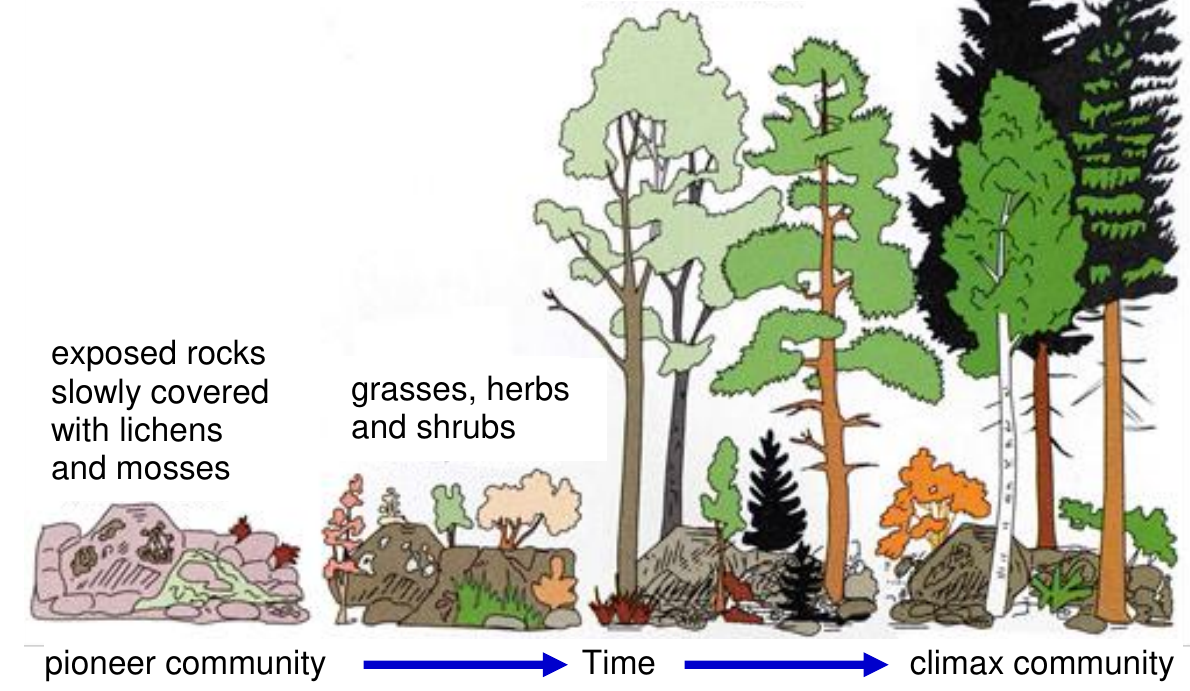
The process follows a predictable sequence that can take hundreds or thousands of years:
Important
Critical Timing Concept
Primary succession is an extremely slow process - it can take centuries to millennia to complete. This is because it must start from bare rock with no existing soil or organic matter.
Stage 1: Pioneer species arrive
The first organisms to colonise bare rock are pioneer species, particularly lichens. These remarkable organisms are perfectly adapted for harsh conditions. They attach themselves to rocky surfaces and begin the slow process of breaking down the rock through weathering. Some pioneer species also release acid-like substances that help dissolve the rock further.
Stage 2: Soil development
Over long periods, the weathering process creates a thin layer of soil. Once sufficient soil has formed, grass species can establish themselves and continue building up the soil layer by contributing organic matter.
Stage 3: Shrub and herb establishment
As time progresses, small to medium-sized herbaceous shrubs and ferns can settle in the developing ecosystem. These plants often outcompete the pioneer species for resources like light, water, and nutrients.
Stage 4: Tree establishment
Eventually, softwood trees (like conifers) and hardwood tree species (like oak or maple) become established. Each plant community creates conditions that are more suitable for the next stage.
Stage 5: Climax community
The final stage is a climax community - a stable ecosystem containing plant and animal species that can maintain themselves in that environment for long periods without major changes.
Secondary succession
Secondary succession is quite different from primary succession. It occurs when land that previously supported vegetation becomes disturbed or damaged. Common examples include:
- Agricultural land that has been abandoned
- Areas where fires have destroyed existing vegetation
- Land cleared by human activities
How secondary succession differs
Important
Key Difference: Soil Presence
The key difference is that soil already exists in secondary succession areas. This means the process happens much faster than primary succession - often taking decades rather than centuries.
Because there's already a soil layer present, pioneer species like grasses can quickly establish themselves. These are then rapidly outcompeted by more complex plants, and eventually hardwood trees and associated animal species return to create a climax community similar to what existed before the disturbance.

The recovery process
The diagram shows how an area recovers after fire damage. The sequence moves from the destroyed landscape through grasses and shrubs, eventually returning to a lush forest community. This demonstrates nature's remarkable ability to heal itself when given time.
Note
Recovery Timeline
Notice how secondary succession follows a similar pattern to primary succession but happens much more quickly. What might take 500-1000 years in primary succession can occur in just 50-100 years in secondary succession.
Why succession matters
Understanding succession helps us appreciate several important ecological concepts:
Note
Ecological Significance of Succession
- How ecosystems develop and change naturally over time
- Why some species are found in certain environments
- How human activities can interrupt natural processes
- The importance of conservation and allowing natural recovery
Succession also explains why different habitats have different species - each represents a different stage in the succession process or different environmental conditions that support different climax communities.
Summary
Key Points to Remember:
- Primary succession starts from bare rock with no soil - it takes centuries to develop
- Pioneer species like lichens are the tough first colonisers that break down rock to create soil
- Secondary succession starts from disturbed land that already has soil - it recovers much faster
- Climax communities are the final, stable ecosystems that develop after succession
- Each stage in succession creates conditions that help the next stage establish itself