Investigations (Grade 11 NSC Matric Life Sciences): Revision Notes
📚Revision Notes
Investigations
Understanding cellular respiration through practical experiments helps us see how living organisms use glucose to produce energy. Scientists use various investigations to demonstrate the key requirements and products of both aerobic and anaerobic respiration. These experiments show us how oxygen is consumed and carbon dioxide is produced during these vital life processes.
Note
These investigations provide direct evidence for cellular respiration by measuring the gases that are consumed and produced during the process. By using controls and chemical indicators, we can prove that living organisms carry out respiration.
Key testing methods and vocabulary
Before exploring the investigations, it's important to understand the main testing techniques used to detect the gases involved in cellular respiration.
Testing for oxygen
The glowing splint test is used to detect oxygen gas. When a glowing wooden splint is placed near oxygen, it will reignite or burn more brightly. This happens because oxygen supports combustion.
Note
The Glowing Splint Test: A glowing (not flaming) wooden splint is the key - if oxygen is present, the splint will burst back into flames or glow much brighter. If oxygen has been consumed, the splint will go out completely.
Testing for carbon dioxide
Lime water is a clear chemical solution that becomes milky or cloudy when carbon dioxide is bubbled through it. This colour change makes it an excellent indicator for detecting carbon dioxide gas production.
Important terms
- Lime water: A chemical solution that detects carbon dioxide by turning milky
- Germination: The natural process where seeds begin to grow into new plants
- Glycogen: The storage form of glucose found in animal cells
Investigation 1: Demonstrating oxygen consumption during cellular respiration
This investigation shows that living organisms consume oxygen when they carry out cellular respiration. Germinating seeds are particularly useful for this experiment because they respire rapidly as they grow, using large amounts of oxygen for energy production.
Aim
To demonstrate that oxygen is consumed by living organisms during cellular respiration.
Method
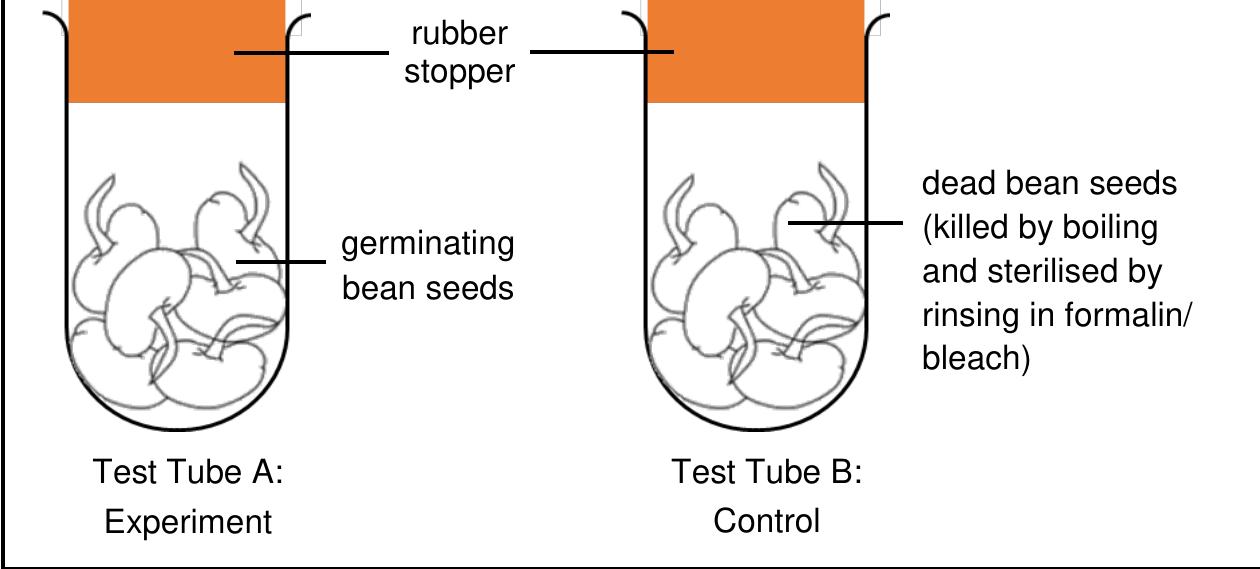
The experiment compares two test tubes - one containing living germinating bean seeds, and another containing dead seeds as a control.
Example
Experimental Setup Procedure:
Step 1: Prepare the test tubes
- Test tube A (Experimental group): Contains germinating bean seeds that are actively respiring
- Test tube B (Control group): Contains dead bean seeds that have been killed by boiling and sterilised with formalin or bleach
Step 2: Setup procedure
- Sterilise all equipment to prevent microorganisms from affecting the results
- Place germinating beans in test tube A and dead beans in test tube B
- Seal both tubes tightly with rubber stoppers
- Leave the setup overnight to allow sufficient time for respiration to occur
- The next morning, remove the stoppers and quickly insert a glowing splint into each tube
Results and explanation
- Test tube A: The glowing splint goes out immediately, indicating no oxygen is present. The germinating seeds have consumed all available oxygen through cellular respiration.
- Test tube B: The glowing splint continues to burn brightly, showing oxygen is still present. The dead seeds cannot respire, so they haven't used any oxygen.
Important
Why controls are essential: The dead seeds in test tube B prove that it's the living process of respiration that consumes oxygen, not just the physical presence of seeds. Without this control, we couldn't be certain that respiration was responsible for the oxygen consumption.
Conclusion
Living organisms consume oxygen during cellular respiration, while dead organisms do not. This proves that oxygen is a essential requirement for aerobic respiration in living cells.
Investigation 2: Demonstrating carbon dioxide production during aerobic respiration
This investigation proves that carbon dioxide is produced as a waste product when organisms carry out aerobic respiration. The experiment uses a living snail and a sophisticated system to detect any carbon dioxide produced.
Aim
To prove that carbon dioxide is produced during aerobic cellular respiration by living organisms.
Experimental setup
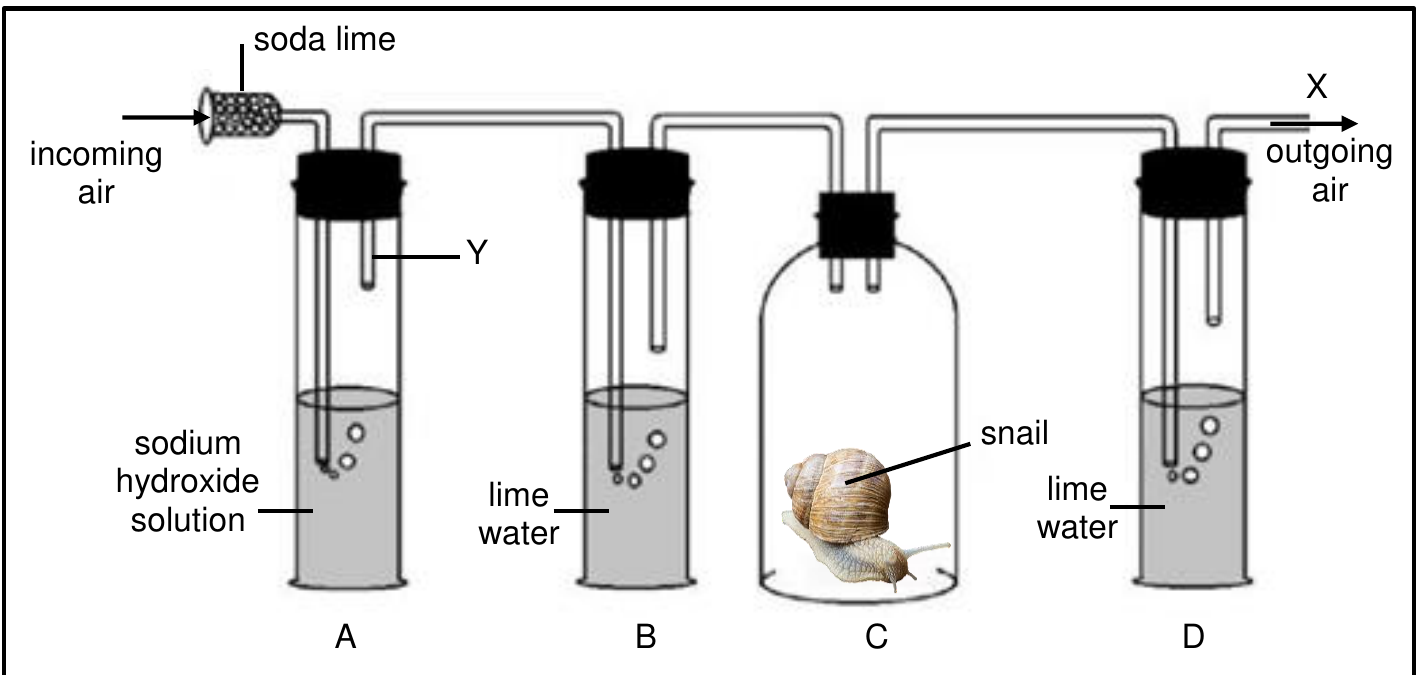
The apparatus consists of four connected containers that allow air to flow through the system whilst detecting carbon dioxide production.
Container functions:
- Container A: Contains sodium hydroxide solution to remove any carbon dioxide from incoming air
- Container B: Contains lime water to confirm that incoming air contains no carbon dioxide
- Container C: Houses a living snail that will produce carbon dioxide through respiration
- Container D: Contains lime water to detect any carbon dioxide produced by the snail
Example
Method Steps:
- Set up the apparatus ensuring all tubes are tightly sealed
- Use a small living organism such as a snail
- Sterilise equipment to prevent interference from microorganisms
- Allow air to flow through the system for 24 hours
- Observe any colour changes in the lime water containers
Results and explanation
- Container B: Lime water remains clear, confirming that incoming air contains no carbon dioxide (it was removed by container A)
- Container D: Lime water turns milky, indicating carbon dioxide has been produced by the snail during respiration
Conclusion
Carbon dioxide is produced as a waste product during aerobic respiration by living organisms. The snail's cellular respiration created carbon dioxide that was detected by the lime water.
Investigation 3: Demonstrating carbon dioxide production during anaerobic respiration
This investigation shows that carbon dioxide is also produced during anaerobic respiration, using yeast fermentation as an example. Unlike aerobic respiration, this process occurs without oxygen.
Aim
To prove that carbon dioxide is produced during anaerobic cellular respiration.
Experimental setup
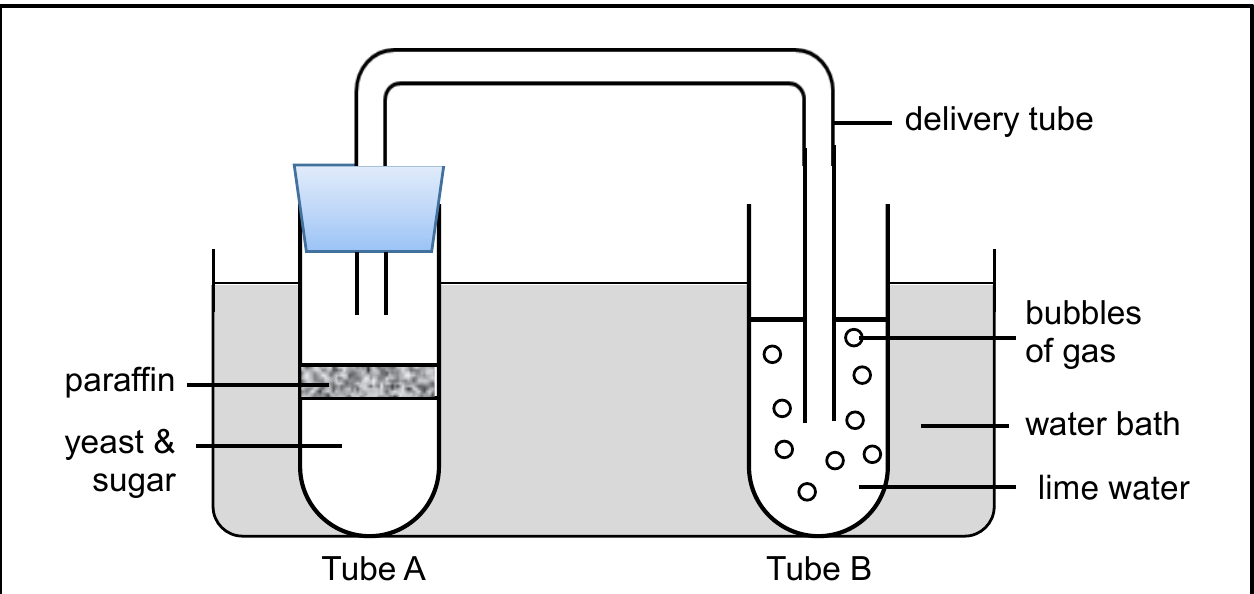
The apparatus uses yeast and sugar solution to create anaerobic conditions and detect carbon dioxide production.
Setup components:
- Tube A: Contains yeast and sugar mixture covered with a paraffin layer to prevent oxygen from entering
- Tube B: Contains lime water in a warm water bath to detect carbon dioxide production
Example
Method Steps:
- Sterilise all equipment to prevent contamination
- Boil the sugar solution beforehand to remove dissolved oxygen
- Add yeast to the sugar solution in tube A
- Cover the mixture with a thin paraffin layer to create anaerobic conditions
- Place the apparatus in a warm water bath (yeast grows more actively in warm conditions)
- Connect tube A to tube B with a delivery tube
- Observe the setup after several hours
Results and explanation
The lime water in tube B becomes milky, indicating that carbon dioxide has been produced. Gas bubbles can be seen travelling from tube A through the delivery tube into the lime water.
Important
Creating anaerobic conditions: The paraffin layer is crucial - it prevents oxygen from dissolving into the yeast mixture, forcing the yeast to carry out anaerobic respiration (fermentation) instead of aerobic respiration.
Conclusion
Carbon dioxide is produced during anaerobic cellular respiration. The yeast carried out fermentation (anaerobic respiration) using the sugar, producing carbon dioxide as a waste product even without oxygen present.
Comparison of respiration types
Understanding the differences between aerobic and anaerobic respiration helps explain why these investigations work:
| Feature | Aerobic Respiration | Anaerobic Respiration |
|---|---|---|
| Oxygen requirement | Requires oxygen | No oxygen needed |
| Products | Carbon dioxide + water | Carbon dioxide + alcohol (plants/yeast) or lactic acid (animals) |
| Location in cell | Cytoplasm and mitochondria | Cytoplasm only |
| Energy yield | Large amount of ATP | Small amount of ATP |
| Glucose breakdown | Complete breakdown | Partial breakdown |
Note
Both types of respiration produce carbon dioxide, which is why lime water works as a test for both aerobic and anaerobic respiration. However, only aerobic respiration consumes oxygen, which is why the glowing splint test specifically detects aerobic respiration.
Summary
Key Points to Remember:
- Glowing splint test: Used to detect oxygen - the splint burns brighter when oxygen is present
- Lime water test: Used to detect carbon dioxide - turns milky when CO₂ is bubbled through it
- Controls are essential: Always compare living specimens with dead/sterilised controls to ensure valid results
- Sterilisation prevents contamination: Clean equipment prevents microorganisms from affecting experimental results
- Both respiration types produce CO₂: Aerobic and anaerobic respiration both release carbon dioxide, but only aerobic respiration consumes oxygen