Understanding and Calculating UIF (Grade 11 NSC Matric Mathematical Literacy): Revision Notes
📚Revision Notes
Understanding and Calculating UIF
What is UIF?
UIF is the abbreviation for the Unemployment Insurance Fund. This is a type of insurance that provides financial support to workers who lose their jobs.
The fund works as a safety net - if you become unemployed, you can claim benefits from the UIF for a certain period while you search for new employment. Both employees and employers contribute to this fund every month.
Note
The UIF system operates on the principle of shared responsibility - both workers and employers contribute equally to create a financial safety net that protects employees during periods of unemployment.
How UIF contributions work
UIF contributions are calculated as a percentage of your gross salary. Your gross salary is the total amount you earn before any deductions are made.
Employee contribution
- You pay 1% of your gross salary each month
- This amount is automatically deducted from your salary
Employer contribution
- Your employer also pays 1% of your gross salary on your behalf
- This means employers pay a matching contribution for each employee
Total contribution
- Combined contribution = 2% of gross salary per month
- Half comes from the employee, half from the employer
Important
The employer contribution is additional to your salary - it's not deducted from what you earn. This means you effectively get double the contribution you pay into the UIF system.
UIF calculation formulas
The basic formulas for calculating UIF contributions are straightforward:
Employee's UIF contribution =
Total UIF contribution =
UIF ceiling amount
There is an important limit on UIF contributions called the ceiling salary:
- Ceiling salary = R12,478.00 per month
- UIF is only calculated on salaries up to this amount
- Maximum UIF deduction = R124.78 per month (1% × R12,478.00)
Important
Understanding the Ceiling Concept
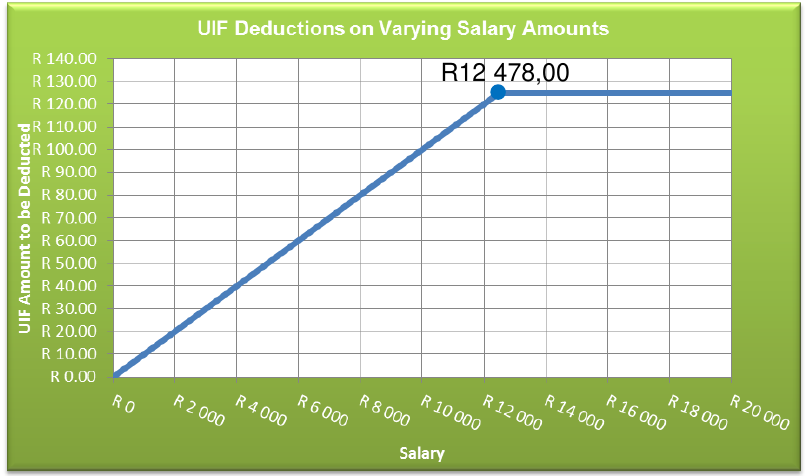
Even if you earn more than R12,478.00 per month, you will never pay more than R124.78 in UIF contributions. This ceiling protects high earners from excessive UIF deductions while ensuring the fund remains sustainable.
Note
The graph above shows how UIF deductions increase with salary up to the ceiling point of R12,478.00, after which the deduction remains constant at R124.78.
Worked examples
Example
Worked Example 1: Basic UIF calculation
Problem: Calculate the UIF contribution for someone earning R8,000.00 per month.
Solution:
- Employee's contribution =
- Employer's contribution =
- Total contribution to UIF =
Example
Worked Example 2: Salary below ceiling
Problem: A person earns R10,000.00 per month. How much UIF will be deducted from their salary?
Solution:
- Since (ceiling), calculate on full salary
- Employee's UIF =
Example
Worked Example 3: Salary above ceiling
Problem: Calculate UIF for someone earning R15,000.00 per month.
Solution:
- Since (ceiling), only calculate on R12,478.00
- Employee's UIF =
- The employee pays the maximum amount, not 1% of R15,000.00
Example
Worked Example 4: High salary scenario
Problem: Someone earns R25,000.00 per month. What is their UIF contribution?
Solution:
- Salary is above ceiling, so UIF =
- This is the maximum UIF anyone can pay, regardless of how high their salary is
Exam tips
When tackling UIF problems in exams, follow these key strategies:
Note
Essential Exam Strategy Points:
- Always check if the salary is above or below R12,478.00 first
- Remember: 1% for employee, 1% for employer = 2% total
- Maximum UIF deduction is always R124.78
- Use the ceiling amount (R12,478.00) for any salary above this limit
- Show your working clearly in calculations
Remember!
Summary
Key Points to Remember:
- UIF stands for Unemployment Insurance Fund - it provides financial support when you lose your job
- Employee contribution is 1% of gross salary (automatically deducted from your pay)
- Employer matches this with another 1%, making the total contribution 2%
- There is a ceiling salary of R12,478.00 - no UIF is calculated on amounts above this
- Maximum UIF deduction is R124.78 per month, regardless of how high your salary is