The Value of a Currency in Relation to Other Currencies (Grade 11 NSC Matric Mathematical Literacy): Revision Notes
📚Revision Notes
The Value of a Currency in Relation to Other Currencies
When comparing different currencies, understanding their relative values involves more than just looking at exchange rates. The true picture requires examining both the mathematical relationships between currencies and their practical implications for purchasing power.
Note
There are two fundamental concepts you need to master when analyzing currency values:
- The strength of a currency relative to others
- The buying power of a currency in its local economy
Strong and weak currencies
Currency strength is determined by comparing how many units of one currency are needed to purchase one unit of another currency. This relationship is expressed through exchange rates and provides insight into the relative economic positions of different countries.
Important
Strong currency: A currency is considered strong when one unit of it can be exchanged for more than one unit of another currency.
Weak currency: A currency is considered weak when one unit of it can be exchanged for less than one unit of another currency.
How to determine currency strength
You can determine whether a currency is strong or weak by examining the exchange rate between two currencies. The key is to look at how many units of Currency A are needed to obtain one unit of Currency B.
Example
Worked Example 1: US Dollar vs South African Rand
Given exchange rate: R7.91 : $1.00
Analysis:
- About 8 South African Rands are needed to buy 1 US Dollar
- Since many more Rand are needed for one Dollar, the Dollar is stronger than the Rand
- The Rand is the weaker currency in this relationship
Example
Worked Example 2: South African Rand vs Zambian Kwacha
Given exchange rate: R1.00 : K395.37
Analysis:
- About 395 Kwacha are needed to buy 1 Rand
- Since many more Kwacha are needed for one Rand, the Rand is stronger than the Kwacha
- The Kwacha is the weaker currency in this relationship
The pattern is clear: when you need multiple units of Currency A to buy one unit of Currency B, Currency B is the stronger currency.
Summary
Key Points about Currency Strength:
- Stronger currency → one unit exchanges for more than one unit of another currency
- Weaker currency → one unit exchanges for less than one unit of another currency
- Compare the exchange rate ratios to determine which currency is stronger
Buying power of a currency
While currency strength tells us about exchange rates, it doesn't reveal the complete picture of what things actually cost in different countries. This is where the concept of buying power becomes crucial.
Important
Buying power: This refers to what you can actually afford to buy in a country, considering both prices and the income people earn there.
The strength of a currency does not automatically determine how expensive things are for people living in that country!
Why exchange rates don't tell the whole story
Many people assume that having a weaker currency automatically makes everything more expensive when travelling. However, this assumption can be misleading. To understand the real cost of items, you must compare prices to the income people earn in that country.
The true cost of any item should be measured as a percentage of local income, not just converted using exchange rates.
Example
Worked Example: Comparing Teachers' Buying Power
Let's compare how expensive a television is for teachers in different countries:
South African teacher:
- Monthly salary: R12,500
- Television price: R5,000
- Percentage of salary needed:
American teacher:
- Monthly salary: $2,000
- Television price: $750
- Percentage of salary needed:
Analysis: Even though the television costs more when converted to Rand ($750 = R5,928 using the exchange rate), it actually requires a smaller percentage of the American teacher's salary to purchase it.
Conclusion: The American teacher has greater buying power for this television, despite the weaker Rand exchange rate.
This example demonstrates why buying power analysis is more meaningful than simple currency conversion when comparing real costs across countries.
Using exchange rate tables
Exchange rate tables provide practical information for currency conversion, but they contain multiple rates for different types of transactions. Understanding these different rates is essential for accurate calculations.
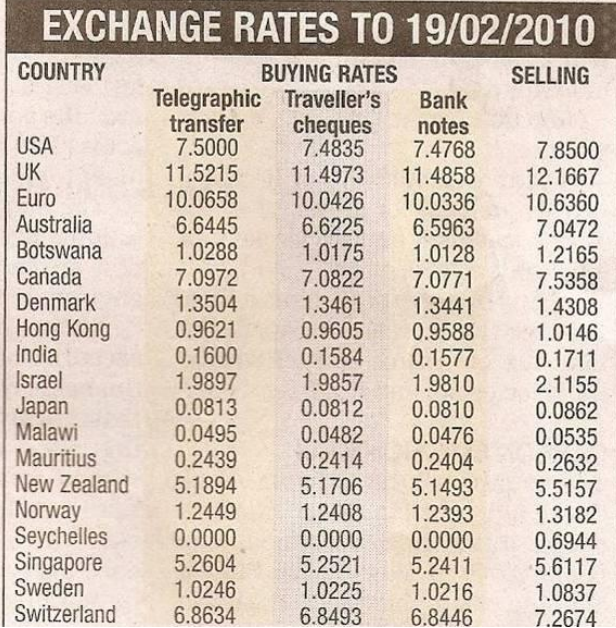
The table shows four different rate categories:
- Telegraphic transfer rates - for electronic money transfers
- Traveller's cheques rates - for traveller's cheques transactions
- Bank notes buying rates - when banks purchase foreign currency from customers
- Bank notes selling rates - when banks sell foreign currency to customers
Note
Different transaction types have different rates because banks and financial institutions charge different fees and margins for various services. Always use the appropriate rate for your specific transaction type.
Worked examples using the exchange rate table
Example
Worked Example 1: Converting Rand to British Pounds
Scenario: You want to buy £800 in UK bank notes for travel.
Solution:
- Use the selling rate for UK: 12.1667 (Rand per Pound)
- Amount needed: £800 × 12.1667 = R9,733.36
Answer: You need R9,733.36 to purchase £800 in bank notes.
Example
Worked Example 2: Converting Euros to Rand
Scenario: You're returning from Europe and want to exchange €7,000 into Rand using bank notes.
Solution:
- Use the buying rate for Euro: 10.0336 (Rand per Euro)
- Amount received: €7,000 × 10.0336 = R70,235.20
Answer: You will receive R70,235.20 when selling €7,000 to the bank.
Example
Worked Example 3: Identifying Weaker Currencies
Question: Which currencies are weaker than the Rand based on the table?
Solution: Look for currencies where 1 Rand buys more than 1 unit of the other currency:
- Japanese Yen (0.0813 means 1 Rand = more than 1 Yen)
- Malawi Kwacha (0.0476 means 1 Rand = more than 1 Kwacha)
Answer: Both the Japanese Yen and Malawi Kwacha are weaker than the Rand.
Currency conversion formula
When converting currencies using exchange rate tables, apply this fundamental formula:
Amount needed = Amount to convert × Exchange rate
Remember to use the correct rate based on your transaction:
- Selling rate when buying foreign currency from the bank
- Buying rate when selling foreign currency to the bank
Summary
Key Takeaways:
- Currency strength is determined by comparing exchange rates - if you need many units of Currency A to buy one unit of Currency B, then Currency B is stronger
- Buying power is more important than currency strength when comparing real costs between countries
- Always compare prices as a percentage of local income to understand true affordability
- Exchange rate tables have different rates for different transaction types - use the correct column for your calculation
- Stronger doesn't always mean more expensive - you must consider local wages and income levels to understand real costs