Financial Documents (Grade 11 NSC Matric Mathematical Literacy): Revision Notes
📚Revision Notes
Financial Documents
Introduction to financial documents
Financial documents are essential business papers that record important information about money matters. In the workplace, you will encounter various types of these documents that serve different purposes. Understanding how to read and interpret these documents is a crucial life skill that will help you manage your finances effectively.
There are two main categories of financial documents you need to know about:
- Documents for employees (like payslips)
- Documents for customers (like quotations, invoices, and receipts)
Note
Financial literacy is one of the most practical skills you'll learn in mathematics. These documents will be part of your everyday life as an adult, whether you're an employee receiving a payslip or a customer making purchases.
Types of financial documents
Employee documents: Payslips
A payslip is a document that a business gives to its employees. It shows important information about how much money the employee earns and what amounts are taken away from their salary.
The main purpose of a payslip is to provide a clear breakdown of:
- How much money the employee earned that month
- What deductions were made from their salary
- How much money they will actually receive
Customer documents: Quotations, invoices and receipts
Businesses also create documents for their customers who want to buy goods or services. These documents follow a logical sequence during the buying process.
A quotation gives customers an estimate of costs before they decide to buy something. It helps customers plan their spending by showing what they would need to pay.
An invoice is created after a customer decides to buy something. It summarises all the costs the customer must now pay because they have agreed to purchase the item or service.
A receipt serves as proof that a customer has already paid for something. It shows the payment details and gives customers evidence of their purchase.
Important
Remember the sequence: Quotation → Invoice → Receipt. This follows the natural buying process from getting a price estimate to making payment and receiving proof of purchase.
Key terminology for financial documents
Payslip terminology
Understanding the following terms will help you read any payslip correctly:
Basic salary - This is the employee's main salary amount, not including any extra income or deductions.
Gross salary - This represents the total of all income sources that an employee receives. It includes the basic salary plus any additional payments.
Taxable income - This is the portion of an employee's salary that is used to calculate how much tax they must pay.
Deductions - These are amounts taken away from the employee's salary to pay for things like medical aid, pension contributions, or taxes.
Net pay - This is the final amount of money the employee actually receives in their bank account. It equals the gross salary minus all deductions.
Customer document terminology
Quantity - This shows the number of items being purchased.
Unit price - This is the cost of each individual item.
Note
Think of these terms as building blocks - once you understand each one, reading any financial document becomes much easier. The terminology is standardized across all businesses in South Africa.
Skills required for working with financial documents
When you work with financial documents, you need to develop two important skills:
- Understanding terminology: You must know what different terms mean and be able to explain them clearly.
- Calculating values: You must be able to show how different amounts in the documents were worked out.
These skills will help you check that the information on financial documents is correct and understand where the numbers come from.
Important
Critical Skills Development
These two skills are not just for exams - they're life skills that will help you:
- Verify that your own payslip is correct
- Check that invoices and receipts are accurate
- Avoid being overcharged or underpaid
- Make informed financial decisions
Worked example: Understanding a payslip
Let's examine a real payslip to see how these skills work in practice.
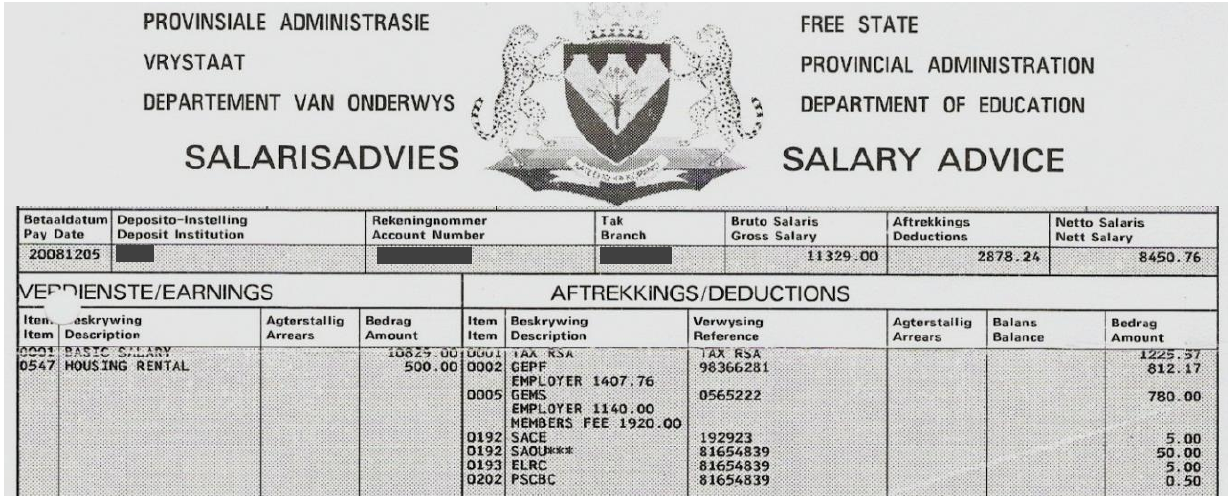
This payslip belongs to an employee from the Free State Provincial Administration's Department of Education.
Example
Worked Example: Analyzing a Government Employee's Payslip
Step 1: Understanding terms used in the document
Looking at this payslip, we can answer questions about the terminology:
Question 1: How much does the employee earn as a Basic Salary?
Answer: R10 829,00
Question 2: How much does the employee pay in Deductions?
Answer: R2 878,24
Question 3: What is a Gross Salary and what is this employee's Gross Salary?
Answer: Gross salary represents the total of all income sources for an employee. This employee's Gross Salary is R11 329,00.
Question 4: What is a Net Salary and what is this employee's Net Salary?
Answer: Net Salary is the difference between the employee's gross salary and their total deductions. It shows the actual amount of money the employee receives in their bank account each month. This employee's Net Salary is R8 450,76.
Step 2: Demonstrating how values were calculated
Now let's show how the values on this payslip were determined:
Calculating Gross Salary:
Calculating Total Deductions:
Calculating Net Salary:
Key formulas to remember
When working with payslips, these formulas are essential:
Note
Essential Payslip Formulas
These three formulas will solve most payslip calculation questions you encounter.
Exam tips
Note
Exam Success Strategies
- Always read financial documents carefully and identify what type of document it is
- Look for key terms and make sure you understand their meanings
- When calculating values, show your working step by step
- Double-check your calculations by working backwards where possible
- Remember that Net Salary is what the employee actually receives, not the Gross Salary
Summary
Key Points to Remember:
- Payslips are for employees and show earnings and deductions
- Quotations, invoices, and receipts are for customers and follow the buying process sequence
- Gross salary includes all income sources, while basic salary is just the main salary amount
- Net salary is what employees actually receive after all deductions
- Always show your working when calculating values from financial documents
- The sequence for customer documents is: Quotation → Invoice → Receipt