Working With Models (Grade 11 NSC Matric Mathematical Literacy): Revision Notes
📚Revision Notes
Working With Models
What are models and nets?
Models are three-dimensional representations of objects that help us understand shape, structure, and spatial relationships. Nets are two-dimensional patterns or templates that can be folded to create three-dimensional shapes.
The key concept in working with models is understanding the relationship between 2D and 3D representations. You need to be able to move smoothly between flat drawings and solid objects, developing your spatial visualization skills.
Note
Understanding the connection between nets and models is fundamental to solving many real-world problems involving packaging, construction, and design. This skill bridges the gap between abstract mathematical concepts and practical applications.
Learning objectives for Grade 11
As a Grade 11 Mathematical Literacy student, you must be able to:
- Build 3-dimensional models from 2-dimensional plans and nets
- Draw 2-dimensional plans and nets of 3-dimensional models
- Use models to investigate various problems involving packaging, perimeter, area and volume
Understanding nets and folding
A net is a 2D pattern that shows how a 3D shape would look if it were unfolded completely flat. When you fold the net along its edges, it creates the 3D shape.
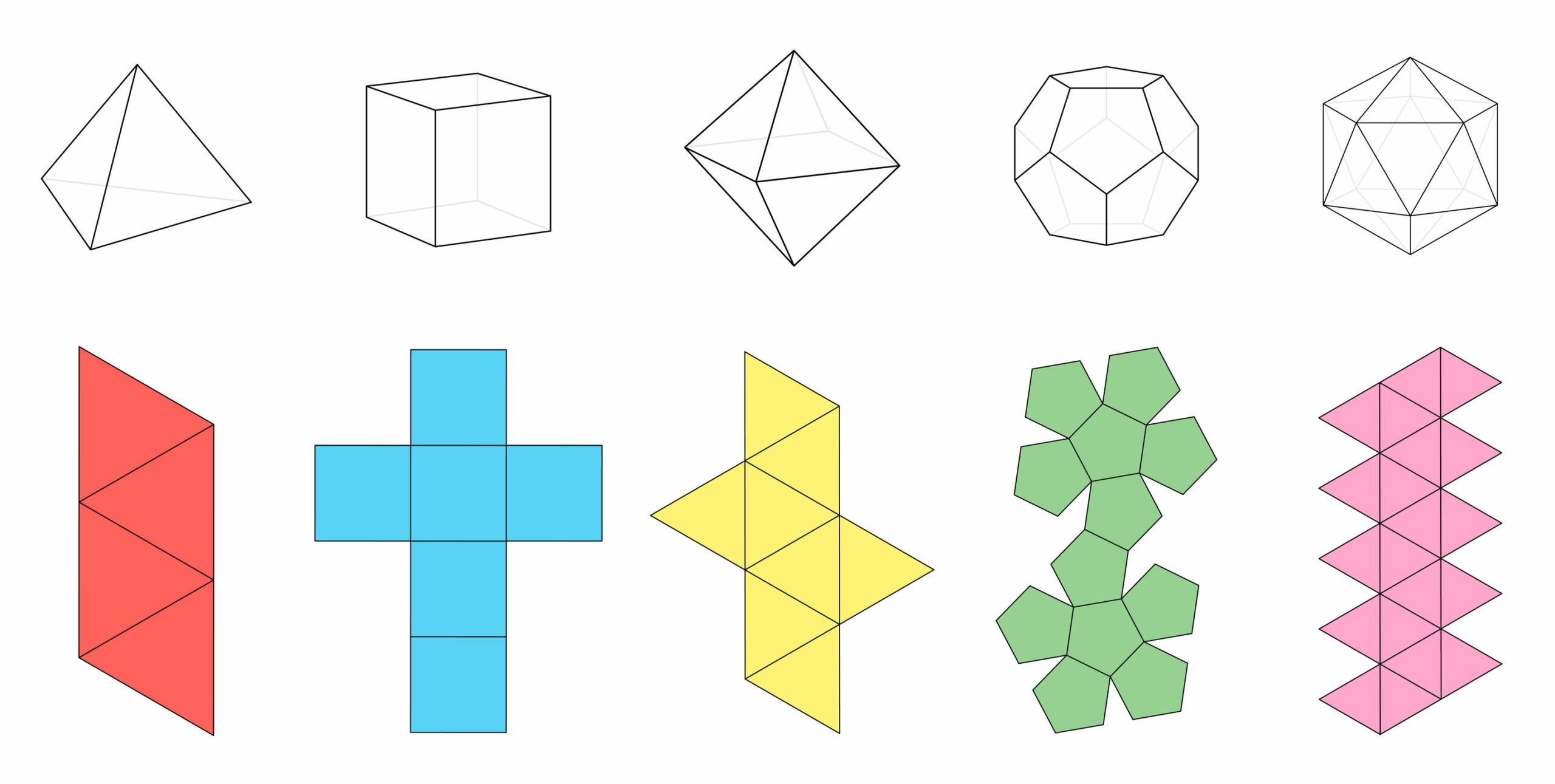
The diagram above shows examples of nets for different 3D shapes.
Folding instructions
Important
Critical Folding Rules
When working with nets, pay attention to the different types of fold lines:
- Dotted lines - fold these forwards (towards you)
- Solid lines - fold these backwards (away from you)
Following these folding rules correctly ensures your net will form the intended 3D shape. Incorrect folding is one of the most common mistakes students make when working with nets.
Types of nets and examples
Pyramid nets
Pyramids have a polygonal base with triangular faces meeting at a point. The net shows the base shape surrounded by triangular faces that will fold up to meet at the apex.
Note
The number of triangular faces in a pyramid net depends on the shape of the base. A triangular pyramid (tetrahedron) has 4 faces, while a square pyramid has 5 faces - one square base and four triangular faces.
Tetrahedron nets
A tetrahedron is a pyramid with four triangular faces. The net consists of four connected triangles that fold to form a solid with four faces, six edges, and four vertices.
Prism nets
Prisms have two parallel bases connected by rectangular faces. The net typically shows the bases at opposite ends with rectangles connecting them.
Working with models in problem solving
Models help you investigate real-world problems involving:
- Packaging design - determining the most efficient box shapes
- Surface area calculations - finding how much material is needed
- Volume calculations - determining how much space is inside
- Perimeter measurements - calculating edge lengths
Note
When solving packaging problems, remember that efficiency often means minimizing material while maximizing volume. This creates interesting optimization challenges that connect mathematical concepts to real business concerns.
Integration with measurement
Working with models connects directly to the measurement topic. When you build a model from a net, you can:
- Calculate the perimeter of each face
- Find the area of individual faces and total surface area
- Determine the volume of the completed 3D shape
This integration helps you understand how 2D measurements relate to 3D properties. For example, the area of each face in a net contributes to the total surface area of the 3D model, while the dimensions help determine the volume.
Note
Connecting 2D and 3D Measurements
The relationship between nets and models allows you to calculate important properties. If a cube has side length , then each face has area , giving a total surface area of , while the volume is .
Worked example: Building a tetrahedron
Example
Worked Example: Building a Tetrahedron
Step 1: Cut out the tetrahedron net with four triangular faces
Step 2: Identify which edges will join together when folded
Step 3: Fold along the lines connecting the triangles
Step 4: Bring the edges together and secure with tape or glue
Step 5: Check that all four faces are triangular and meet at vertices
Worked example: Drawing a cube net
Example
Worked Example: Drawing a Cube Net
Step 1: Visualise the cube as six square faces
Step 2: Choose one face as the base
Step 3: Draw four squares in a cross pattern for the sides
Step 4: Add the remaining square for the top
Step 5: Verify that folding would create a complete cube
Exam tips
Important
Essential Exam Strategies
- Always check that your net has the correct number of faces for the 3D shape
- Remember that different net arrangements can create the same 3D shape
- Practice folding nets mentally to visualise the final shape
- Use models to help solve packaging and volume problems
- Connect 2D measurements on nets to 3D properties of models
Remember!
Summary
Key Points to Remember:
- Nets are 2D patterns that fold into 3D models
- Dotted lines fold forwards, solid lines fold backwards
- Models help solve real problems with packaging, area, and volume
- Working with models integrates 2D and 3D mathematical thinking
- Practice moving between flat nets and solid shapes to build spatial awareness