Time (Grade 11 NSC Matric Mathematical Literacy): Revision Notes
📚Revision Notes
Time
Understanding time recording values
Time recording values are measurements that show how long something takes, usually displayed on devices like stopwatches or timers. These values typically show time in a format that includes hours, minutes, and seconds.

Note
When you see a time like 1:09:26 on a stopwatch, this means:
- 1 hour
- 9 minutes
- 26 seconds
Being able to work with these time values is essential for planning activities and solving time-related problems in real life situations like sports events, cooking, or managing your study schedule.
Converting time between different units
Sometimes you need to express time using only one unit (like all seconds or all hours). This requires understanding the basic time relationships.
Important
Key conversions to remember:
- 1 minute = 60 seconds
- 1 hour = 60 minutes = 3,600 seconds
Worked example 1: Converting to seconds
Example
Worked Example: Converting to seconds
Convert 1 hour 9 minutes 26 seconds into seconds only:
Step 1: Convert the minutes to seconds
- 9 minutes = seconds
Step 2: Convert the hour to seconds
- 1 hour = 60 minutes = seconds
Step 3: Add all the seconds together
- Total = seconds
Worked example 2: Converting to hours
Example
Worked Example: Converting to hours
Convert 1 hour 9 minutes 26 seconds into hours only:
Step 1: Convert minutes to hours
- 9 minutes ÷ 60 = 0.15 hours
Step 2: Convert seconds to hours
- 26 seconds ÷ 60 = 0.433 minutes
- 0.433 minutes ÷ 60 = 0.007 hours
Step 3: Add all parts together
- Total = hours
Calculating time differences
When finding the time difference between two recorded times, work systematically through each time component. This is useful for calculating how long activities take or planning schedules.
Worked example 3: Finding elapsed time
Example
Worked Example: Finding elapsed time
An athlete runs through one marker at 1:27:48 and through another marker at 2:06:13. Find the time taken between markers:
Method: Calculate the time from the first reading to the next whole minute, then to the next whole hour, then to the final time.
Step 1: From 1:27:48 to 1:28:00
- Time elapsed = 12 seconds
Step 2: From 1:28:00 to 2:00:00
- Time elapsed = 32 minutes
Step 3: From 2:00:00 to 2:06:13
- Time elapsed = 6 minutes 13 seconds
Step 4: Add all time periods
- Total time = 32 minutes 28 seconds + 6 minutes 13 seconds = 38 minutes 41 seconds
Note
Exam tip: Always break down complex time calculations into smaller, manageable steps to avoid errors.
Reading and interpreting timetables
Timetables are essential tools for organizing and planning activities. When reading examination timetables, you need to identify several key pieces of information.
Note
Essential information from timetables:
- Week and date when each exam occurs
- Time of day the exam starts
- Duration of each exam (length in hours)
- Venue where the exam takes place
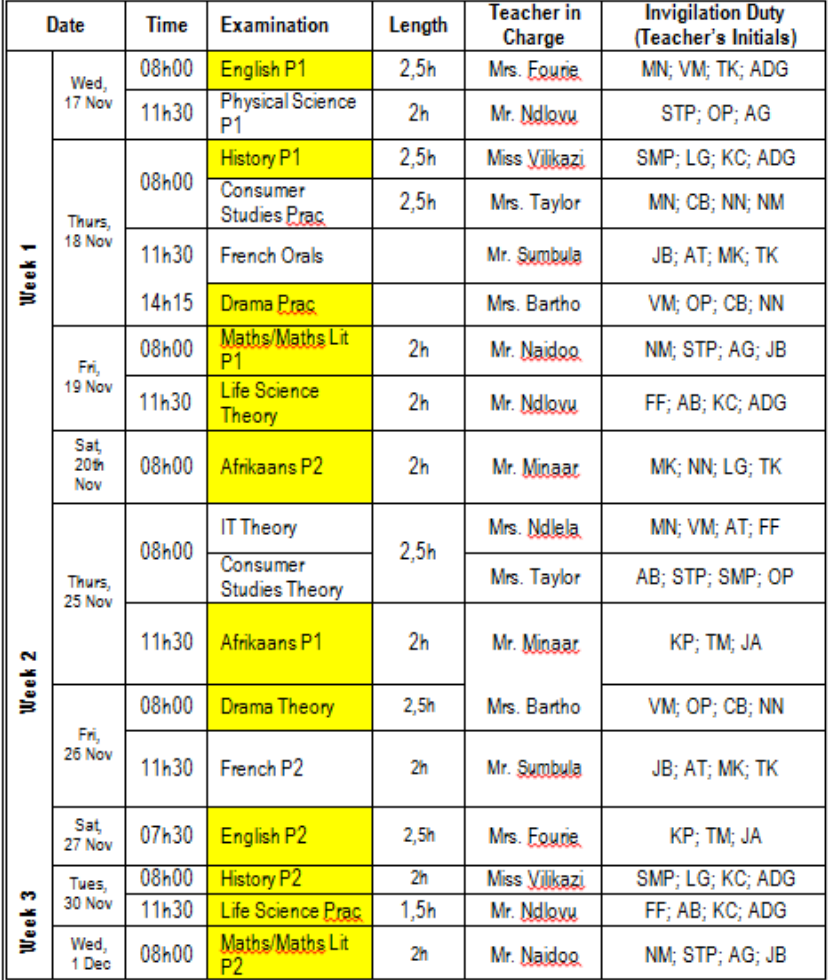
For teachers, timetables may include additional information such as:
- Which teacher is in charge of each exam
- Invigilation duties (which teachers supervise each exam)
- Teacher initials for easy identification
Worked example 4: Using timetables for planning
Example
Worked Example: Using timetables for planning
From the timetable, if you have English P1 on Wednesday 17 November at 08h00 for 2.5 hours:
Planning considerations:
- Arrive at venue before 08h00
- Exam finishes at 08h00 + 2.5 hours = 10h30
- Plan study time accordingly for this 2.5-hour exam
Worked example 5: Managing multiple exams
Example
Worked Example: Managing multiple exams
If you have Physical Science P1 at 11h30 (2 hours) and then Life Science Theory at 08h00 the next day (2 hours):
Time management:
- Physical Science ends at 11h30 + 2 hours = 13h30
- You have the rest of that day and evening to prepare for Life Science
- Life Science exam is 8 hours later (next morning)
Note
Study tip: Use timetables to plan your revision schedule, ensuring you allocate enough time for each subject based on exam duration and difficulty.
Remember!
Summary
Key Points to Remember:
-
Time recording values show elapsed time in hours:minutes
format (h:mm) -
Convert systematically using 60 seconds = 1 minute and 60 minutes = 1 hour
-
Calculate time differences by breaking the problem into smaller time intervals and adding them together
-
Read timetables carefully to identify dates, times, duration, and venues for proper planning
-
Plan ahead using timetables to manage study time and avoid scheduling conflicts